Morning edition · Friday, 23 October 2026
The wind did what the Strait could not
Brent settled at its highest since May on Thursday. The same day, German turbines nearly tripled their output, gas plants burned half as much as on Wednesday, and Friday's power cleared at €137.59.
On Thursday Brent crude jumped 4% to settle at $113.17 a barrel, its highest settlement since May, after a report that the US and Israel were drawing up plans for renewed attacks on Iran2. On Friday morning in Asia it barely moved, at $112.963. That is the headline. The German grid wrote a different one.
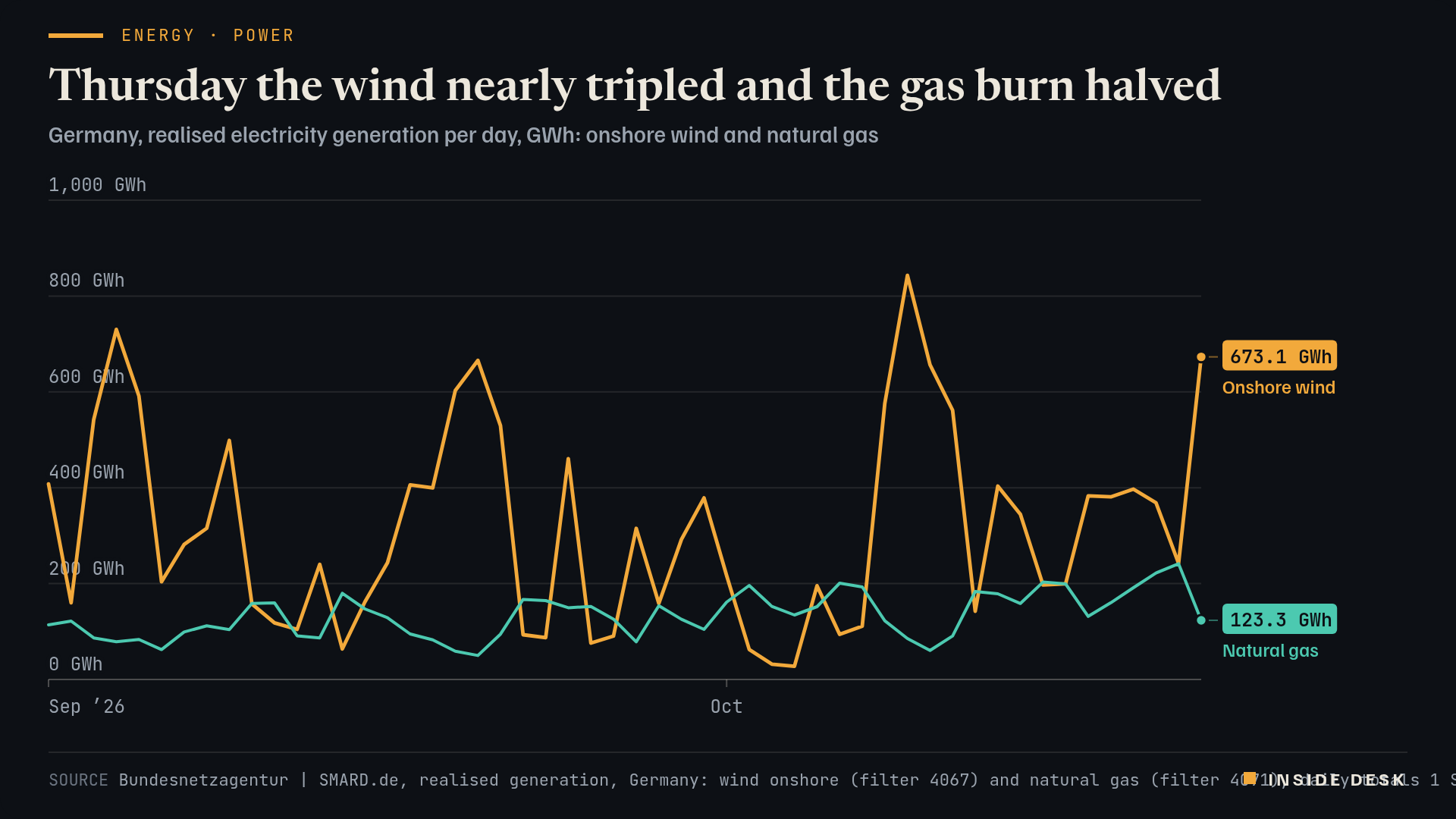
Onshore wind turbines in Germany generated 673.1 gigawatt hours on Thursday 22 October, up from 242.3 GWh on Wednesday, according to the Bundesnetzagentur’s SMARD data1. It was the third-best wind day since the start of September. Gas-fired plants, which on Wednesday had burned their way to 241.4 GWh, the highest of the autumn so far, fell to 123.3 GWh1. Desk arithmetic: wind up about 2.8 times, gas down by about half, in one day.
Line chart of daily electricity generation in Germany from onshore wind and from natural gas, 1 September to 22 October 2026, in gigawatt hours. Wind swings widely, from 27.4 GWh on 4 October to 842.9 GWh on 9 October. Gas runs lower and steadier, from 50.1 GWh on 20 September to 241.4 GWh on Wednesday 21 October, its highest of the period. On Thursday 22 October onshore wind generated 673.1 GWh, up from 242.3 GWh the day before and the third-highest day since 1 September, while gas fell to 123.3 GWh, about half of Wednesday's total.
Source Bundesnetzagentur | SMARD.de, realised generation, Germany: wind onshore (filter 4067) and natural gas (filter 4071), daily totals 1 Sep to 22 Oct 2026, retrieved 23 Oct 2026 05:15 CEST, values rounded to 0.1 GWh · CC BY 4.0. Bundesnetzagentur | SMARD.de, market data. CC BY 4.0.
Data (CSV) · SVG · PNG

Latest values as a table
| Date | Onshore wind | Natural gas |
|---|---|---|
| 2026-10-17 | 383.1 | 131.5 |
| 2026-10-18 | 381 | 160.2 |
| 2026-10-19 | 397.1 | 191.6 |
| 2026-10-20 | 368.7 | 222.3 |
| 2026-10-21 | 242.3 | 241.4 |
| 2026-10-22 | 673.1 | 123.3 |
The auction followed the turbines. The day-ahead price for the Germany-Luxembourg zone, which had averaged €211.94 per megawatt hour for Wednesday’s delivery, cleared at €148.61 for Thursday and €137.59 for Friday1. Desk arithmetic: Friday’s power is about 35% cheaper than Wednesday’s, in a week when oil rose.
Do not over-read it. The October average is still €167.60 per megawatt hour over 1 to 23 October, against €94.97 over the same days of 20251. Gas still sets the price in many hours, and the wind already eased overnight: by 03:00 on Friday onshore output was running at about 19 GWh an hour, against a Thursday average of 281. A windy day does not end an energy shock. It just shows you where the exit is.
That exit is built from paperwork: planning permits, grid connections, auction rounds, transmission lines finished on time. None of it trends. All of it showed up in Thursday’s numbers, on a day when a report of strike plans moved oil by 4% and a weather front moved German power the other way. Nothing here is advice.
What to watch
Nobody can blockade the weather; the trick is to have built enough to catch it.
Sources
- Market data: realised generation (wind onshore, natural gas) and day-ahead price DE-LU, daily and hourly — Bundesnetzagentur / SMARD.de, retrieved 23 Oct 2026, 05:15 CEST.
- Stock futures are little changed after tech sector sell-off: Live updates — CNBC, 22 Oct 2026, updated 22:26 EDT.
- Oil little changed as supply concern lingers amid Houthi attacks on Saudi Arabia — Reuters via Euronext, 23 Oct 2026, 03:05.
Every figure in this piece traces to a source above or to the desk’s own arithmetic on those sources, marked as such. Quotations are short and attributed. Spot an error? Write to the desk; corrections are logged on the method page.
Commentary for information only. Not investment, legal, tax, medical or political advice. Not an offer or solicitation. Analysis may be incomplete or wrong. Charts show published public data, not a trading feed; binding numbers live with the institutions that publish them.