Morning edition · Friday, 23 October 2026
Ordinary Ledger: the cheapest tariff climbed, the default still costs more
The cheapest new-customer electricity tariffs in Germany rose about ten per cent in a month, to 30.64 cents a kilowatt hour. Basic supply still sits almost ten cents above them.
The comparison portal StromAuskunft evaluates tariffs in more than 6,300 German towns every day. On Thursday its average for the cheapest new-customer electricity tariffs reached 30.64 cents a kilowatt hour, up just over ten per cent on the month and 13.6% on the year, Berliner Zeitung reported1.
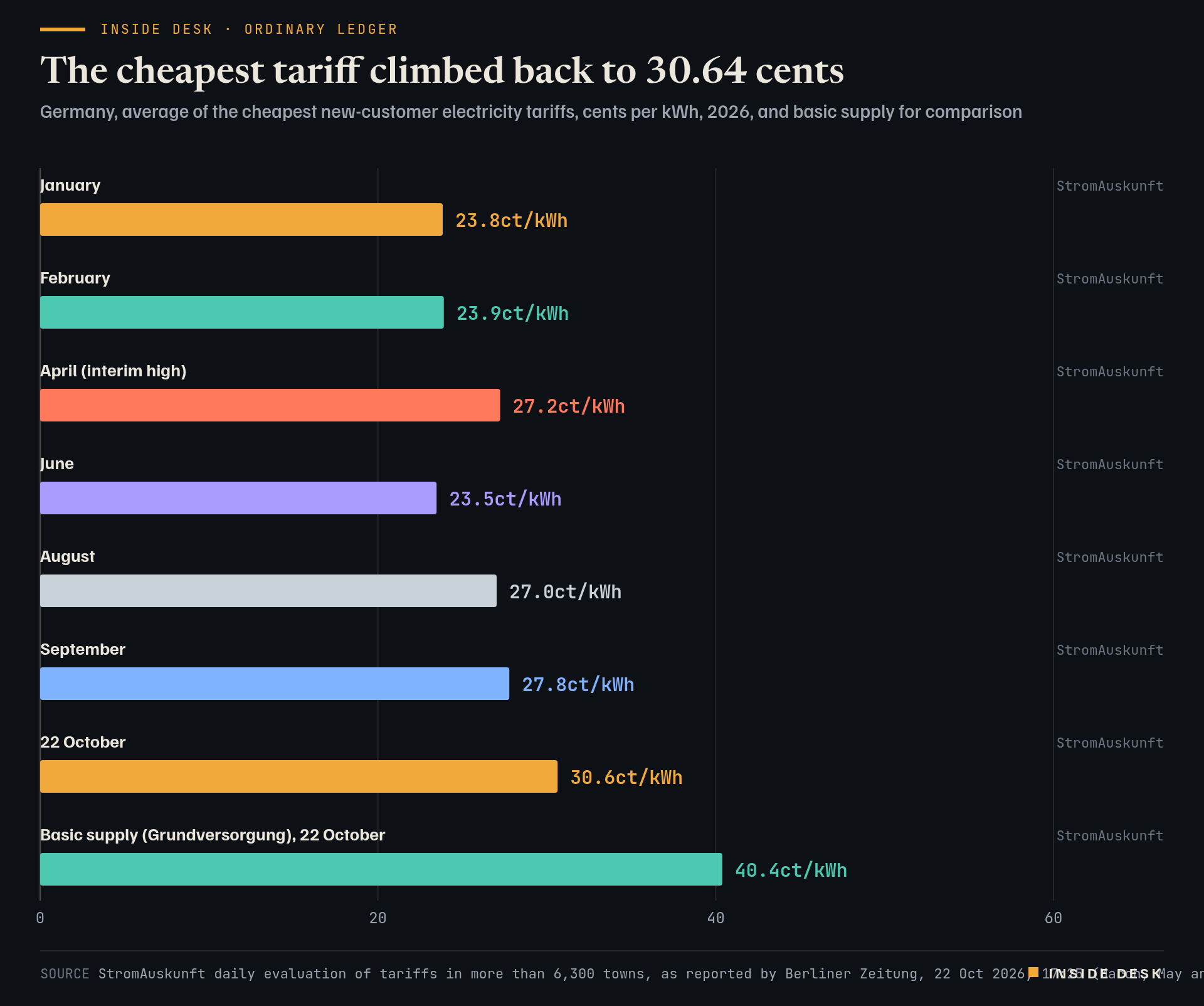
The curve. The year started cheap. In January the figure was 23.84 cents, in February 23.90, helped by €6.5 billion of federal subsidy for the transmission grid charges1. It touched 27.24 cents in April, fell back to 23.47 in June, then climbed: 27.03 in August, 27.78 in September, 30.64 now1. The reason given is procurement costs: the Iran war and the Hormuz blockade pushed the European gas price at times to €59 a megawatt hour, and gas plants often set the power price1.
Bar chart: the average cheapest new-customer electricity tariff in Germany was 23.84 cents per kWh in January and 23.90 in February, 27.24 in April, 23.47 in June, 27.03 in August, 27.78 in September and 30.64 cents on 22 October 2026, the latest value. Basic supply averaged 40.39 cents on 22 October.
Source StromAuskunft daily evaluation of tariffs in more than 6,300 towns, as reported by Berliner Zeitung, 22 Oct 2026, 17:25 (March, May and July not reported). Figures as reported by the named organisations; facts cited with attribution.
Data (CSV) · SVG · PNG

Latest values as a table
| Value | |
|---|---|
| January | 23.84ct/kWh |
| February | 23.9ct/kWh |
| April (interim high) | 27.24ct/kWh |
| June | 23.47ct/kWh |
| August | 27.03ct/kWh |
| September | 27.78ct/kWh |
| 22 October | 30.64ct/kWh |
| Basic supply (Grundversorgung), 22 October | 40.39ct/kWh |
The default. Basic supply, the tariff you are on if you never chose one, averages 40.39 cents, almost ten cents more1. At 3,500 kilowatt hours a year that is about €1,414 against €1,072 in the cheapest tariff, a gap of roughly €3411. In Thuringia, basic supply averages 51.73 cents against 30.26 for the cheapest offer, more than €751 a year apart1. Existing customers paid 31.4 cents on average in August, according to Verivox data cited in the report1.
The geography. The cheapest town in the sample is Ringelai in Bavaria at 26.39 cents; the dearest is Lindau on Lake Constance at 40.66 cents1. Mecklenburg-Western Pomerania, Brandenburg and Bavaria are cheapest; Hamburg, North Rhine-Westphalia and Saarland dearest, mostly because of regional grid charges and competition1. Green tariffs cost only 0.54 cents more, about €19 a year at 3,500 kWh1.
The constructive reading. Desk arithmetic: at 3,500 kWh, January’s cheapest tariff cost €834 a year and today’s €1,072, about €238 more. That is the market. The €341 between basic supply and the cheapest offer is not the market; it is paperwork, and paperwork is the part you control. Note that new-customer prices move daily, and a contract signed today fixes today’s figure, not January’s. Nothing here is advice.
What to watch
The price you are offered moves with the market. The price you never looked at moves with your habits.
Sources
- Stromkosten steigen um 10 Prozent in einem Monat – doch ein Wechsel spart im Schnitt 341 Euro — Berliner Zeitung, 22 Oct 2026, 17:25.
Every figure in this piece traces to a source above or to the desk’s own arithmetic on those sources, marked as such. Quotations are short and attributed. Spot an error? Write to the desk; corrections are logged on the method page.
Commentary for information only. Not investment, legal, tax, medical or political advice. Not an offer or solicitation. Analysis may be incomplete or wrong. Charts show published public data, not a trading feed; binding numbers live with the institutions that publish them.