Morning edition · Friday, 23 October 2026
The market met before the committees did
Three central banks meet next week. On Thursday a tech sell-off did some of their deliberating for them: the biggest Treasury rally since March 2023, a stronger yen, and half a hike priced out. France was the exception.
Next week three committees sit down. The Federal Reserve meets, the European Central Bank is expected to hold its deposit rate at 2.5%, and the Bank of Japan decides on Friday4. On Thursday, before any of them had opened a briefing book, the bond market held its own meeting, and it voted for less.
The trigger was an invoice, not a speech. Meta reported negative free cash flow of $2.12 billion for the third quarter and raised the bottom of its full-year capital spending range to $135 billion, from $130 billion; the price of insuring its five-year debt reached an all-time high, CNBC reported3. Reuters called it the company’s first cash outflow in more than a decade1. The Nasdaq Composite fell 2.6%, its worst day since June, and the S&P 500 1.2%, its worst since July2.
The bond vote. Money went where it usually goes when shares fall: into US Treasuries. The 10-year yield fell more than 19 basis points overnight, the biggest drop since March 2023, before steadying at 4.9591% on Friday, back below 5%1. The 2-year yield fell nearly 19 basis points to 4.6566%1. The 2-year is the committee’s yield, the one that moves with expectations for the Fed, and it moved as much as the long one.
That is where the committee arithmetic changed. Markets “sharply pared back” expectations of further Fed tightening, stripping out almost a full quarter-point hike for next year, Reuters reported; a December rise is no longer fully priced, with the implied probability down to 85%1. ING’s analysts put it plainly: “The risk-off environment takes pressure off the Fed to hike next week”4.
The currency vote. The yen strengthened to 156.28 per dollar, its strongest in more than a month, and was set for a 1% gain on the week4. The dollar index was at 101.52, near its lowest since the start of the month, and the Swiss franc held near its firmest in a month at 0.8199 per dollar4. OCBC’s analysts, quoted by Reuters, sorted the havens by fear: AI jitters favour the yen, oil fears favour the Canadian dollar and the Norwegian crown, and French fiscal stress favours the franc4.
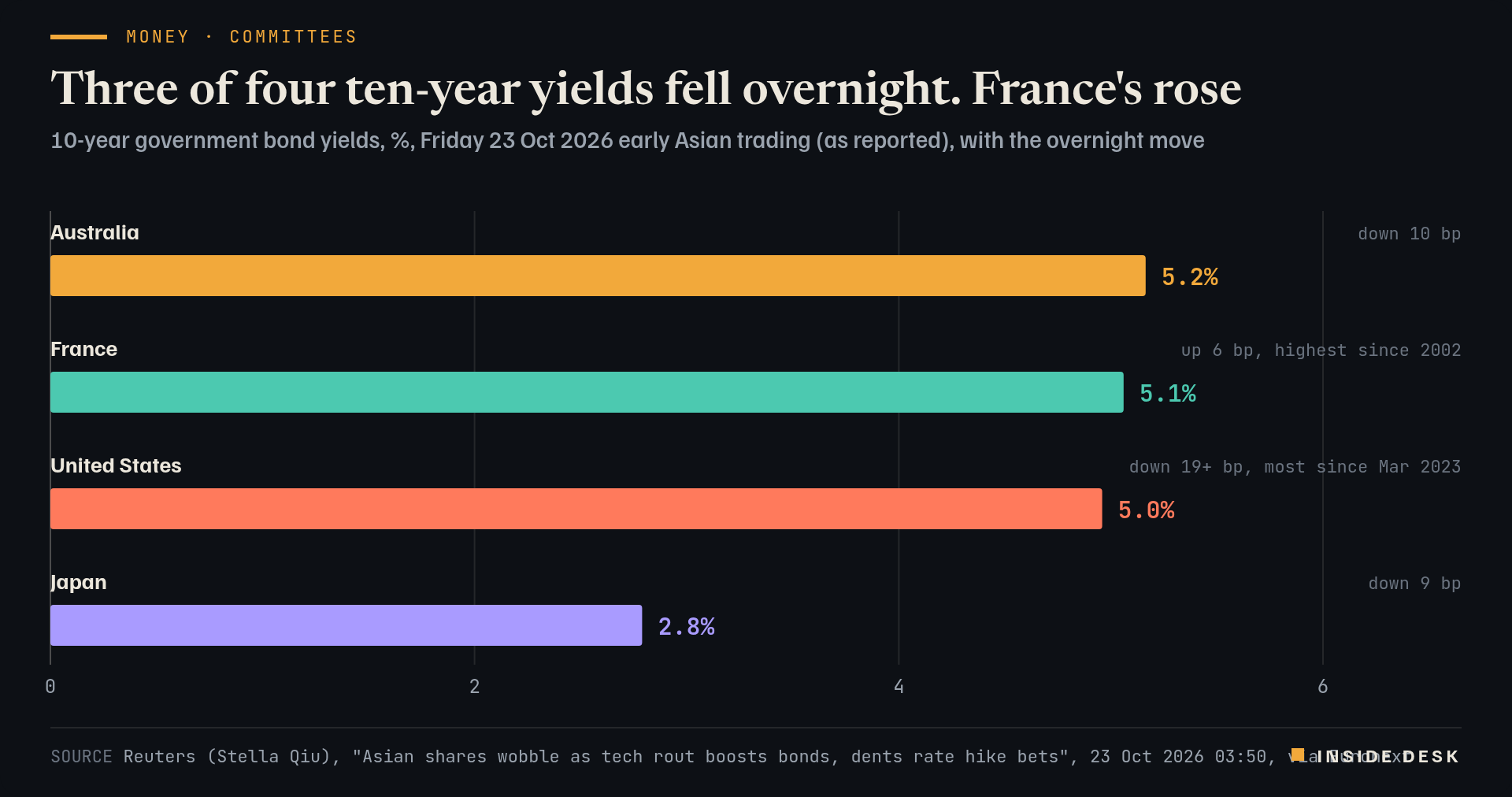
The exception. Not every ten-year bond was a refuge. France’s benchmark yield rose another 6 basis points overnight to 5.0601%, its highest since 2002, while Japan’s fell 9 basis points to 2.790% and Australia’s 10 basis points to 5.164%1.
Bar chart of 10-year government bond yields in early Asian trading on Friday 23 October 2026, as reported by Reuters: Australia 5.164%, down 10 basis points; France 5.0601%, up 6 basis points overnight to its highest since 2002; the United States 4.9591%, after a fall of more than 19 basis points, the biggest since March 2023; Japan 2.790%, down 9 basis points. France is the only one of the four that rose.
Source Reuters (Stella Qiu), "Asian shares wobble as tech rout boosts bonds, dents rate hike bets", 23 Oct 2026 03:50, via Euronext. Figures as reported by the named organisations; facts cited with attribution.
Data (CSV) · SVG · PNG

Latest values as a table
| Value | |
|---|---|
| Australia | 5.164% |
| France | 5.0601% |
| United States | 4.9591% |
| Japan | 2.79% |
Desk arithmetic: on Friday morning’s figures, France paid about 10 basis points more than the United States to borrow for ten years. The euro, at $1.122, was held back by the same worry4. A safe haven is not a nationality. It is a budget that markets believe will pass.
Tokyo’s homework. Japan handed its committee a fresh number on Friday. Core consumer prices, excluding fresh food, rose 2.1% in September from a year earlier, up from 1.7% in August; the measure that also strips out energy, which the BOJ watches closely, rose 2.4%5. Most economists polled by Reuters expect the Bank of Japan to hold next Friday and raise rates by a quarter point in December4. That is a poll, not a decision, and the desk records it as one.
What this is not. It is not a verdict on the economy. Brent settled at $113.17 on Thursday, its highest since May2, and expensive oil does not make committees relax. ING expects the 10-year yield to “snap back above (5%)” eventually, citing inflation, the deficit and the AI boom1. A single session can move a probability; it cannot write a minute.
Here is the constructive part, and it is a dull one. “US Treasury bonds are — gasp — working as your hedge again,” wrote Nomura’s Charlie McElligott1. The word that matters is “again”. On Thursday shares and bonds parted company, and the mechanism that is supposed to cushion a household’s pension when shares slide did roughly what it says on the tin. Lower long yields also lifted the shares of homebuilders and regional banks, CNBC reported2, which is how a bond rally eventually reaches a mortgage quote.
Next week the committees will read the same screens you have read here, plus the data you have not: wages, prices, order books. They do not need to agree with Thursday’s vote. They only need to explain theirs. Nothing here is advice.
What to watch
- Whether the US 10-year yield stays below 5%; ING's Padhraic Garvey says he is "not convinced it keeps on going"1.
- The three meetings next week: the Fed, the ECB (expected to hold its deposit rate at 2.5%) and the Bank of Japan on Friday4.
- Brent, which settled at $113.17 on Thursday, the highest since May, and pulls the other way on inflation2.
A committee meets every six weeks; a market meets every second. The committee still gets the last word.
Sources
- Asian shares wobble as tech rout boosts bonds, dents rate hike bets — Reuters via Euronext, 23 Oct 2026, 03:50.
- Stock futures are little changed after tech sector sell-off: Live updates — CNBC, 22 Oct 2026, updated 22:26 EDT.
- Meta stock sinks nearly 7% as AI spend pushes free cash flow negative — CNBC, 22 Oct 2026.
- Yen shines as AI jitters spur safe-haven rush — Reuters via Free Malaysia Today, 23 Oct 2026.
- Japan core inflation in September surges to its highest this year at 2.1% — CNBC, 22 Oct 2026, 19:37 EDT.
Every figure in this piece traces to a source above or to the desk’s own arithmetic on those sources, marked as such. Quotations are short and attributed. Spot an error? Write to the desk; corrections are logged on the method page.
Commentary for information only. Not investment, legal, tax, medical or political advice. Not an offer or solicitation. Analysis may be incomplete or wrong. Charts show published public data, not a trading feed; binding numbers live with the institutions that publish them.