Morning edition · Friday, 23 October 2026
The shield wears off at six months
A study at IDWeek finds most US babies have lost detectable measles antibodies from their mothers by six months, half a year before the routine first dose. Public health labs, meanwhile, are asking for a faster test.
A baby is born with its mother’s antibodies, and for decades that borrowed protection was one reason the first measles shot waits until 12 to 15 months in the United States1. A study presented this week at IDWeek in Washington suggests the loan runs out much sooner1.
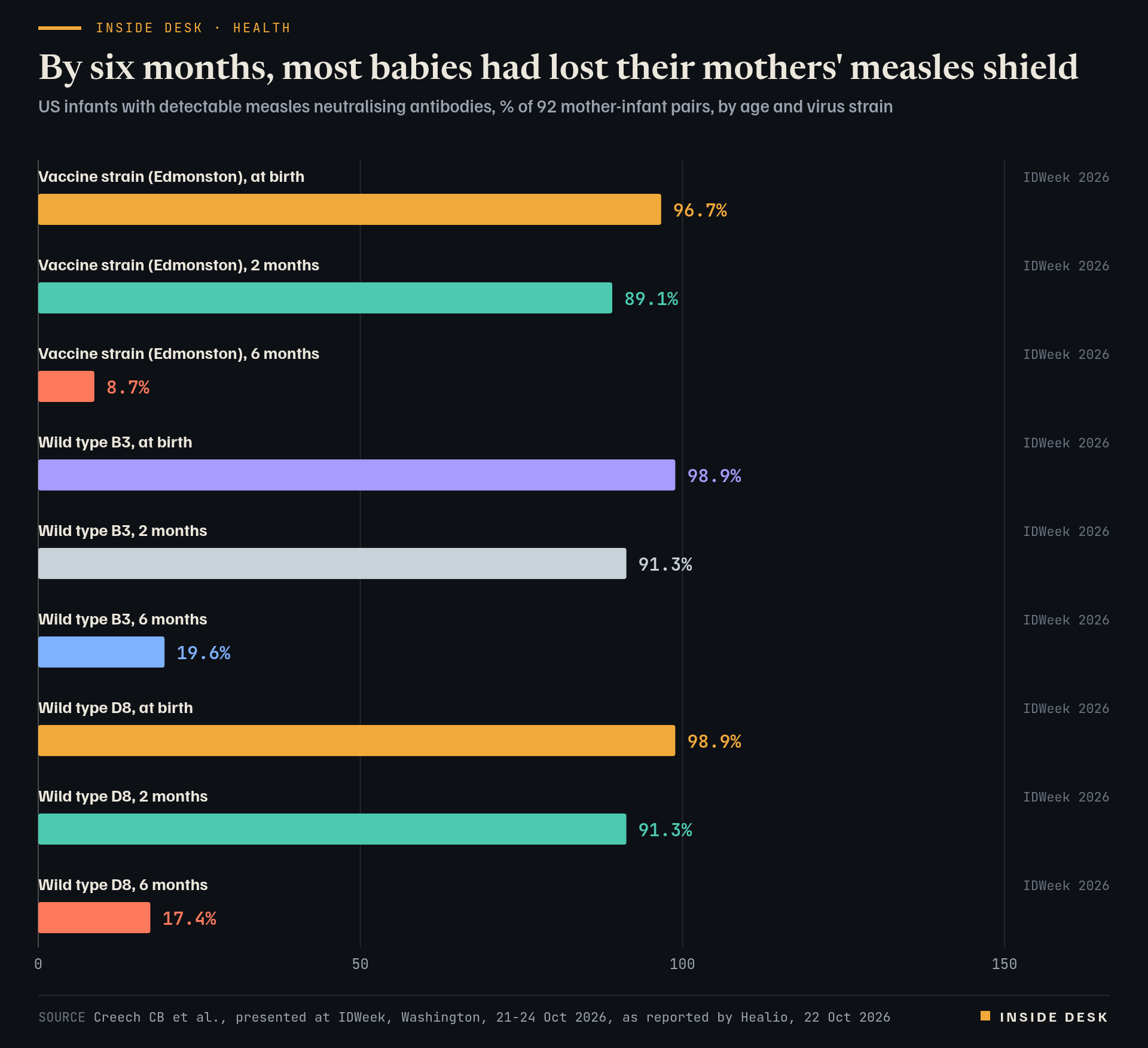
The numbers. C. Buddy Creech of Vanderbilt and colleagues used leftover samples from 92 mother-infant pairs1. At birth, 96.7% of infants had detectable neutralising antibodies against the vaccine strain; at two months, 89.1%; at six months, 8.7%1. Against two common wild strains, B3 and D8, the six-month figures were 19.6% and 17.4%1. Antibody concentrations against the vaccine strain fell from 1,173 to 65 mIU/mL over the six months1.
Bar chart: the share of 92 US infants with detectable measles neutralising antibodies was 96.7% at birth, 89.1% at two months and 8.7% at six months for the vaccine strain; 98.9%, 91.3% and 19.6% for wild type B3; and 98.9%, 91.3% and 17.4% for wild type D8.
Source Creech CB et al., presented at IDWeek, Washington, 21-24 Oct 2026, as reported by Healio, 22 Oct 2026. Figures as reported by the named organisations; facts cited with attribution.
Data (CSV) · SVG · PNG

Latest values as a table
| Value | |
|---|---|
| Vaccine strain (Edmonston), at birth | 96.7% |
| Vaccine strain (Edmonston), 2 months | 89.1% |
| Vaccine strain (Edmonston), 6 months | 8.7% |
| Wild type B3, at birth | 98.9% |
| Wild type B3, 2 months | 91.3% |
| Wild type B3, 6 months | 19.6% |
| Wild type D8, at birth | 98.9% |
| Wild type D8, 2 months | 91.3% |
| Wild type D8, 6 months | 17.4% |
Why now. The schedule was set when many mothers had immunity from infection, which passes more antibody to the baby1. Most mothers today are vaccinated and pass on less1. That matters more in a year like this one: the CDC counted 4,410 confirmed US cases by 15 October, and Pennsylvania alone 1,310 cases and five deaths in August and September1. “If measles elimination is not going to be our norm anymore, then we’re going to have to think about what the earliest reasonable time to vaccinate is,” Creech said1.
The lab bench. Health officials in California, Oregon, Washington and Hawaii have asked CDC director Erica Schwartz to validate a rapid, high-volume measles test; a request from May was denied after two months, citing “other competing priorities”2. Labs now rely on individual PCR runs, while platforms bought in the Covid years can process up to 500 tests in eight hours2. An HHS spokesperson said the agency was “prioritizing emerging technologies”2. A vaccine given within 72 hours of exposure can prevent infection, which is why speed of diagnosis is not a technicality2.
The constructive reading. Both stories point to fixable machinery. A schedule can be revised on evidence; infants from six months can already be vaccinated when travelling or in outbreak areas1. A validated protocol, once published, can be run by any lab2. Nothing here is medical advice; the schedule is a question for your paediatrician.
What to watch
- The Pan American Health Organization's November meeting on whether the US keeps its measles elimination status1.
- The follow-up study on infants' long-term response to a first dose at nine months, the WHO's schedule in high-risk countries1.
- Whether the CDC answers the West Coast Health Alliance's request to validate a high-throughput test2.
Immunity is inherited for a few months and earned for a lifetime. The schedule has to fit the gap.
Sources
- Study: Babies lose most measles antibodies by age 6 months — Healio, 22 Oct 2026.
- CDC denies approval for high-volume measles test, citing 'other priorities' — The Guardian, 22 Oct 2026, 14:30 EDT.
Every figure in this piece traces to a source above or to the desk’s own arithmetic on those sources, marked as such. Quotations are short and attributed. Spot an error? Write to the desk; corrections are logged on the method page.
Commentary for information only. Not investment, legal, tax, medical or political advice. Not an offer or solicitation. Analysis may be incomplete or wrong. Charts show published public data, not a trading feed; binding numbers live with the institutions that publish them.