Morning edition · Friday, 23 October 2026
Podium vs Print: "they love it" and 34 per cent
Asked how Americans feel about the Iran war, the president said that in one way they love it. The most recent Reuters/Ipsos panel, interviewed three days earlier, found a third approving of the strikes. He did leave himself a second sentence.
“Well, in one way they love it because I'm doing what should have been done by other presidents. And in another way maybe they don't.”
Donald Trump, President of the United States, to reporters at the White House, 22 October 2026 (Washington time)
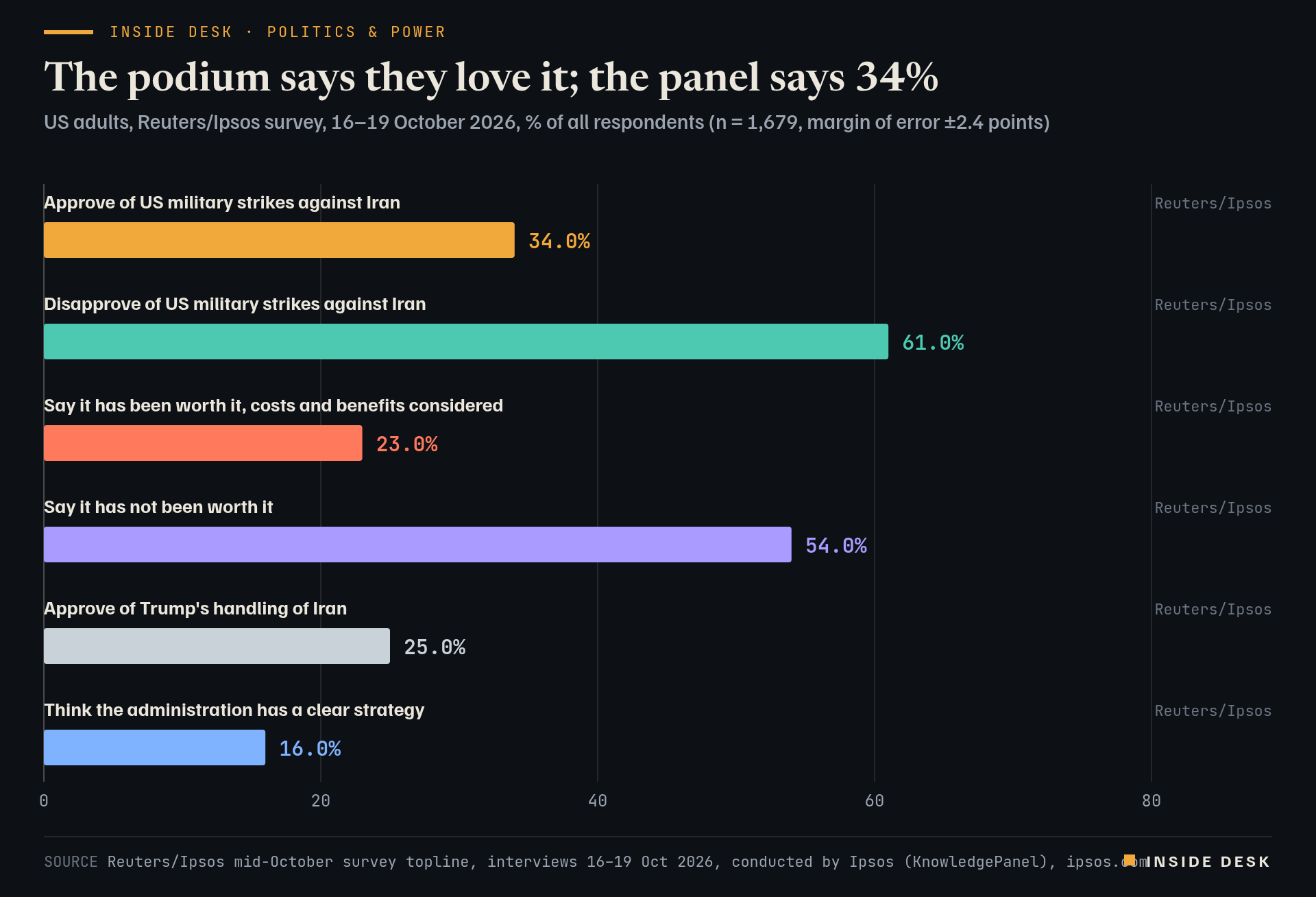
34% approve of US military strikes against Iran, 61% disapprove
Among 1,679 US adults, 34% approve and 61% disapprove of the strikes; 23% say the action has been worth it, 54% say it has not.
Reuters/Ipsos mid-October survey, conducted by Ipsos, Interviews 16–19 October 2026
The podium. On Thursday at the White House, Donald Trump was asked about public reaction to the Iran war. “Well, in one way they love it because I’m doing what should have been done by other presidents,” he said. “And in another way maybe they don’t.” He called the conflict “a price to pay” to stop Iran getting a nuclear weapon: “we can’t let Iran have a nuclear weapon”1.
The print. The latest Reuters/Ipsos survey interviewed 1,679 US adults from 16 to 19 October, with a margin of error of plus or minus 2.4 points2. Asked whether they approve of US military strikes against Iran, 34% said yes and 61% said no2. Weighing costs and benefits, 23% said the action has been worth it and 54% said it has not2. A quarter, 25%, approve of the president’s handling of Iran. Just 16% think the administration has a clear strategy, against 58% who think it does not2. And 78% expect US involvement to go on “for an extended period”, against 16% who expect it to end within weeks2.
Bar chart from the Reuters/Ipsos survey of 16 to 19 October 2026: 34% of US adults approve of US military strikes against Iran and 61% disapprove; 23% say the action has been worth it and 54% say it has not; 25% approve of Trump's handling of Iran; 16% think the administration has a clear strategy.
Source Reuters/Ipsos mid-October survey topline, interviews 16–19 Oct 2026, conducted by Ipsos (KnowledgePanel), ipsos.com. Figures as reported by the named organisations; facts cited with attribution.
Data (CSV) · SVG · PNG

Latest values as a table
| Value | |
|---|---|
| Approve of US military strikes against Iran | 34% |
| Disapprove of US military strikes against Iran | 61% |
| Say it has been worth it, costs and benefits considered | 23% |
| Say it has not been worth it | 54% |
| Approve of Trump's handling of Iran | 25% |
| Think the administration has a clear strategy | 16% |
The gap. The quote contains its own correction. “In one way… in another way maybe they don’t” is a two-sided sentence, and the panel shows which side is bigger. The love is real, but it is partisan. Among Republicans, 74% approve of the strikes; among independents, 24%; among Democrats, 11%2. Desk arithmetic: disapproval outweighs approval by 27 points overall, so “they” in the first half of the sentence describes roughly one American in three. The president is not inventing a mood. He is quoting his own room.
Verdict. The podium was half right and said so itself. The print gives the proportions: a third approve, three in five do not, and very few see a plan. None of that settles whether the war is right; polls measure consent, not wisdom. It does settle the word “love”. A democracy gets to check a president’s sense of the room with a random sample, published with its margin of error and every question in full2. That dull PDF is one of the better things about the system, and it will be read closely in the weeks before the November midterms3.
What to watch
A crowd at a rally is a sample of one opinion. A panel is a sample of the country.
Sources
- Trump says US could go further in Iran war, Tehran threatens wider response (live) — Iran International, 22 Oct 2026, entry 22:05 GMT+1.
- Reuters/Ipsos mid-October Survey Topline — Ipsos, interviews 16–19 Oct 2026.
- Democrats plan to investigate U.S. diesel companies involved in easing Russian sanctions — The Washington Post, 22 Oct 2026.
Every figure in this piece traces to a source above or to the desk’s own arithmetic on those sources, marked as such. Quotations are short and attributed. Spot an error? Write to the desk; corrections are logged on the method page.
Commentary for information only. Not investment, legal, tax, medical or political advice. Not an offer or solicitation. Analysis may be incomplete or wrong. Charts show published public data, not a trading feed; binding numbers live with the institutions that publish them.