Evening edition · Thursday, 22 October 2026
Podium vs Print: the one per cent met the debt brake
Ten days ago the chancellor said one point of extra growth gives the room to cut the electricity tax for everyone. Today's tax estimate found the growth, and the finance ministry found no room. Both are telling the truth about different lines.
“Das ist genau das eine Prozent Wachstum, was uns diese Spielräume gibt.”
Friedrich Merz, Chancellor and CDU leader, in Berlin, 12 October 2026
+€4.1bn for the Bund in 2027; 'insgesamt keine Spielräume'
Tax revenue for the whole state in 2027 is €10.9bn above the May estimate, the Bund's share €4.1bn, and the ministry headlines 'no room overall in 2027'.
Federal Ministry of Finance, results of the 171st tax estimate, 22 October 2026
The podium. On 12 October Friedrich Merz announced that the electricity tax should fall “for everyone” to the European minimum, households included, using “financial room in the budget” that could appear “if growth firms up”1. His arithmetic was simple: one point of growth is worth about €10 billion in extra tax in Germany, half of it for the federal government. “Das ist genau das eine Prozent Wachstum, was uns diese Spielräume gibt”, he said: that is exactly the one per cent that gives us this room1.
The print. On Thursday the tax estimators delivered the growth part. The government’s autumn projection now has 1.3% for this year and 1.1% for next, up from 0.5% and 0.9%3. Revenue for all levels of government in 2027 is €10.9 billion above the May estimate; for the years to 2030 the plus is €43.4 billion3. The federal share for 2027 is €4.1 billion3. Then the ministry’s own headline: “insgesamt keine Spielräume in 2027”, no room overall2. Lars Klingbeil put it this way: “we gain no new room, but we do not have to close new gaps either”2. The extra money flows mainly to the Länder and municipalities; at federal level, some years come in below May2.
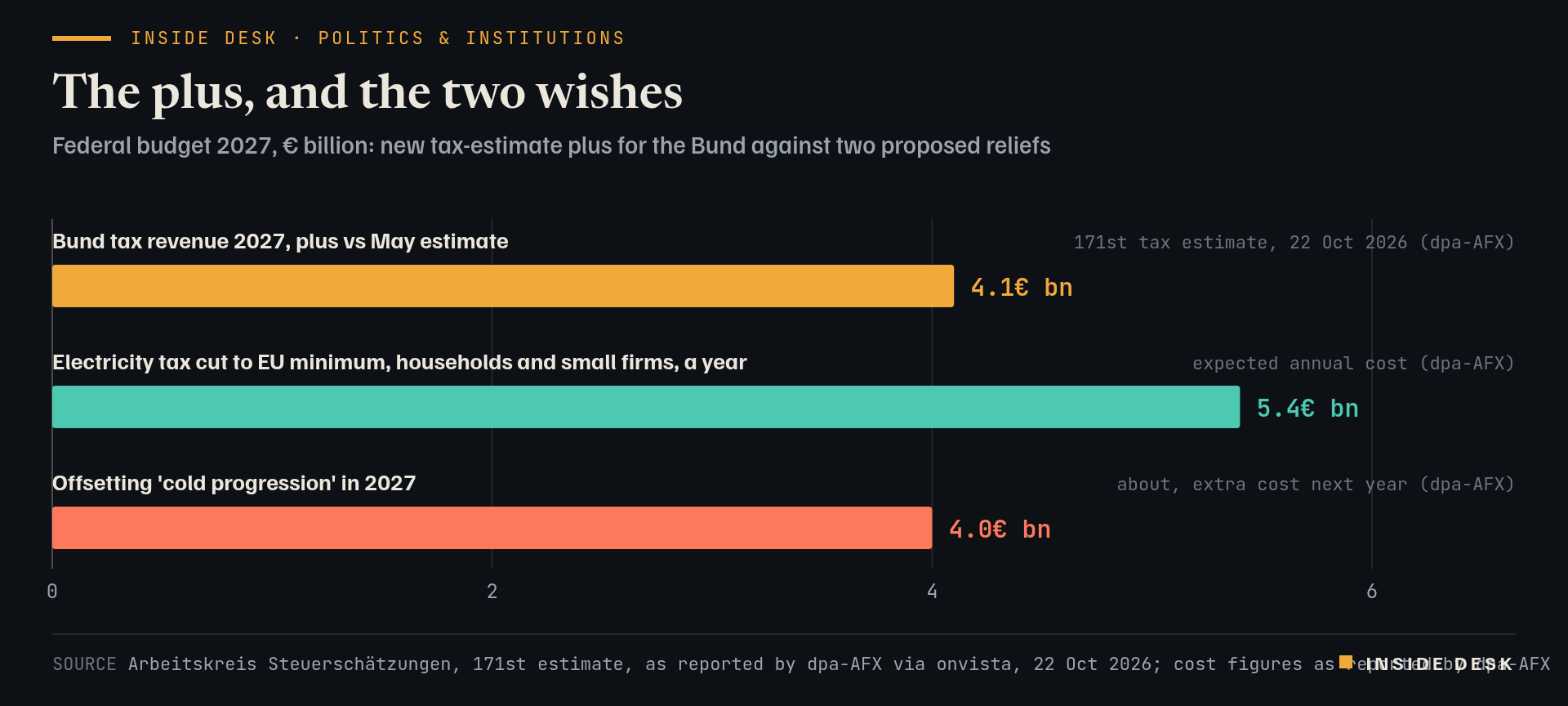
Bar chart: the October tax estimate adds about €4.1 billion to federal tax revenue for 2027 compared with May, against an expected €5.4 billion a year for cutting the electricity tax to the EU minimum and about €4 billion for offsetting cold progression in 2027.
Source Arbeitskreis Steuerschätzungen, 171st estimate, as reported by dpa-AFX via onvista, 22 Oct 2026; cost figures as reported by dpa-AFX. Figures as reported by the named organisations; facts cited with attribution.
Data (CSV) · SVG · PNG

Latest values as a table
| Value | |
|---|---|
| Bund tax revenue 2027, plus vs May estimate | 4.1€ bn |
| Electricity tax cut to EU minimum, households and small firms, a year | 5.4€ bn |
| Offsetting 'cold progression' in 2027 | 4€ bn |
The gap. Two things sit between the podium and the print. The first is the debt brake’s cyclical component: the better the economy runs, the less the federal government may borrow, so much of the tax plus is expected to be “eaten up” by a lower borrowing limit3. The second is the bill. Cutting the electricity tax to the EU minimum for households and small firms is expected to cost about €5.4 billion a year, and the CDU/CSU’s other wish, offsetting cold progression, about €4 billion next year3. Desk arithmetic: the two together are about €9.4 billion, more than twice the federal plus, before the debt brake takes its share. For a household, the tax cut is real money: from 2.05 to 0.1 cents per kWh1, so about €68 a year on 3,500 kWh, or about €81 with 19% VAT (desk arithmetic).
Verdict. Merz was right that growth produces tax, and the estimate confirms it. He skipped the line in the constitution that converts good times into smaller deficits. That is not a scandal; it is the rule doing what it was written to do. The useful fight now is the dull one in the Budget Committee in mid-November: which levy, which saving, which line pays for the cut3. Until someone names it, the promise is a podium and the €4.1 billion is the print. Nothing here is advice.
What to watch
- The Budget Committee's final session in mid-November, where the 2027 budget is closed, usually late at night3.
- Whether the plastics, tobacco and sugar levies already pencilled into the draft survive the coalition talks3.
- Any proposal that names where the €5.4 billion a year for the electricity tax would come from3.
Growth is a promise to the treasury. The debt brake reads the small print first.
Sources
- CDU will Stromsteuer „für alle“ auf EU-Minimum absenken: Merz sieht „Spielräume“ — stern.de (AFP), 12 Oct 2026, 16:23.
- Stabile Entwicklung 2026, insgesamt keine Spielräume in 2027 und weiterhin Konsolidierungsbedarf (Ergebnisse der 171. Steuerschätzung) — Bundesministerium der Finanzen, 22 Oct 2026.
- ROUNDUP: Steuereinnahmen ziehen an - Klingbeil: keine Etat-Entlastung — dpa-AFX via onvista, 22 Oct 2026, 13:07.
Every figure in this piece traces to a source above or to the desk’s own arithmetic on those sources, marked as such. Quotations are short and attributed. Spot an error? Write to the desk; corrections are logged on the method page.
Commentary for information only. Not investment, legal, tax, medical or political advice. Not an offer or solicitation. Analysis may be incomplete or wrong. Charts show published public data, not a trading feed; binding numbers live with the institutions that publish them.