Evening edition · Thursday, 22 October 2026
More young adults feel it, not more of it
A US survey study finds daily anxiety among 18- to 25-year-olds rose from 15% to 19.5% between 2020 and 2024, while its reported intensity did not. The rise is in how many, and in who gets a name for it.
A study published in the American Journal of Public Health looked at nearly 11,000 Americans aged 18 to 25 who answered the National Health Interview Survey between 2020 and 20241. Its headline is plain: nearly one in five said they felt anxious every day in 2024, up from 15% in 20201.
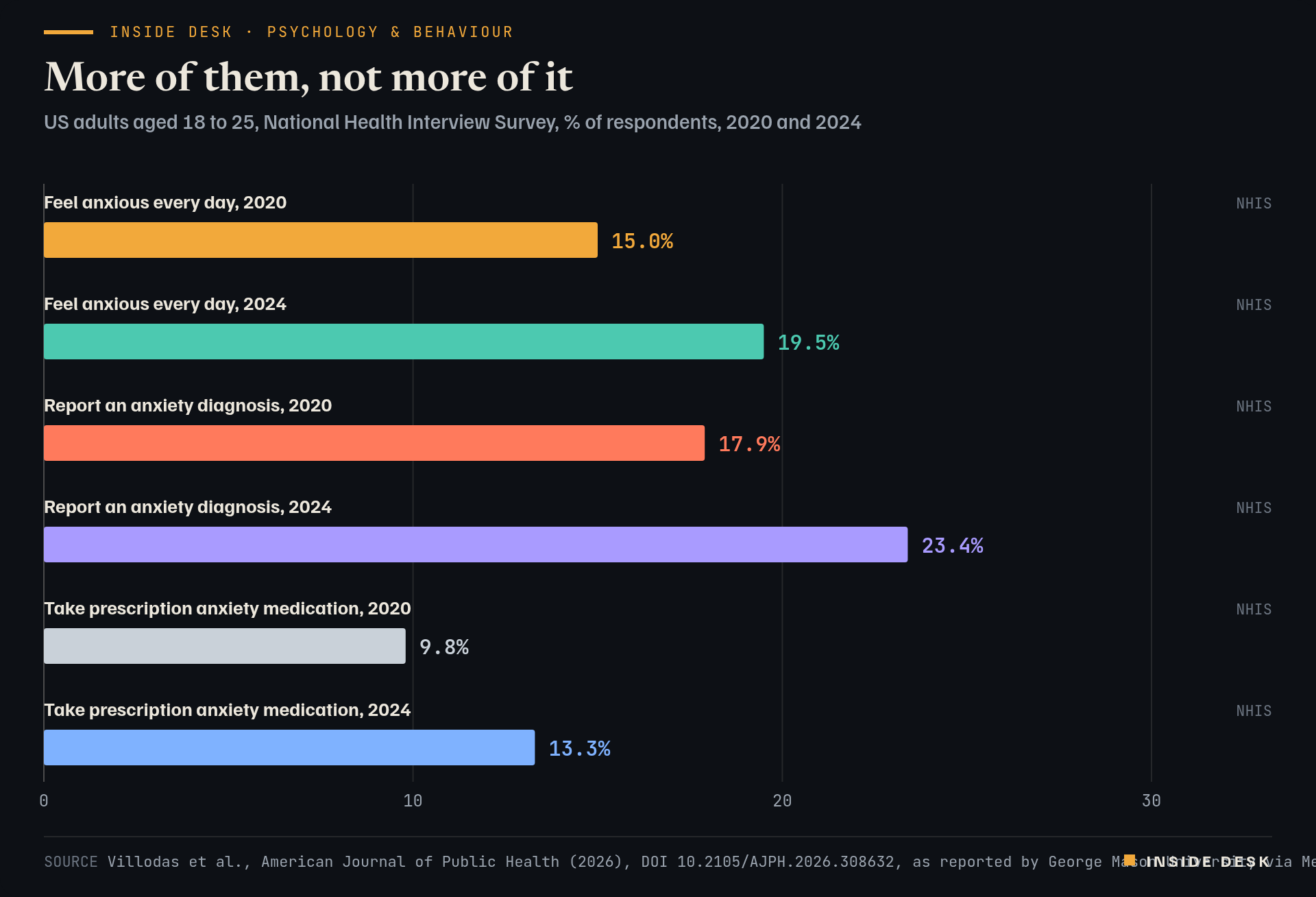
The three lines. The rise shows up everywhere you would look for it. Daily anxiety went from 15% to 19.5%; a reported anxiety diagnosis from 17.9% to 23.4%; prescription anxiety medication from 9.8% to 13.3%1. Desk arithmetic: each moved by roughly 30-36% in four years.
Bar chart: among US adults aged 18 to 25, daily anxiety rose from 15% in 2020 to 19.5% in 2024, reported anxiety diagnoses from 17.9% to 23.4%, and prescription anxiety medication use from 9.8% to 13.3%.
Source Villodas et al., American Journal of Public Health (2026), DOI 10.2105/AJPH.2026.308632, as reported by George Mason University via Medical Xpress, 22 Oct 2026. Figures as reported by the named organisations; facts cited with attribution.
Data (CSV) · SVG · PNG

Latest values as a table
| Value | |
|---|---|
| Feel anxious every day, 2020 | 15% |
| Feel anxious every day, 2024 | 19.5% |
| Report an anxiety diagnosis, 2020 | 17.9% |
| Report an anxiety diagnosis, 2024 | 23.4% |
| Take prescription anxiety medication, 2020 | 9.8% |
| Take prescription anxiety medication, 2024 | 13.3% |
The line that did not move. The intensity respondents reported “didn’t change significantly overall”1. That is the quiet finding. More young adults are anxious every day, but the typical anxious young adult does not describe it as worse than in 2020. A society can respond to “more people” with capacity, and to “worse” with urgency; this survey points at the first.
Who, not just how many. The authors, led by Melissa Villodas of George Mason University, looked at groups in combination rather than one at a time1. In 2024, 44.6% of lesbian, gay and bisexual respondents reported a diagnosis, against 18.5% of straight respondents, and their medication use doubled from 12.9% to 26%1. Among women, 32.1% reported a diagnosis, against 14.7% of men1. And 31.3% of white respondents reported a diagnosis, against 12.7% of Black and 15.3% of Hispanic respondents, although Black and white young adults did not differ significantly in reported intensity1. The researchers point to access to care, stigma and how symptoms are recognised1.
The constructive reading. The study cannot say what caused the rise after 20201. What it can do is tell a health system where to look: at groups whose anxiety is as strong but less often diagnosed. A survey that repeats every year, asks the same questions and gets published is unglamorous machinery. It is also how you find out that a gap is in the clinic door rather than in the person. Nothing here is medical advice.
What to watch
A rising count can mean more suffering, or more naming. Usually it means some of both.
Sources
- Study finds 1 in 5 young adults in the U.S. experience daily anxiety — George Mason University via Medical Xpress, 22 Oct 2026.
Every figure in this piece traces to a source above or to the desk’s own arithmetic on those sources, marked as such. Quotations are short and attributed. Spot an error? Write to the desk; corrections are logged on the method page.
Commentary for information only. Not investment, legal, tax, medical or political advice. Not an offer or solicitation. Analysis may be incomplete or wrong. Charts show published public data, not a trading feed; binding numbers live with the institutions that publish them.