Evening edition · Thursday, 22 October 2026
Germany burned less gas for power and paid more for it
Brent hit a five-month high while the Gulf's barrels kept moving. German power plants burned a sixth less gas this October, and power still cost about 80% more than a year ago.
Brent crude futures rose $3.19, or 2.9%, to $112.01 a barrel by 13:11 GMT on Thursday, after touching $112.68, the highest since 18 May, Reuters reported1. The triggers were the ones you have read about all week: more Houthi strikes in Saudi Arabia, and Iran’s Revolutionary Guard saying four vessels in the northern Gulf were hit and set on fire and three more struck mines west of the Strait of Hormuz1,2. On Thursday, six people told Reuters, Saudi Aramco told staff to leave its Dhahran headquarters and work from home1.
Here is the part the headline leaves out. The barrels are moving. Kpler data show oil exports from the Persian Gulf above their pre-war levels, the Guardian reported, partly because more crude now travels overland by pipeline to the Red Sea and the Gulf of Oman2. Morgan Stanley put Middle East crude exports at about 17 million barrels a day last week1. “Reports of Middle East crude oil exports exceeding pre-conflict levels are more than countered by attacks on ships in the Strait of Hormuz and the Houthi strikes on Saudi Arabia,” said Tamas Varga of PVM Oil1.
So Thursday’s price is not a count of missing oil. It is the price of the chance that oil goes missing: insurance, rerouting, a mine field, an office tower emptied as a precaution. Nobody can invoice a probability, but everyone pays for one.
How the fear reaches you. For a household in Germany the barrel is mostly a petrol-pump and heating-oil story. The bigger bill runs through gas, and through power stations that burn it. Dutch TTF gas, Europe’s benchmark, settled at €87.43 per megawatt hour on Wednesday, up 2.78% on the day, after a rally of about 19% in October3. EU gas storage is 74.58% full, 16.0 points below the five-year average of 90.6% for the date, and has started to draw down3. Germany’s stores are 61.1% full3. The cold has arrived where the stores are thinnest: Munich 3.6°C, Berlin 5.6°C in GasRadar’s morning readings3.
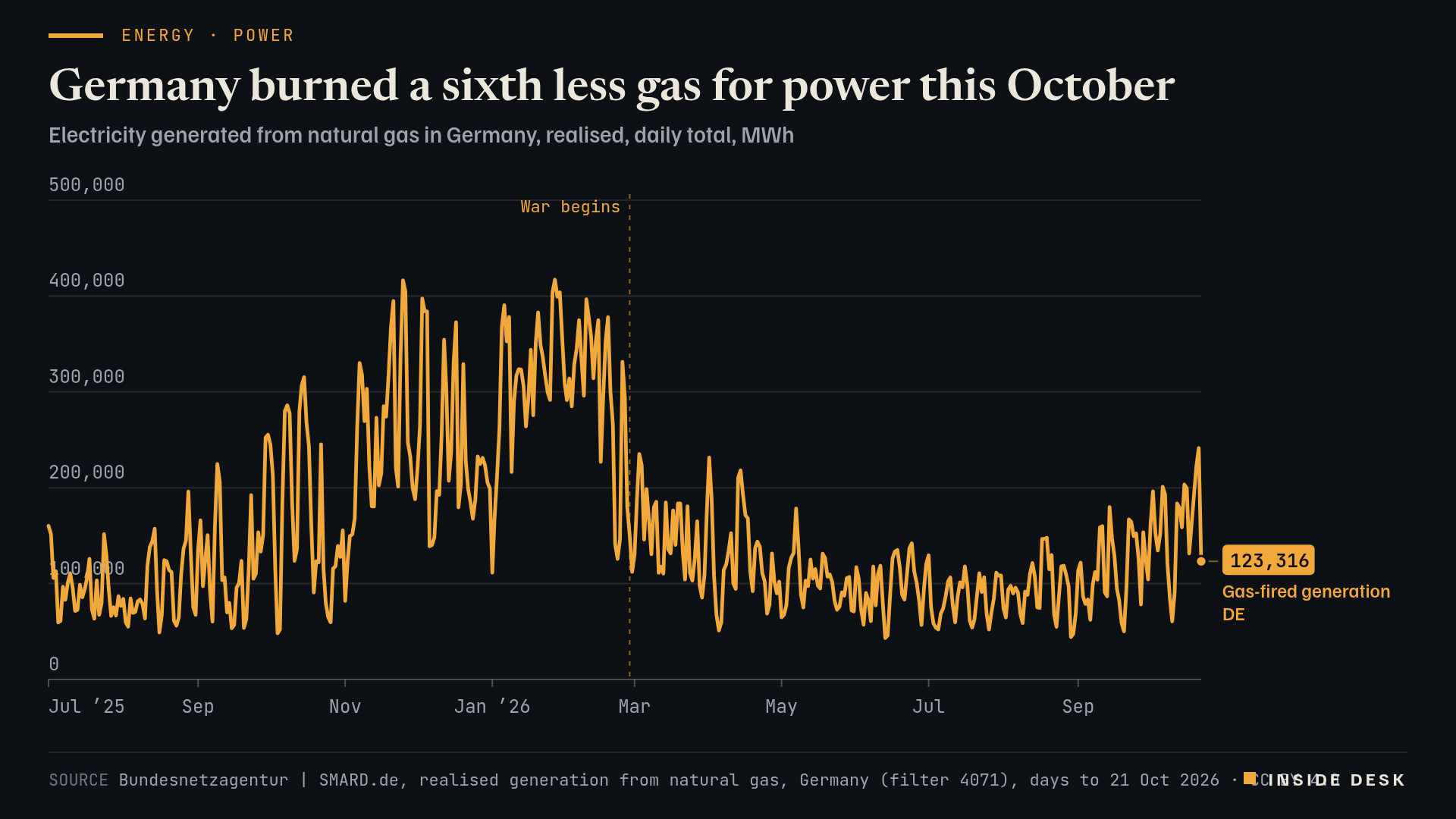
The print. Now the part that sounds backwards. Germany has burned less gas for electricity this October, not more. Gas plants generated about 3,421 gigawatt hours over 1 to 21 October 2026, against about 4,054 GWh over the same days of 2025, according to the Bundesnetzagentur’s SMARD data4. Desk arithmetic: about 16% less. Solar panels made up much of the difference; their output over the same days is up by about two-fifths4. Lignite is up too4.
Line chart of daily electricity generation from natural gas in Germany since July 2025, in megawatt hours. It rises each autumn and peaks in winter, at 417,047 MWh on 27 January 2026, and falls to a low of 43,247 MWh on 13 June 2026. Over 1 to 21 October 2026 gas plants generated about 3,421 gigawatt hours, against about 4,054 for the same days of 2025, roughly 16% less. The latest value, for Wednesday 21 October 2026, is 241,431 MWh, the highest daily total since 25 February 2026.
Source Bundesnetzagentur | SMARD.de, realised generation from natural gas, Germany (filter 4071), days to 21 Oct 2026 · CC BY 4.0. Bundesnetzagentur | SMARD.de, market data. CC BY 4.0.
Data (CSV) · SVG · PNG

Latest values as a table
| Date | Gas-fired generation DE |
|---|---|
| 2026-10-17 | 131503 |
| 2026-10-18 | 160247 |
| 2026-10-19 | 191613 |
| 2026-10-20 | 222274 |
| 2026-10-21 | 241432 |
| 2026-10-22 | 123316 |
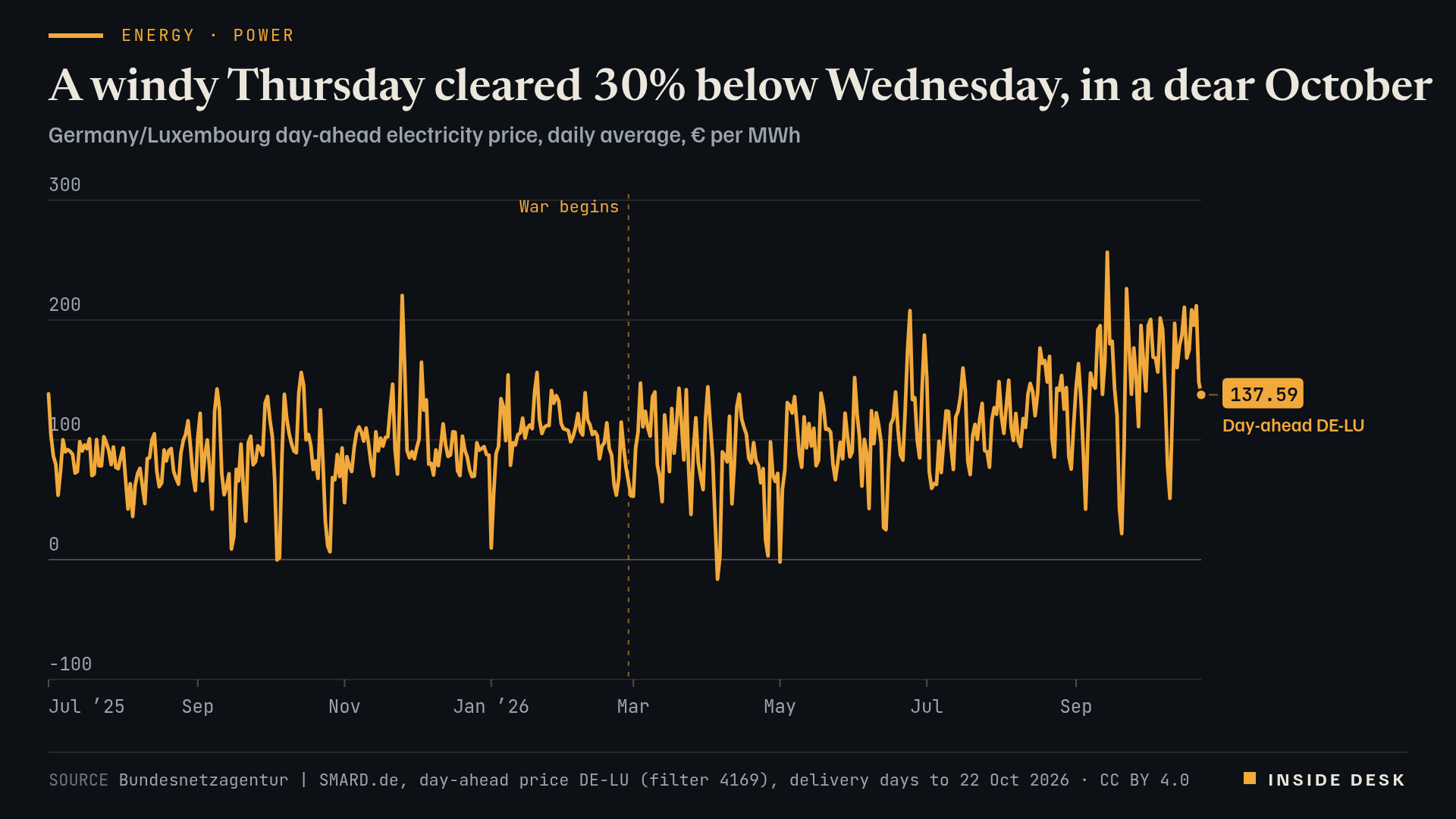
And yet the day-ahead auction for the Germany-Luxembourg zone averaged €169.93 per megawatt hour over 1 to 21 October, against €94.14 a year earlier4. Desk arithmetic: about 80% higher, on a sixth less gas.
The reason is the dullest rule in the market. In most hours the price is set by the last plant needed to meet demand, and in Germany that is still often a gas plant. Fewer gas hours lower your exposure; they do not lower the price of the hours that remain. When the molecule costs more, so does the marginal hour, however few of those hours there are.
You can watch the rule work day by day. Wednesday 21 October was the biggest gas-burning day since 25 February, at about 241 GWh, and it was also the dearest delivery day of the week, at €211.944. Thursday cleared at €148.61, and Friday, auctioned at midday on Thursday, at €137.594. Gas burn for those days is not yet published.
Line chart of the daily average German-Luxembourg day-ahead electricity price since July 2025, in euros per megawatt hour. Monthly averages stay between about €77 and €110 through July 2026, including the months after the war begins at the end of February; the daily low is −€16.34 on 5 April. The price climbs from August, averaging €144.82 in September with a daily high of €256.55 on 14 September, and €168.96 over 1 to 22 October, against €95.54 over the same days of 2025. The latest value, for delivery on Thursday 22 October 2026, is €148.61, down from €211.94 for Wednesday 21 October.
Source Bundesnetzagentur | SMARD.de, day-ahead price DE-LU (filter 4169), delivery days to 22 Oct 2026 · CC BY 4.0. Bundesnetzagentur | SMARD.de, market data. CC BY 4.0.
Data (CSV) · SVG · PNG

Latest values as a table
| Date | Day-ahead DE-LU |
|---|---|
| 2026-10-18 | 175.21 |
| 2026-10-19 | 208.44 |
| 2026-10-20 | 195.66 |
| 2026-10-21 | 211.94 |
| 2026-10-22 | 148.61 |
| 2026-10-23 | 137.59 |
What this argues for. Not panic, and not a speech. The two lines on these charts point at the same unglamorous fixes. Every gas hour replaced by a solar or wind hour is an hour the Gulf cannot price. Every interconnector lets a windy hour in the north cover a cold hour in the south. And every percentage point in a storage cavern is a cold February that does not have to be bought on the spot market. None of this makes the news like a tanker on fire. All of it decides the invoice.
The oil market will keep reacting to words and drones. PVM’s Varga expects no de-escalation before the US midterm elections1; that is a view, not a fact, and the desk records it as such. What is a fact is the arithmetic of the last three weeks: less gas burned, more paid for each megawatt hour. A country cannot control the Strait of Hormuz. It can control how many of its hours depend on it. Nothing here is advice.
What to watch
- Whether Aramco's instruction to staff to leave its Dhahran headquarters and work remotely stays an office measure1.
- EU storage, 74.58% full and now drawing down by about 0.04 points a day, against a five-year norm of 90.6% for the date3.
- Friday's German delivery day, already auctioned at €137.59, and whether the cold in the south meets the wind in the north4.
Fear is priced by the barrel, but it is paid by the megawatt hour.
Sources
- Brent hits five-month high on escalating Middle East conflict — Reuters (via Yahoo Finance), 22 Oct 2026, 09:22 EDT.
- Oil prices jump to five-month high as attacks threaten global supply — The Guardian, 22 Oct 2026, modified 08:41 EDT.
- European gas briefing, 22 Oct 2026: TTF 87.43 EUR/MWh, EU storage 74.6 % — GasRadar (GIE AGSI+, ICE Endex data), 22 Oct 2026, 06:45 CET.
- Market data: realised generation by source (natural gas, lignite, solar) and day-ahead price DE-LU, daily — Bundesnetzagentur / SMARD.de, retrieved 22 Oct 2026, 16:27 CEST.
Every figure in this piece traces to a source above or to the desk’s own arithmetic on those sources, marked as such. Quotations are short and attributed. Spot an error? Write to the desk; corrections are logged on the method page.
Commentary for information only. Not investment, legal, tax, medical or political advice. Not an offer or solicitation. Analysis may be incomplete or wrong. Charts show published public data, not a trading feed; binding numbers live with the institutions that publish them.