Event
Resilience is an inventory
Six months after April's warning, the IMF's growth number had not moved and its inflation number had. The Fund's own explanation is a list of things that run down.
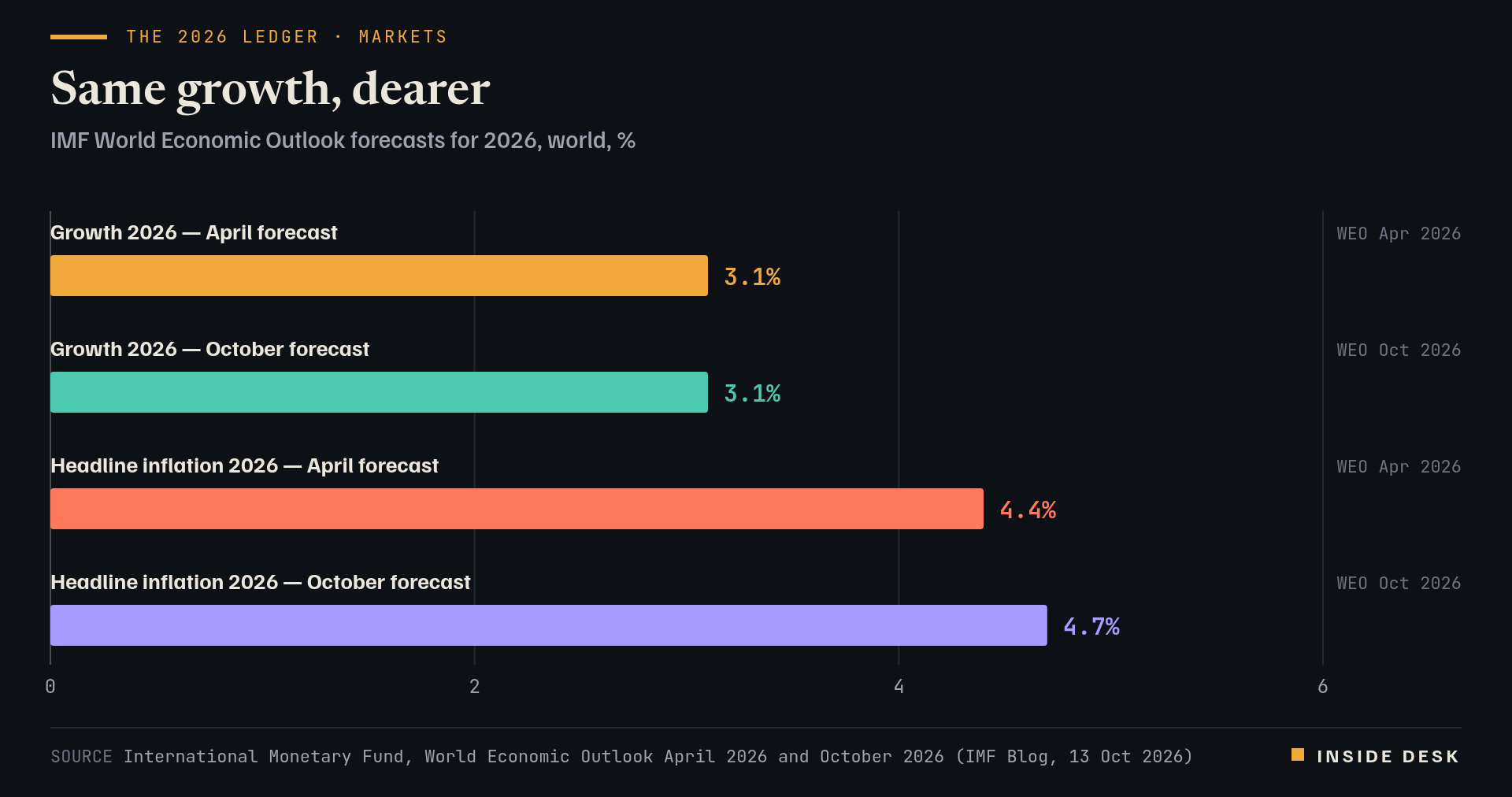
On 13 October the IMF published its autumn World Economic Outlook, Resilience Under Strain, Urgent Choices2. The headline number was the same as in April: world growth of 3.1% in 20261,3. In the Fund’s words, the forecast “remains broadly unchanged from April, despite a more persistent energy market disruption than anticipated”1.
Bar chart comparing the IMF's April and October 2026 forecasts for 2026: world growth 3.1% in both, headline inflation 4.4% in April and 4.7% in October.
Source International Monetary Fund, World Economic Outlook April 2026 and October 2026 (IMF Blog, 13 Oct 2026). Figures as reported by the named organisations; facts cited with attribution.
Data (CSV) · SVG · PNG

Latest values as a table
| Value | |
|---|---|
| Growth 2026 — April forecast | 3.1% |
| Growth 2026 — October forecast | 3.1% |
| Headline inflation 2026 — April forecast | 4.4% |
| Headline inflation 2026 — October forecast | 4.7% |
What did move. Headline inflation for 2026 was now forecast at 4.7%, against 4.4% in April, and at 4.1% for 2027, against 3.7%1,3. Core inflation was put at 3.9% this year1. Growth for 2027 was raised to 3.4%, from 3.2% in April1,3. Put simply: the world produced about what the Fund expected and paid more for it.
The explanation is a list. The IMF credited two sets of factors. The first: “the rerouting of energy supplies, increased energy production in other countries, inventory drawdowns, substitution to other sources of energy, including renewables, and higher energy efficiency”1. The second: an investment boom driven by artificial intelligence1. Read the first list slowly. Rerouting has a cost, production elsewhere has a ceiling, and inventory drawdowns have a floor.
The Fund said so itself. “Dwindling energy inventories could allow geopolitical shocks to transmit even more forcefully to energy prices,” the blog warned, and the investment boom was “concentrating risks”, making the expansion “heavily reliant on a small number of firms, sectors, and economies”1. Six days earlier the IEA had put the remaining public emergency stocks of its members at around 1.1 billion barrels4. That is a large cushion, and a smaller one than in March.
The constructive reading. The record of 2026 so far is not one of collapse. It is one of a system that bent: ships rerouted, producers elsewhere pumped, households and firms paid more and carried on. That is genuinely good news, and the desk is happy to say it. It is also news with a maturity date. Resilience built from stocks is a loan; resilience built from capacity is an asset. For the year’s last quarter, the question for you is which of the two your own budget is leaning on.
What it left behind
A buffer that is being used is not a buffer. It is a bill with a delayed due date.
Sources
- Global Economic Resilience Is Under Strain, Demanding Decisive Policy Action — IMF Blog (Silvana Tenreyro), 13 Oct 2026.
- World Economic Outlook, October 2026: Resilience Under Strain, Urgent Choices — International Monetary Fund, 13 Oct 2026.
- World Economic Outlook, April 2026: Global Economy in the Shadow of War – Executive Summary — International Monetary Fund, 14 Apr 2026.
- Statement by IEA Executive Director on meeting of IEA Member governments on 7 October 2026 — International Energy Agency, 7 Oct 2026.
Every figure in this piece traces to a source above or to the desk’s own arithmetic on those sources, marked as such. Quotations are short and attributed. Spot an error? Write to the desk; corrections are logged on the method page.
Commentary for information only. Not investment, legal, tax, medical or political advice. Not an offer or solicitation. Analysis may be incomplete or wrong. Charts show published public data, not a trading feed; binding numbers live with the institutions that publish them.