Event
The bypass breaks, both banks hike
In one week the pipeline that carried Saudi oil around Hormuz was hit, the ECB raised rates and the Fed did the same. The Fed decided on the very day the ECB's increase took effect. The tank had made the argument for both.
In the second week of September, drones launched from Iraq damaged Saudi Arabia’s East-West pipeline, which can carry 7 million barrels a day from the Gulf to the Red Sea coast, and Riyadh shut it4. It was the main route by which Saudi crude avoided Hormuz. Kpler estimated the market could lose 120 million barrels if it stayed closed for a month4. Andy Lipow of Lipow Oil Associates summed it up: “The longer the shutdown, the higher the price”4.
Two prices again. Brent futures settled at $105.68 on Monday 14 September, after nearly touching $1104. The EIA’s spot price for a physical North Sea barrel was $121.25 that day and $130.80 the next5. If you heat a building or run a fleet, the second number was yours.
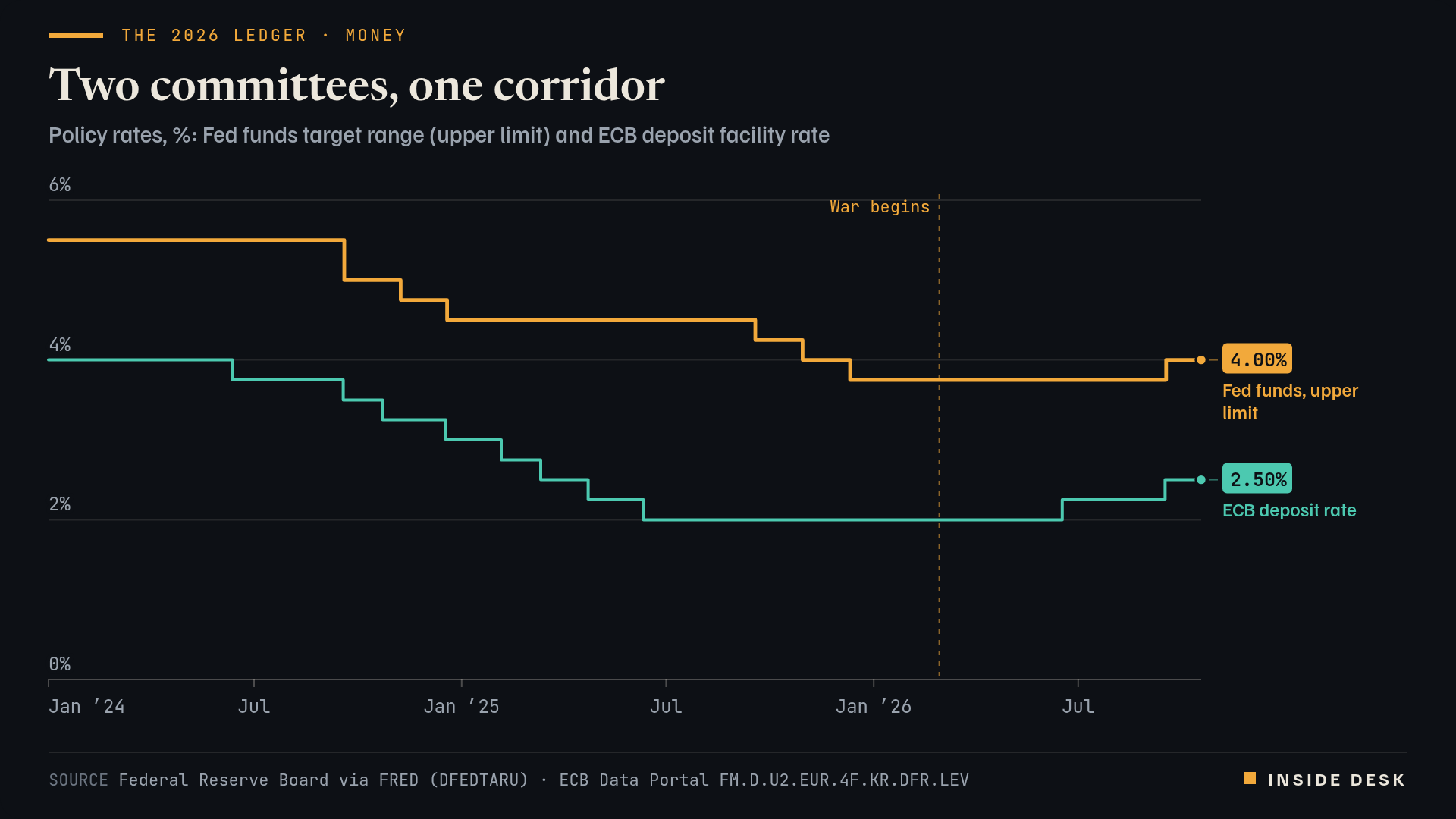
Frankfurt had moved the same week. On 10 September the ECB raised its three key rates by 25 basis points, the deposit rate to 2.50% from 16 September, saying inflation “is set to remain well above target for an extended period”1. Its staff now projected inflation of 3.0% this year and 2.5% next, and it repeated that it was “not pre-committing to a particular rate path”1.
Washington followed, on the very day the ECB’s increase took effect. On 16 September the Federal Open Market Committee raised the federal funds range by a quarter point to 3.75% to 4%, by twelve votes to none, saying the move “will support a timelier return to the Committee’s 2 percent goal”2. In July the same committee had held by nine votes to three, with three members already asking for this increase3. The dissent was the forecast; the September vote was the receipt.
Step chart since January 2024 of the Fed funds target upper limit and the ECB deposit rate. The Fed's upper limit falls from 5.50% in 2024 to 3.75% by December 2025 and rises to 4.00% in September 2026. The ECB deposit rate falls from 4.00% to 2.00% by June 2025, then rises to 2.25% in June 2026 and 2.50% in September 2026.
Source Federal Reserve Board via FRED (DFEDTARU) · ECB Data Portal FM.D.U2.EUR.4F.KR.DFR.LEV. Board of Governors of the Federal Reserve System (H.15) via FRED. Public domain. European Central Bank Data Portal. Reuse permitted with source acknowledgement.
Data (CSV) · SVG · PNG

Latest values as a table
| Date | Fed funds, upper limit | ECB deposit rate |
|---|---|---|
| 2026-10-13 | 4 | 2.5 |
| 2026-10-14 | 4 | 2.5 |
| 2026-10-15 | 4 | 2.5 |
| 2026-10-16 | 4 | 2.5 |
| 2026-10-17 | 4 | 2.5 |
| 2026-10-18 | – | 2.5 |
What the chart says, and what it does not. It shows two central banks that spent 2024 and 2025 cutting, and 2026 reversing6,7. It does not show that they were wrong to cut; the energy shock that changed their minds began in February. Reading hindsight into a rate path is the easiest mistake in finance. The honest reading is narrower: when the price of energy is set by a corridor, policy is set by how long the corridor stays shut.
For you, the useful conclusion is the dull one. If your loan, your deposit or your rent is linked to either of these lines, the committees have told you plainly that they are watching the tank, not the screen, and that they will not promise the next step in advance.
What it left behind
When the physical price outruns the futures price, the committee is not reading the screen. It is reading the invoice.
Sources
- Monetary policy decisions, 10 September 2026 — European Central Bank, 10 Sep 2026.
- Federal Reserve issues FOMC statement (September 16) — Federal Reserve Board, 16 Sep 2026.
- Federal Reserve issues FOMC statement (July 29) — Federal Reserve Board, 29 Jul 2026.
- Oil prices rise after Saudi Arabia shuts down critical pipeline that bypasses Strait of Hormuz — CNBC, 13–14 Sep 2026.
- Crude Oil Prices: Brent – Europe (DCOILBRENTEU), EIA spot price — U.S. EIA via FRED, St. Louis Fed, accessed 16 Oct 2026.
- Federal Funds Target Range – Upper Limit (DFEDTARU) — Board of Governors of the Federal Reserve System via FRED, accessed 16 Oct 2026.
- Deposit facility rate (FM.D.U2.EUR.4F.KR.DFR.LEV) — ECB Data Portal, accessed 16 Oct 2026.
Every figure in this piece traces to a source above or to the desk’s own arithmetic on those sources, marked as such. Quotations are short and attributed. Spot an error? Write to the desk; corrections are logged on the method page.
Commentary for information only. Not investment, legal, tax, medical or political advice. Not an offer or solicitation. Analysis may be incomplete or wrong. Charts show published public data, not a trading feed; binding numbers live with the institutions that publish them.