Event
The court sends the invoice back
Six justices said a tariff is a tax, and taxes belong to Congress. The refund goes to whoever signed the customs entry, which is rarely the person who paid the higher price.
On Friday 20 February the Supreme Court decided Learning Resources, Inc. v. Trump by six votes to three2. Chief Justice Roberts wrote for the majority, joined by Justices Barrett, Gorsuch, Jackson, Kagan and Sotomayor; Justice Kavanaugh wrote the principal dissent, joined by Justices Thomas and Alito1. The holding was short: the emergency-powers law the administration had used does not authorise the President to impose tariffs1.
The reasoning was shorter still. The power to “regulate… importation” is not the power to tax, and tariffs are a tax, which under the Constitution belongs to Congress. As the majority put it, “had Congress intended to convey the distinct and extraordinary power to impose tariffs, it would have done so expressly”1.
Institutions beat influencers, again. Within hours there was a replacement: a 10% tariff under Section 122 of the Trade Act of 1974, effective 24 February, capped by statute at 15% and at 150 days unless Congress extends it1. Markets took the day calmly; stocks rose and Treasury yields edged up, with investors estimating that the government might owe $150 billion to $200 billion in refunds3. The ruling did not decide refunds at all1.
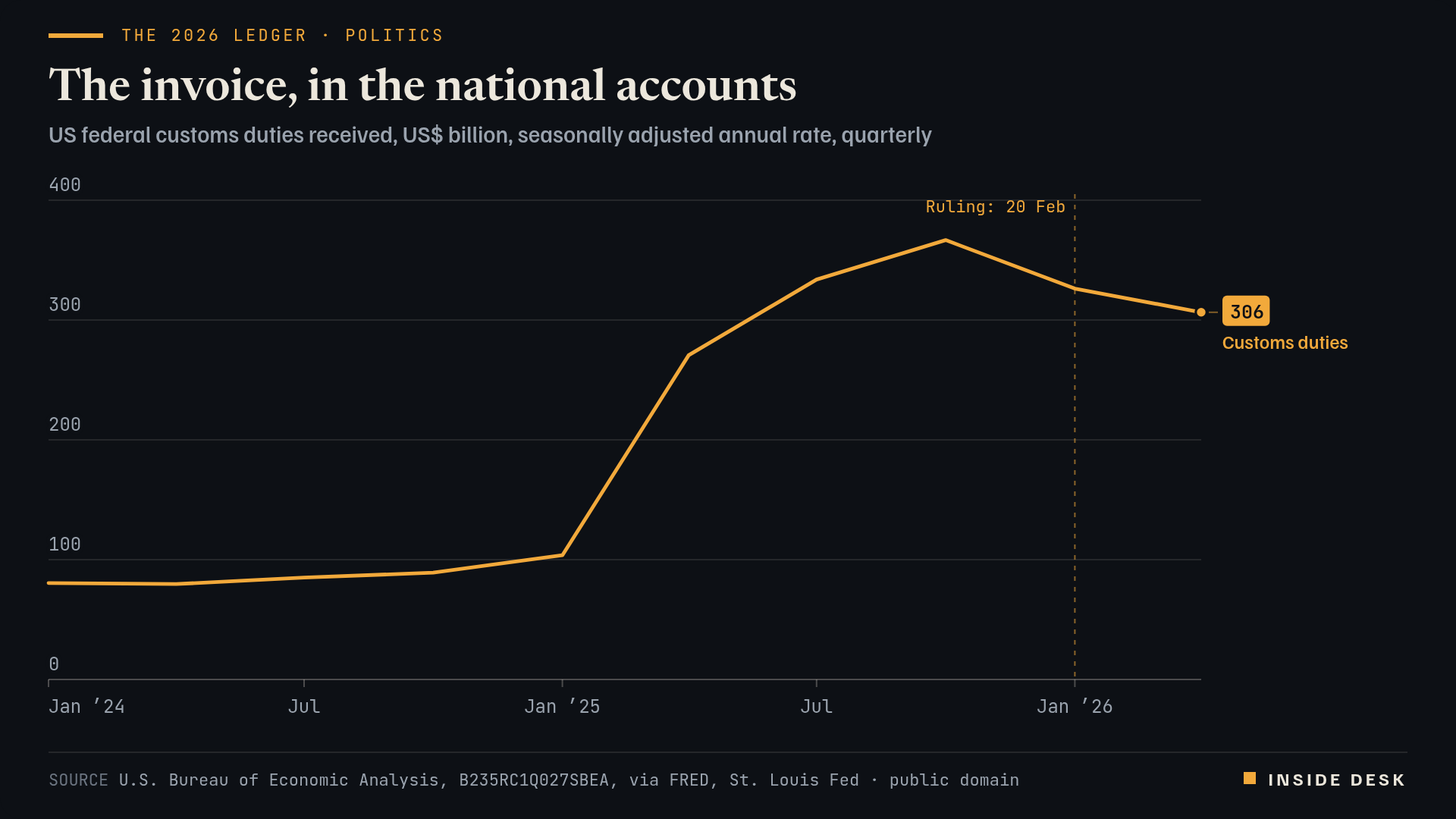
The invoice tells you who paid. Customs duties are collected from importers, and the national accounts show how large the bill became. On the Bureau of Economic Analysis series, federal customs receipts ran at an annual rate of about $89 billion in the fourth quarter of 2024 and about $367 billion a year later5. That is the line in the chart below, and it is not an opinion about trade policy. It is a record of who sent money to the Treasury.
Line chart of quarterly US federal customs receipts at a seasonally adjusted annual rate. They are about $80 billion to $89 billion through 2024, jump to about $271 billion in the second quarter of 2025 and $367 billion in the fourth, then ease to $326 billion in the first quarter of 2026 and $306 billion in the second, after the February ruling.
Source U.S. Bureau of Economic Analysis, B235RC1Q027SBEA, via FRED, St. Louis Fed · public domain. U.S. Bureau of Economic Analysis via FRED, Federal Reserve Bank of St. Louis. U.S. government data, public domain.
Data (CSV) · SVG · PNG

Latest values as a table
| Date | Customs duties |
|---|---|
| 2025-01-01 | 103.66 |
| 2025-04-01 | 270.592 |
| 2025-07-01 | 333.75 |
| 2025-10-01 | 366.651 |
| 2026-01-01 | 326.223 |
| 2026-04-01 | 306.398 |
The refund follows the paperwork, not the price. Customs built a portal for IEEPA refunds, with interest4. Its own guidance is blunt: “CBP is only able to refund IEEPA duties to the Importer of Record” or a party that importer designates4. If a retailer passed the tariff on to you at the till, the refund goes to the retailer. That is not a scandal; it is how invoices work. It is also why “the tariff was struck down” and “you got your money back” are different sentences.
Hindsight. The series did not fall back to 2024 levels: receipts were still running at about $306 billion a year in the second quarter of 20265. Duties under other laws stayed in force, and the replacement levy took over part of the job1. The court changed who may decide. It did not change the habit of deciding.
What it left behind
- The replacement 10% levy under Section 122 of the Trade Act, a power never used before, was limited to 150 days, to 24 July, unless Congress extended it1.
- Refunds flow to the importer of record, with interest, through a customs portal; CBP says valid claims are generally paid within 60 to 90 days of acceptance4.
A tariff is an invoice with a flag on it. The court only asked who is allowed to send it.
Sources
- IEEPA Tariffs Terminated, Replacement Section 122 Tariffs Take Effect — Covington & Burling LLP, 27 Feb 2026.
- Learning Resources, Inc. v. Trump, No. 24-1287 (opinion) — Supreme Court of the United States, 20 Feb 2026.
- US Supreme Court ruling overturning Trump tariffs could spook bond vigilantes — Reuters, 20 Feb 2026.
- International Emergency Economic Powers Act (IEEPA) Duty Refunds — U.S. Customs and Border Protection, accessed 16 Oct 2026.
- Federal government current tax receipts: Customs duties (B235RC1Q027SBEA) — U.S. Bureau of Economic Analysis via FRED, St. Louis Fed, accessed 16 Oct 2026.
Every figure in this piece traces to a source above or to the desk’s own arithmetic on those sources, marked as such. Quotations are short and attributed. Spot an error? Write to the desk; corrections are logged on the method page.
Commentary for information only. Not investment, legal, tax, medical or political advice. Not an offer or solicitation. Analysis may be incomplete or wrong. Charts show published public data, not a trading feed; binding numbers live with the institutions that publish them.