Sunday long-read · Sunday, 1 November 2026
The Sunday long read: the week was written in ship counts, settlements and a licence number
Speeches about Hormuz, Iran and Russian diesel filled the week. The paperwork told a steadier story: 277 transits, a contract that expired $4.21 above its successor, and General License No. 135, with three tankers of Russian diesel due on the US East Coast by about 11 November.
There were two weeks in the Gulf this week. One was spoken. It had a vice-president’s letter, a supreme leader’s call to end “the impasse”, Qatari mediators flying back to Tehran barely a day after leaving it, and reports that Washington and Israel are preparing for possible military action after Tuesday’s US midterm elections4,6. The other was written down. It had a weekly ship count from a British maritime office, an expiring oil contract, and a six-month permit from the US Treasury with a number on it. This long read is about the second week, because the second week is the one you pay for.
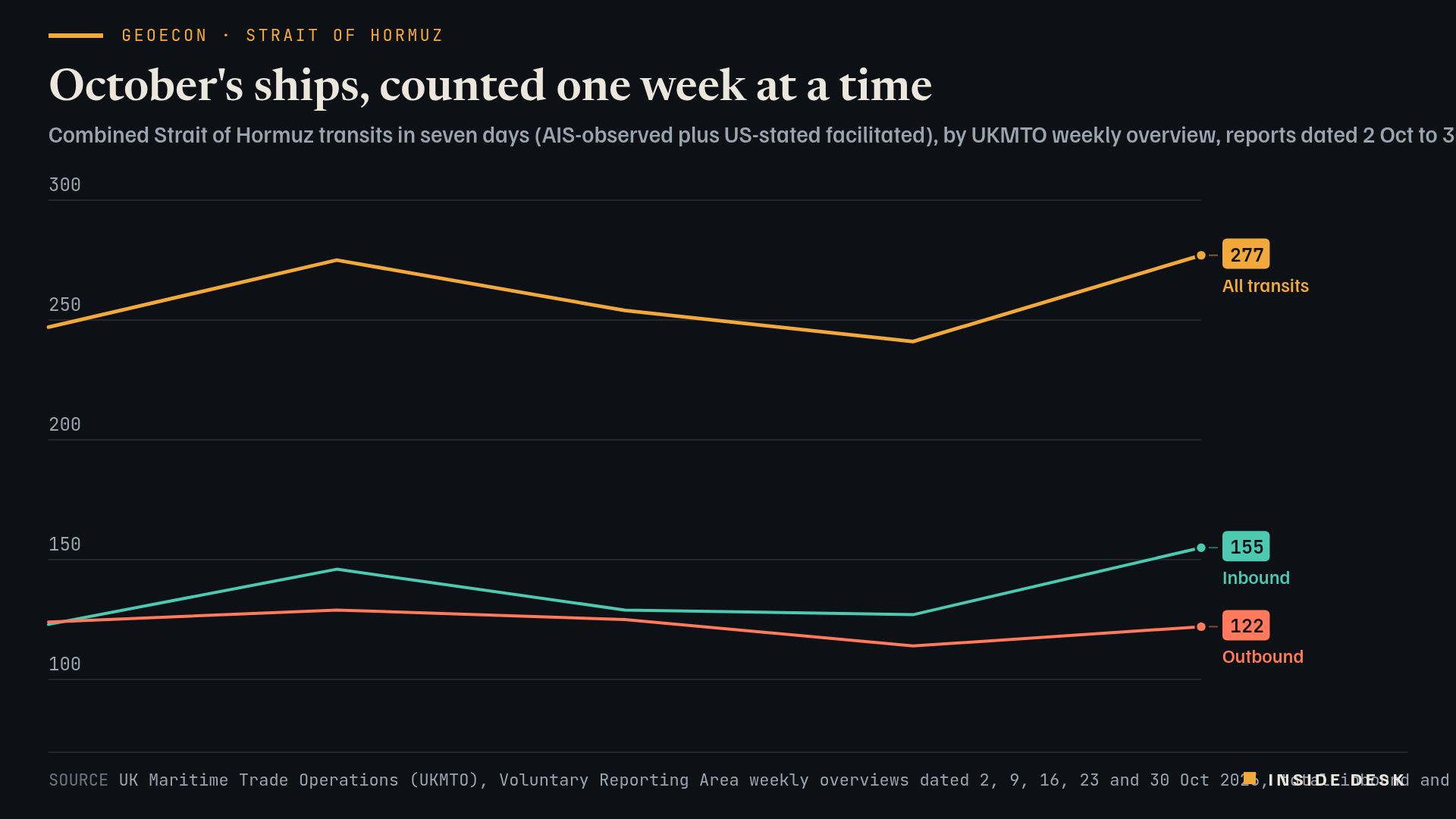
The count. Each Friday in October, UK Maritime Trade Operations, the British maritime security office that takes reports from merchant ships, has published a two-page overview of the Strait of Hormuz. On 30 October it counted 122 outbound and 155 inbound transits over seven days, against 114 and 127 the week before1. It called that “approximately 70% below pre-conflict levels”1. Desk arithmetic: 277 transits against 241 is 36 more ships, a rise of about 15%, and the highest weekly total in the five overviews UKMTO published in October1,2.
Line chart of weekly Strait of Hormuz transits reported by UKMTO, from the overview dated 2 October to the one dated 30 October 2026. All transits go 247, 275, 254, 241 and 277, the latest value and the highest of the five weeks. Inbound transits go 123, 146, 129, 127 and 155, the latest value. Outbound transits go 124, 129, 125, 114 and 122, the latest value. UKMTO describes the latest week as approximately 70% below pre-conflict levels.
Source UK Maritime Trade Operations (UKMTO), Voluntary Reporting Area weekly overviews dated 2, 9, 16, 23 and 30 Oct 2026, total inbound and outbound transits last 7 days (AIS derived via S&P plus US NCAGS stated facilitated transits, which UKMTO says it cannot independently verify); totals are Inside Desk arithmetic · retrieved 1 Nov 2026. Figures as reported by the named organisations; facts cited with attribution.
Data (CSV) · SVG · PNG

Latest values as a table
| Date | All transits | Inbound | Outbound |
|---|---|---|---|
| 2026-10-02 | 247 | 123 | 124 |
| 2026-10-09 | 275 | 146 | 129 |
| 2026-10-16 | 254 | 129 | 125 |
| 2026-10-23 | 241 | 127 | 114 |
| 2026-10-30 | 277 | 155 | 122 |
The chart is unexciting on purpose. Five Fridays, five numbers between 241 and 2771,2. October was not the month the strait reopened, and it was not the month it closed. It was the month it kept being counted, by the same office, the same way, so that a reader in Frankfurt can compare one Friday with the last.
The small print matters as much as the totals. UKMTO’s figure combines two kinds of ship: those its analysts can see broadcasting on AIS, the transponder system, and those the US Navy says it has escorted or facilitated, which UKMTO says it “cannot independently verify”1. AIS-observed transits rose to 64 from 47; the US-stated figure was “roughly level”, outnumbering the visible ships by about three to one1. Most visible ships still route through the channel Iran calls its own, though UKMTO notes more using the southern route1. Eighty per cent of the transits the US reports are energy carriers1.
An independent tracker shows how thin the visible part is. On Saturday, hormuz.now counted 11 AIS-visible commercial crossings, four inbound and seven outbound, four of them tankers, against a seven-day average of 8.3 a day and a pre-crisis baseline of 84.8 a day5. That counts a narrower set of ships with a different method, so it does not contradict UKMTO’s 277. It explains why the official figure leans so heavily on ships nobody outside a navy can see.
The ledger of damage. The same office keeps a second column. UKMTO has received reports of 88 incidents in the strait since the war began on 28 February, and its data suggest at least 35 attacks on shipping in the Gulf and the strait in October, the worst month of the war; March, with about 30, was the second worst3. It rates the threat “severe”, meaning an attack is considered highly likely4.
One of October’s incidents is a lesson in how ledgers connect. On Thursday a small boat attached two explosive devices to an outbound tanker 25 nautical miles north-east of Khasab, starting an engine-room fire; the crew were safe and the ship continued to its next port4. Maritime security sources named it the Panama-flagged Louise 1 and called it the first known successful limpet-mine attack in the area since the war began4. The same tanker, Reuters reported, was struck by Ukrainian naval drones in the Black Sea in July, over its alleged role in carrying Russian oil for the so-called shadow fleet4. One hull, two wars, two incident reports. The ship’s paperwork knows more about this conflict’s geography than most of its commentary.
The price. On Friday the December Brent contract expired. It settled at $117.64 a barrel, up $2.76 on the day, after touching $118; the more active January contract settled at $113.436. Brent finished October 13.6% higher and US crude 15.2% higher6. Desk arithmetic: the expiring month closed $4.21 above the one behind it. A front month that much dearer than the next says buyers were paying for barrels they needed now. It also means the headline price on Monday’s screens will be about four dollars lower without anybody having sold anything. That is a calendar change, not a calm market.
The Reuters report carried a quieter fact that belongs in the same ledger. Saudi Arabia’s crude exports rose in October from September, according to two of three ship-tracking companies, despite the attacks in the Gulf and Houthi claims of strikes on Saudi oil sites6. Two of three is not unanimity, and this desk will not turn it into a trend. But it is the kind of sentence that gets written by people counting cargoes, not by people giving interviews.
The licence. The week’s most consequential piece of paper was not new. It was dated 9 October and numbered 135. OFAC’s General License No. 135 authorises “all transactions” otherwise banned under two US sanctions regulations that relate to the sale, delivery, offloading or importation of Russian-origin diesel, until 7 April 20277. The lawyers at Clyde & Co note that it sits in tension with the Ending Importation of Russian Oil Act of 2022, which lets the president lift the import ban only by certifying conditions to Congress, and that the details of the diesel deal itself “have not been publicized in any official format”7.
This week the licence became cargo. Three tankers carrying about 140,000 tonnes of Russian diesel were crossing the Atlantic, Fox News reported on Tuesday, and Russia’s deputy prime minister Alexander Novak said a fourth was expected to leave on 28 October8. The first, the Malta-flagged Agioi Fanendes, carries about 40,000 tonnes and signals New York, with an estimated arrival around 7 November; the Talisman is due on the East Coast around 9 November and the Leruo around 11 November8. The Talisman is sanctioned by the US, the UK and the EU; the Leruo by the EU, the UK and Canada8. A US licence covers US law. It does not authorise European, British or Canadian companies to touch the shipments, and EU and UK bans on carrying Russian diesel remain in force7,8.
Notice what the paperwork does here. It splits one political question, whether Washington should buy Russian fuel, into several dull ones that institutions can answer: which statute governs, which ship is listed by whom, which bank may process the payment, which court hears the challenge. A US senator has written to two shipping companies demanding they recall their tankers; lawmakers have asked banks, fuel distributors and port authorities to preserve records8. You may like the deal or loathe it. Either way, the argument is happening in letters, records and filings, which is where it can be checked.
The sequence. Back in the spoken week, the diplomacy turned out to be an argument about ordering. Iran International reports a proposed seven-day framework in which Washington wants nuclear talks to begin on day one and Tehran on day seven, after other steps are taken4. Iran’s foreign minister has rejected reopening the strait as a unilateral gesture before naval restrictions are lifted and $24 billion of frozen assets released4. Six days on a calendar separate the positions. Each side wants the other to sign first.
That is not a reason for despair. A dispute about sequence is a dispute about procedure, and procedure is where institutions are strongest. Escrow, staged release, verification visits: the world has a thick manual for “you first”. Nothing in this week’s paperwork says the manual will be used. Everything in it says the people who keep the counts will notice if it is.
What this means for you. When the next headline tells you the strait is open or shut, look for Friday’s UKMTO number and ask whether it moved. When the oil price drops by four dollars on Monday, check whether a contract simply expired. When a deal is announced, look for the licence number and the date it lapses. Those three habits will not make the week less dangerous. They will make it less confusing.
The constructive reading. A war-zone strait is being counted weekly by a maritime security office that publishes its doubts alongside its figures. An exchange settles a contract on schedule, even at a six-month high. A Treasury permit is challenged in letters and law firms’ notes rather than ignored. None of it is heroic. All of it is the reason you can know, on a Sunday morning in November, roughly how many ships went through the Strait of Hormuz last week. Nothing here is investment advice.
What to watch
- UKMTO's next weekly overview, due on the Friday pattern of the last five, with the first full count of the week that included the Louise 1 attack1,2.
- The Russian diesel tankers' arrival dates: Agioi Fanendes around 7 November, Talisman around 9 November, Leruo around 11 November, as signalled to Fox News' reporting8.
- The US midterm elections on Tuesday 3 November, after which Reuters reports traders are bracing for a possible escalation in the Iran war6.
- Whether Tehran answers the letter from US Vice President JD Vance; Iranian media confirm receipt but no reply4,6.
A speech tells you what someone wants. A count tells you what happened. A licence tells you what is now allowed. Read them in that order, and rarely the other way round.
Sources
- Voluntary Reporting Area weekly overview, Strait of Hormuz transit overview (week ending 30 Oct 2026) — UK Maritime Trade Operations (UKMTO), 30 Oct 2026, retrieved 1 Nov 2026, 08:53 CET.
- Voluntary Reporting Area weekly overviews dated 2, 16 and 23 Oct 2026 — UK Maritime Trade Operations (UKMTO), 2 to 23 Oct 2026, retrieved 1 Nov 2026, 08:53 CET.
- Hormuz shipping traffic remains 70% below pre-war levels, UKMTO says — Middle East Eye, 31 Oct 2026, 04:16 CET.
- Hormuz shipping remains about 70% below pre-war levels - UKMTO (live entries incl. Louise 1 and Qatari mediation) — Iran International, 31 Oct 2026, 03:37 CET.
- Strait of Hormuz traffic on Saturday 31 October 2026 — hormuz.now, data updated 1 Nov 2026, 08:55 CET.
- Oil jumps 2%, settles at 6-month highs on fears of escalation in Iran — Reuters via Euronext, 30 Oct 2026, 20:26 CET.
- Sanctions Alert: OFAC Authorizes US Imports of Russian Diesel, But Beware of Limitations — Clyde & Co, 13 Oct 2026.
- Russian diesel tankers close in on US ports as Trump, Putin deal triggers legal showdown — Fox News, 28 Oct 2026, 00:09 CET.
Every figure in this piece traces to a source above or to the desk’s own arithmetic on those sources, marked as such. Quotations are short and attributed. Spot an error? Write to the desk; corrections are logged on the method page.
Commentary for information only. Not investment, legal, tax, medical or political advice. Not an offer or solicitation. Analysis may be incomplete or wrong. Charts show published public data, not a trading feed; binding numbers live with the institutions that publish them.