Sunday long-read · Sunday, 1 November 2026
The first wet month since February, and 120 litres still missing
Germany's weather service has closed the books on October: warm, sunny, wetter than usual, and so unevenly wet that the north got three times what the east did.
On Friday the Deutscher Wetterdienst published its preliminary review of October, drawn from roughly 2,000 measuring stations1. The headline is a small relief: about 76 litres of rain per square metre fell across Germany, 36% more than the 1961–1990 October mean of 56 litres, and about a fifth more than the 1991–2020 mean1. It was the first month since February in which Germany as a whole got more rain than its reference value1.
The small print. Read one paragraph further and the relief is rationed. For the year so far, Germany is still about 120 litres per square metre short of the long-term averages, the DWD writes, and soil moisture has not recovered in many places, especially in the southern half and the east1. The rivers say the same: the service notes “very low” water levels on the large rivers1. One wet month has not paid back half a year of dry ones.
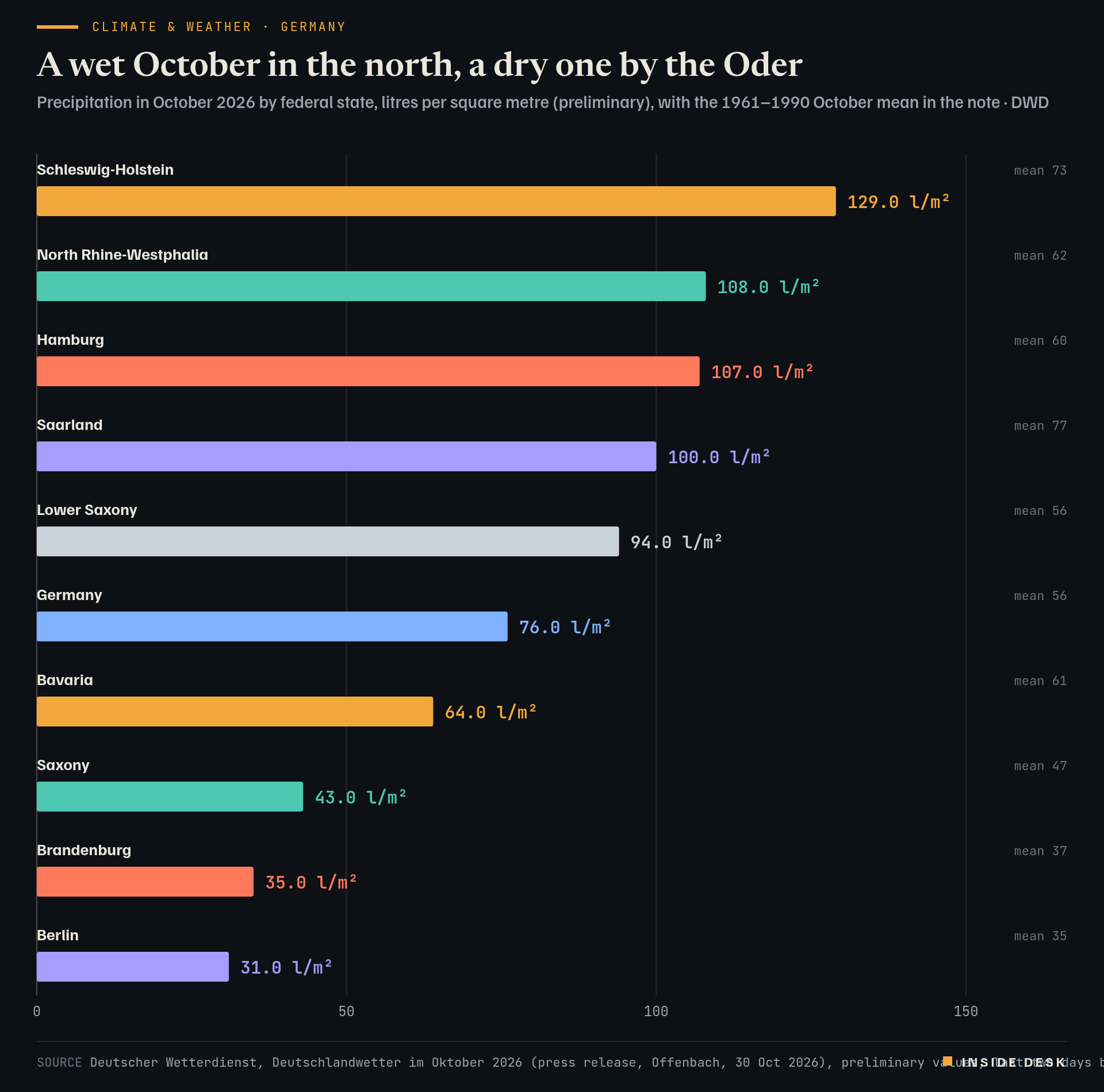
The map. The rain fell by postcode, not by nation. The north and west sometimes got three times as much as the east1. Schleswig-Holstein was by far the wettest state, at 129 litres against a mean of 73; Hamburg got almost 80% more than usual1. Berlin got about 31 litres, the least of any state, and parts of the Polish border area under 201. Brandenburg, for the second October running, was among the driest regions1.
Bar chart of October 2026 precipitation in selected German federal states, in litres per square metre, preliminary DWD values. Schleswig-Holstein had 129 against a 1961–1990 mean of 73, North Rhine-Westphalia 108 against 62, Hamburg 107 against 60, Saarland 100 against 77, Lower Saxony 94 against 56. Germany as a whole had about 76 against 56. Bavaria had 64 against 61, Saxony 43 against 47, Brandenburg 35 against 37, and Berlin, the last bar, 31 against a mean of 35.
Source Deutscher Wetterdienst, Deutschlandwetter im Oktober 2026 (press release, Offenbach, 30 Oct 2026), preliminary values, last two days based on forecasts; retrieved 1 Nov 2026. Figures as reported by the named organisations; facts cited with attribution.
Data (CSV) · SVG · PNG

Latest values as a table
| Value | |
|---|---|
| Schleswig-Holstein | 129 l/m² |
| North Rhine-Westphalia | 108 l/m² |
| Hamburg | 107 l/m² |
| Saarland | 100 l/m² |
| Lower Saxony | 94 l/m² |
| Germany | 76 l/m² |
| Bavaria | 64 l/m² |
| Saxony | 43 l/m² |
| Brandenburg | 35 l/m² |
| Berlin | 31 l/m² |
The warmth. The month averaged 10.6 °C, 1.6 degrees above the 1961–1990 mean and 1.2 degrees above 1991–20201. It opened with 27.5 °C at Mehringen in Saxony-Anhalt on the 1st and touched −3.1 °C at Dippoldiswalde-Reinberg in Saxony on the 20th1. In North Rhine-Westphalia, every month this year has been warmer than the reference period so far1. The sun shone about 122 hours, 12–13% more than usual: the eighth sunnier-than-average month in a row1.
What to do with it. If you garden, farm or simply water a tree on your street, the regional line matters more than the national one: a wet October in Kiel tells a vegetable grower near Frankfurt (Oder) nothing. The DWD publishes a soil-moisture viewer for exactly this purpose1. The figures are preliminary; the last two days of the month were filled in from forecasts, and the service says so in plain words1. That candour is the most reassuring line in the release. A weather service that marks its own estimates is one you can plan with.
What to watch
One good month is a deposit, not a repayment. The soil keeps its own ledger.
Sources
- Deutschlandwetter im Oktober 2026 — Deutscher Wetterdienst (DWD), 30 Oct 2026.
Every figure in this piece traces to a source above or to the desk’s own arithmetic on those sources, marked as such. Quotations are short and attributed. Spot an error? Write to the desk; corrections are logged on the method page.
Commentary for information only. Not investment, legal, tax, medical or political advice. Not an offer or solicitation. Analysis may be incomplete or wrong. Charts show published public data, not a trading feed; binding numbers live with the institutions that publish them.