Sunday long-read · Sunday, 25 October 2026
The Sunday long read: the second Saturday was counted, not shouted
France marched again. Fewer people came, fewer marches were held, more than twice as many were arrested and the public buildings stood. The story is in the count, and the count is an institution.
Every large protest produces two numbers before it produces an argument. One comes from the Interior Ministry, the other from the unions, and the distance between them is where the evening’s television lives. On Saturday the two were 410,000 and 800,0001. Last Saturday they were 550,000 and 800,0001. The interesting fact of the week is not either number. It is that both sides kept counting, the same way, a week apart, so that you can compare them.
What the ministry counted. By its own figures, 410,000 people marched across France on 24 October in 289 actions, against 550,000 in 430 actions on 17 October1,2. In Paris the prefecture counted 110,000; the CGT said 250,0001,2. In Marseille, where a march went ahead “à titre dérogatoire”, by exception, the prefecture counted 17,000 and the CGT 100,0002. In Rennes, 11,500 people gathered despite a ban2. In Orléans, where the Rassemblement national was holding its congress, 13,500 people marched against the party and the minister reported no incidents1.
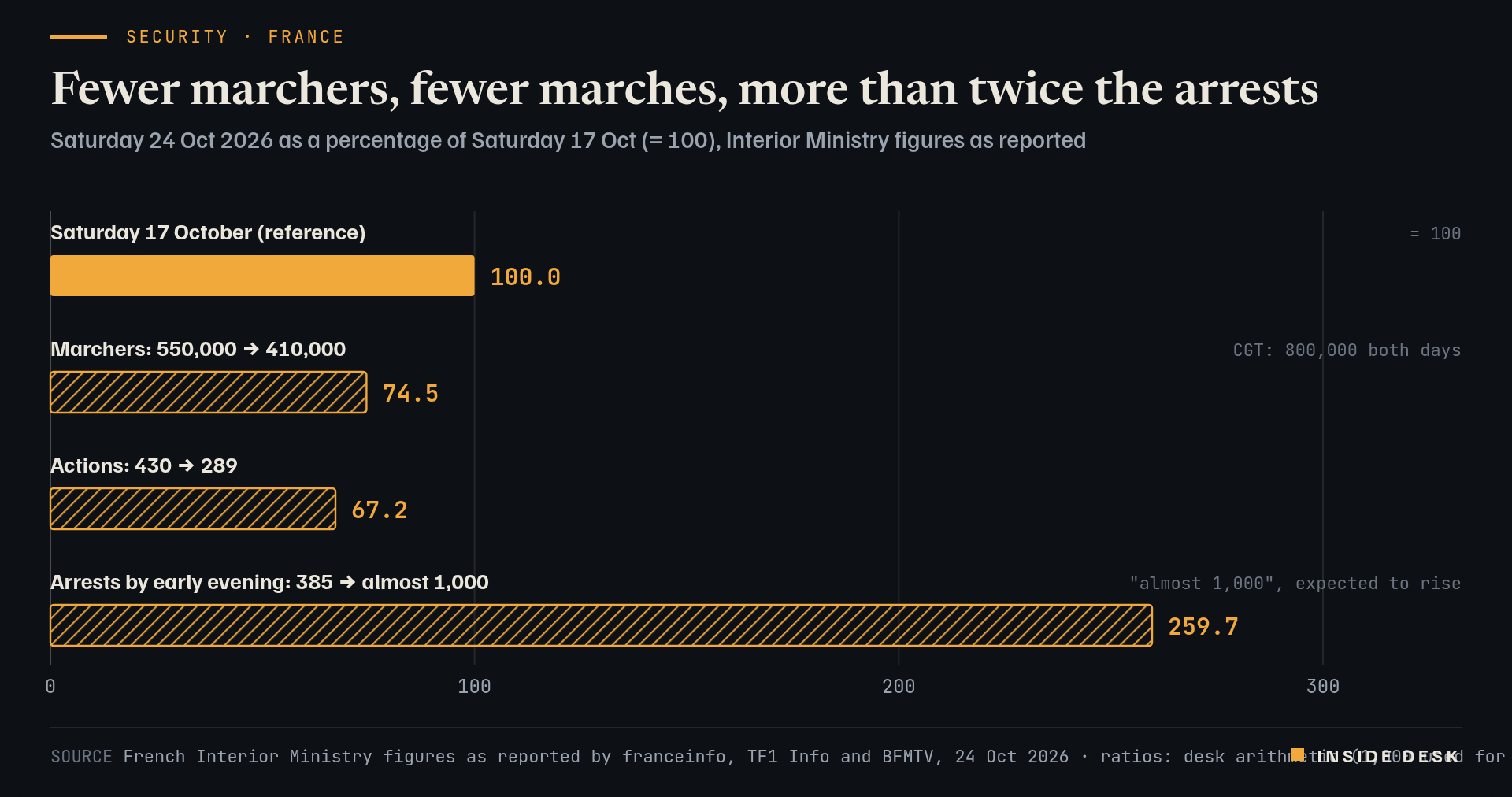
Bar chart comparing France's second Saturday of cost-of-living protests, 24 October 2026, with the first, 17 October, set at 100, using Interior Ministry figures as reported by franceinfo, TF1 Info and BFMTV. Marchers fell from 550,000 to 410,000, or 74.5. Actions fell from 430 to 289, or 67.2. Arrests by early evening rose from 385 to almost 1,000, or about 260, a figure the minister said would rise. The CGT union counted 800,000 marchers on both days.
Source French Interior Ministry figures as reported by franceinfo, TF1 Info and BFMTV, 24 Oct 2026 · ratios: desk arithmetic (1,000 used for "almost 1,000"). Figures as reported by the named organisations; facts cited with attribution.
Data (CSV) · SVG · PNG

Latest values as a table
| Value | |
|---|---|
| Saturday 17 October (reference) | 100 |
| Marchers: 550,000 → 410,000 (Inside Desk arithmetic) | 74.5 |
| Actions: 430 → 289 (Inside Desk arithmetic) | 67.2 |
| Arrests by early evening: 385 → almost 1,000 (Inside Desk arithmetic) | 259.7 |
What changed. The number of arrests. By early Saturday evening the minister, Laurent Nuñez, reported “almost 1,000” arrests, and said the figure would rise “significantly” once consolidated1,3. At the same hour on 17 October the count had been 3851,3. Desk arithmetic: fewer marchers, about three quarters of last week’s, and fewer actions, about two thirds, met more than two and a half times as many arrests by the same hour. The chart above sets the three ratios side by side.
The arrests were not, mostly, made in the marches. The minister pointed to checks carried out beforehand at stations, on roads and around city centres, many on prosecutors’ requisitions, which led to seizures of objects that could be used as weapons1. That is the design announced on Friday: 70,000 police and gendarmes, 10,000 more than on 17 October; elite units guarding public buildings rather than policing marches; routes away from shopping districts preferred; prefects free to ban marches where safety could not be guaranteed4.
What it cost. Not nothing. Clashes broke out at the end of the marches in Paris, Lyon, Marseille, Rennes, Bordeaux and Toulouse2. In Paris the prefecture said more than 500 “casseurs” confronted police on the cours de Vincennes, for at least two hours by the minister’s account2. Two people were seriously injured, in Toulouse and Clermont-Ferrand, and 22 were hurt in Lyon, 18 of them police officers5. In Marseille three shops were looted or damaged2. The minister spoke of an “extremely high level of violence”2. Those are real injuries and real shop windows, and they deserve inquiries, not adjectives.
But compare the week before. On 17 October the evening was looting and the morning was a list of damaged towns. On Saturday the minister’s summary was a sentence a ministry rarely gets to say: “Les cortèges se sont bien passés”, the marches went well, and the public buildings stood2,3. The CGT’s leader, Sophie Binet, called it “a massive and peaceful mobilisation despite provocations”2. The minister and the union disagreed, as usual, on the number. They agreed, unusually, on the character of the march itself.
The Friday in between. The week was not calm. On Friday morning a gunman opened fire from a car in Trappes and La Verrière, west of Paris, killing one person and wounding others, among them a 12-year-old girl6. A 39-year-old suspect was arrested the same day, and the national anti-terrorism prosecutor opened an investigation6. This desk still waits for the prosecutor on motive. What matters here is sequence: an attack in the morning, an arrest the same day, and the next day’s marches held. A state under strain that keeps doing its paperwork in the right order is a state that works.
The contrarian half. The loudest reading of the week was that France is coming apart. The counts say something duller and more hopeful. Whichever count you prefer, hundreds of thousands of people walked through their cities to complain about prices and public services, and the overwhelming majority walked home. The violence moved from the middle of the day to the end of it, and the police met it earlier, at stations and on approach roads, under prosecutors’ warrants.
It is not a victory. The measure of the policing will be how many of those arrests hold up before a judge, and whether the two serious injuries are explained. The right to march is only protected if the people who police it are accountable for how they do it.
What this means for you. When the next protest weekend comes, wait for the second number: the same figure, from the same counter, a week later. The change in a series tells you more than the size of a headline.
The constructive reading. A government asked to choose between order and the right to protest chose to publish its plan the day before, count its arrests in public and compare them with last week’s. Unions counted their own marchers and said so. A prosecutor took the attack, so that nobody else had to guess. None of that is heroic. It is the dull machinery that lets a country argue about the price of diesel without burning down the shop that sells it.
What to watch
- The consolidated arrest figure. The minister said Saturday's evening count of almost 1,000 would rise "significantly"; the final number, and how many arrests end in charges, is the honest measure of the day.
- Whether the unions call a third Saturday, and whether prefects again ban marches or license routes away from shopping streets.
- The anti-terrorism prosecutor's next statement on Friday's shooting in Trappes and La Verrière. Motive is a finding, not a guess.
- Two serious injuries, in Toulouse and Clermont-Ferrand: what the inquiries into them conclude.
A protest is a right, a riot is a crime, and the line between them is drawn by people who count. Count first, speak second.
Sources
- Mobilisation en baisse, près de 1 000 interpellations, deux blessés graves… Ce qu'il faut retenir de cette nouvelle journée de manifestation contre la vie chère — franceinfo, 24 Oct 2026.
- Mobilisation suivie et défilés dans le calme, heurts en fin de cortèges... Le point sur les manifestations du 24 octobre — TF1 Info, 24 Oct 2026, updated 22:34.
- Cortège calme, 1.000 interpellations, bâtiments publics intacts: Laurent Nuñez tire son bilan des manifestations du 24 octobre — BFMTV, 24 Oct 2026.
- Blindés, unités d'élite, 70 000 policiers et gendarmes… Laurent Nuñez détaille l'important dispositif de sécurité mobilisé pour les manifestations du 24 octobre — franceinfo, 23 Oct 2026, 15:43.
- EN DIRECT Mobilisation du 24 octobre : près de 1 000 interpellations, plusieurs blessés graves… Les dernières infos au lendemain des manifestations — Midi Libre, 25 Oct 2026.
- Un mort et plusieurs blessés graves, un suspect arrêté, "un crime terroriste"... Ce que l'on sait de l'attaque à l'arme à feu à Trappes et La Verrière — franceinfo, 23 Oct 2026, updated 16:09.
Every figure in this piece traces to a source above or to the desk’s own arithmetic on those sources, marked as such. Quotations are short and attributed. Spot an error? Write to the desk; corrections are logged on the method page.
Commentary for information only. Not investment, legal, tax, medical or political advice. Not an offer or solicitation. Analysis may be incomplete or wrong. Charts show published public data, not a trading feed; binding numbers live with the institutions that publish them.