Sunday long-read · Sunday, 25 October 2026
Ordinary Ledger: the storm sold power at €13, the tank still cost €112
Germany's wholesale electricity price fell from €211.94 on Wednesday to €13.12 for Sunday as the wind picked up. Diesel at the pump barely moved. Two invoices, one weekend, and only one of them reaches you this month.
The Ordinary Ledger reads the week’s prices in the order a household meets them. This week two of them went in opposite directions, and only one moved fast.
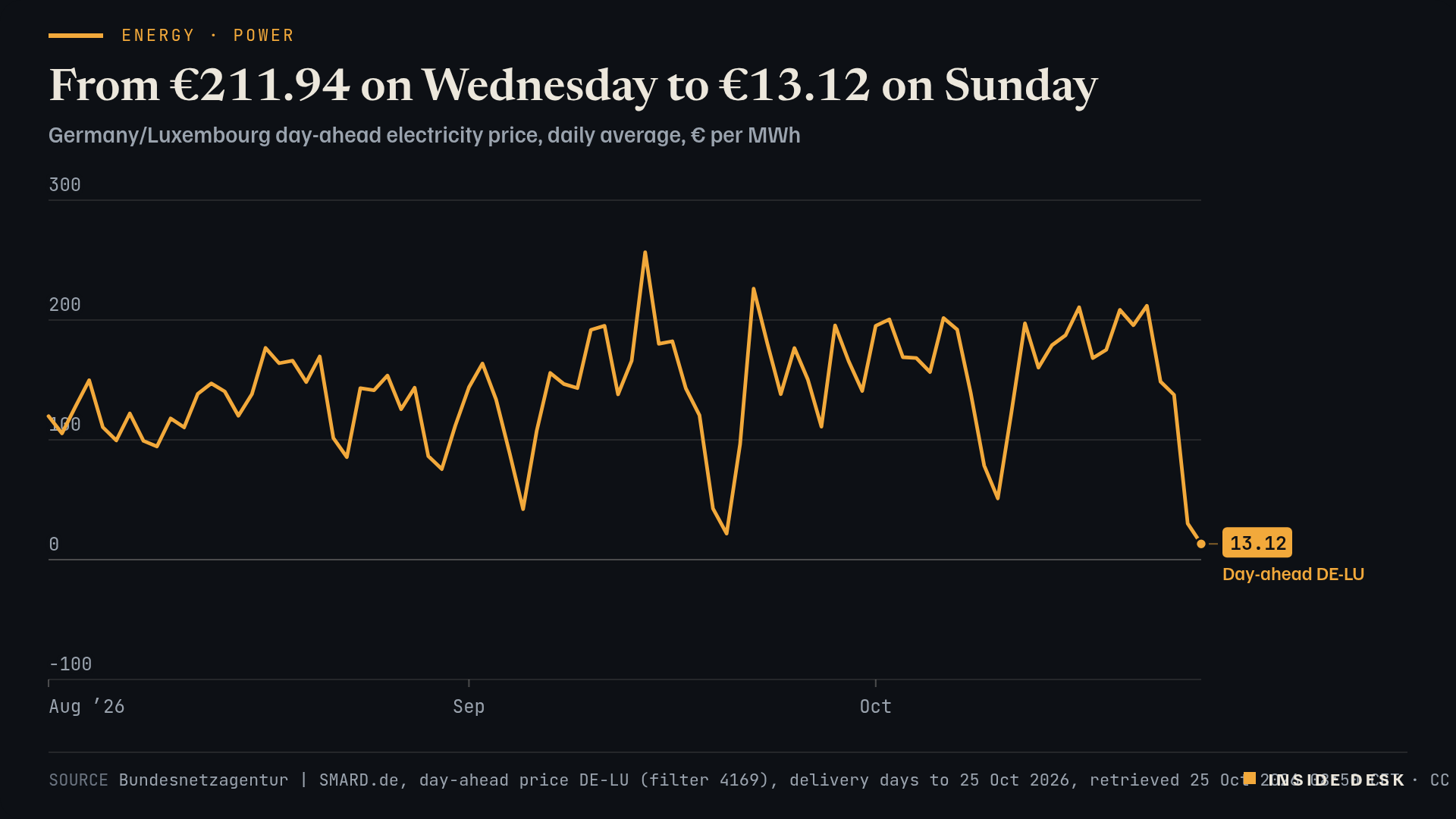
Power, wholesale. Germany’s day-ahead electricity auction cleared at a daily average of €211.94 per megawatt hour for Wednesday, then €148.61 for Thursday, €137.59 for Friday, €30.12 for Saturday and €13.12 for Sunday1. Desk arithmetic: Sunday’s power costs about one sixteenth of Wednesday’s.
Line chart of the daily average German-Luxembourg day-ahead electricity price from 1 August to 25 October 2026, in euros per megawatt hour. September averaged €144.82. In the week to Wednesday 21 October the price stayed around €175 to €212, reaching €211.94 on Wednesday. It then fell for four days in a row: €148.61 on Thursday, €137.59 on Friday, €30.12 on Saturday 24 October and €13.12 for delivery on Sunday 25 October, the last point. Over 1 to 25 October the average is €155.92, against €89.11 over the same days of 2025.
Source Bundesnetzagentur | SMARD.de, day-ahead price DE-LU (filter 4169), delivery days to 25 Oct 2026, retrieved 25 Oct 2026 08:50 CET · CC BY 4.0. Bundesnetzagentur | SMARD.de, market data. CC BY 4.0.
Data (CSV) · SVG · PNG

Latest values as a table
| Date | Day-ahead DE-LU |
|---|---|
| 2026-10-20 | 195.66 |
| 2026-10-21 | 211.94 |
| 2026-10-22 | 148.61 |
| 2026-10-23 | 137.59 |
| 2026-10-24 | 30.12 |
| 2026-10-25 | 13.12 |
Why. The weather, not a minister. Onshore wind turbines generated 242,281 megawatt hours on Wednesday and 1,009,174 on Saturday; gas-fired plants fell from 241,432 to 42,4562. Desk arithmetic: wind about four times higher, gas down to about a sixth. When the wind supplies most of the demand, the expensive gas plant no longer sets the price, and the auction clears low.
Why you will not see it this month. One windy weekend is not a cheap month. Over 1 to 25 October the day-ahead price averaged €155.92, against €89.11 over the same days of 20251. Desk arithmetic: about three quarters higher. Most households pay a tariff their supplier bought months ahead. The wholesale line is next year’s weather report, not this month’s bill.
Fuel, at the pump. ADAC’s weekly reading on Wednesday put Super E10 at €2.110 a litre, down 4.1 cents on the week, and diesel at €2.255, up 0.8 cents3. ADAC said most of the tax cut now appears to be reaching petrol pumps3. Desk arithmetic: a 50-litre diesel tank cost about €112.75, a 50-litre E10 tank about €105.50. Brent rose 6% after that reading was taken, so the next one may not be as kind.
Heating oil. On Friday afternoon the German average stood at €174.25 per 100 litres, €4.96 more than a week earlier and €40.21 more than three months earlier4. No wind farm helps a tank in the cellar.
The ledger, totalled. Down sharply: wholesale power, for a weekend. Down a little: petrol. Up a little: diesel. Up steadily: heating oil. The fast-moving price was the one you mostly do not pay directly; the ones you do pay moved slowly, and mostly up.
The constructive reading. Every number here was free and public by Sunday morning: an auction result and a generation count from the regulator’s own platform, a weekly pump average, a daily heating-oil price. You can see your winter coming in more detail than any household could a generation ago. Nothing here is advice.
What to watch
- ADAC's next weekly pump reading on Wednesday, after Brent's 6% weekly rise. Pumps follow crude with a lag.
- Whether the windy weekend shows up in the October average day-ahead price, which runs at €155.92 so far against €89.11 a year ago.
- The fuel-price cap ADAC says starts on 1 January 2027, and what replaces the tax cut that ends in December.
The wind cut one price you mostly don't pay yet. The war raised one you pay every week. Keep the two in separate columns.
Sources
- Day-ahead price DE-LU, daily (filter 4169) — Bundesnetzagentur | SMARD.de, retrieved 25 Oct 2026, 08:50 CET.
- Realised generation, wind onshore (filter 4067) and natural gas (filter 4071), Germany, daily — Bundesnetzagentur | SMARD.de, retrieved 25 Oct 2026, 08:52 CET.
- Tanken in Deutschland: Benzinpreis sinkt, Dieselpreis steigt leicht — ADAC, 21 Oct 2026.
- Heizölpreise aktuell für Deutschland — HeizOel24, 23 Oct 2026, 16:26.
Every figure in this piece traces to a source above or to the desk’s own arithmetic on those sources, marked as such. Quotations are short and attributed. Spot an error? Write to the desk; corrections are logged on the method page.
Commentary for information only. Not investment, legal, tax, medical or political advice. Not an offer or solicitation. Analysis may be incomplete or wrong. Charts show published public data, not a trading feed; binding numbers live with the institutions that publish them.