Evening edition · Friday, 16 October 2026
The committee is behind the print, on purpose
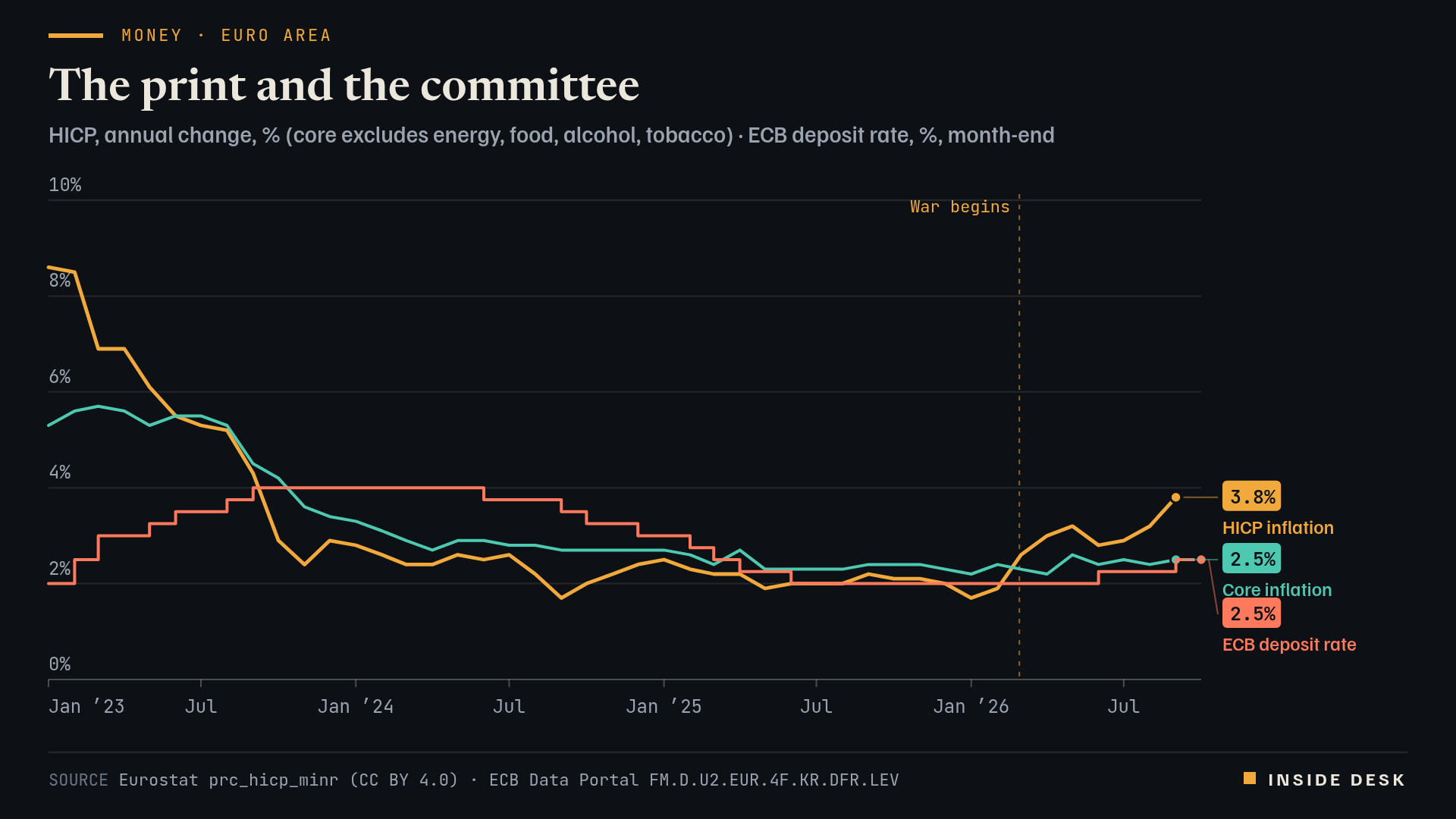
Euro-area inflation is 3.8%. The deposit rate is 2.5%. That gap is not negligence. It is a bet that wages stay calm.
Eurostat confirmed this morning that euro-area inflation was 3.8% in September, up from 3.2% in August1. Energy prices were 18.9% higher than a year earlier. Strip out energy, food, alcohol and tobacco and the rate was 2.5%; services ran at 3.2%1.
The ECB’s deposit rate is 2.50%, after increases that took effect in June and September2. Against headline inflation, that is a real rate of about minus 1.3 points. If you think the committee is asleep, read what it says it is doing.
Line chart since January 2023 of euro-area HICP inflation, core inflation and the ECB deposit rate. Inflation falls from 8.6% to around 2% by 2025, then rises after the energy shock to 3.8% in September 2026; core is 2.5%. The deposit rate rises to 4% in 2023, steps down from 2024 to 2% in mid-2025 and back up to 2.5% by September 2026.
Source Eurostat prc_hicp_minr (CC BY 4.0) · ECB Data Portal FM.D.U2.EUR.4F.KR.DFR.LEV. Eurostat. Reuse authorised under CC BY 4.0 (Commission Decision 2011/833/EU). European Central Bank Data Portal. Reuse permitted with source acknowledgement.
Data (CSV) · SVG · PNG

Latest values as a table
| Date | HICP inflation | Core inflation | ECB deposit rate |
|---|---|---|---|
| 2026-05-01 | 3.2 | 2.6 | 2 |
| 2026-06-01 | 2.8 | 2.4 | 2.25 |
| 2026-07-01 | 2.9 | 2.5 | 2.25 |
| 2026-08-01 | 3.2 | 2.4 | 2.25 |
| 2026-09-01 | 3.8 | 2.5 | 2.5 |
| 2026-10-01 | – | – | 2.5 |
“We do not react to energy prices, we react if we see risks of higher energy prices becoming embedded in inflation,” Christine Lagarde told the European Parliament’s economic committee on 28 September3. Her evidence that it is not yet embedded: compensation per employee grew 3.3% in the second quarter, down from 3.6% in the first, and most measures of longer-term inflation expectations stand at around 2%3. And a quieter argument: long-term interest rates “have risen notably”, which she said will slow growth and reduce pass-through by more than the September projections assumed3. The bond market is doing some of the committee’s work for it.
That is a coherent position, and also a bet. It holds as long as two dull prints stay dull: wages and core. Core edged up from 2.4% to 2.5% in September1. Not a break; a lean. The next decision is on 29 October4. The desk will be reading the wage line before the press conference, not after.
What to watch
- The Governing Council decision and press conference on 29 October4.
- Wage data before the press conference, not after: the ECB's own test is whether energy reaches pay.
- Core inflation. A move from 2.5% is a lean; a run of them is a break.
A committee that waits is not a committee that sleeps. Read the wage line.
Sources
- HICP – monthly data, annual rate of change (prc_hicp_minr), September 2026 final — Eurostat, released 16 Oct 2026.
- Deposit facility rate (FM.D.U2.EUR.4F.KR.DFR.LEV) — ECB Data Portal, as of 16 Oct 2026.
- Hearing of the Committee on Economic and Monetary Affairs of the European Parliament (speech by Christine Lagarde) — European Central Bank, 28 Sep 2026.
- Meetings of the Governing Council and the General Council — European Central Bank, accessed 16 Oct 2026.
Every figure in this piece traces to a source above or to the desk’s own arithmetic on those sources, marked as such. Quotations are short and attributed. Spot an error? Write to the desk; corrections are logged on the method page.
Commentary for information only. Not investment, legal, tax, medical or political advice. Not an offer or solicitation. Analysis may be incomplete or wrong. Charts show published public data, not a trading feed; binding numbers live with the institutions that publish them.