Evening edition · Friday, 16 October 2026
The barrel and the screen
The futures screen says the oil shock is cooling. The cargo market says it is still here. Only one of them has to be delivered by Tuesday.
There are two oil prices this week, and they are not having the same week.
The first lives on the screen. Brent futures for December delivery settled on Thursday at $105.92 a barrel, fourteen cents lower on the day, and were trading at $105.14 late on Friday morning, European time4,3. That is the number on the evening news, the one that moves in cents and gets a verb: eased, edged, steadied.
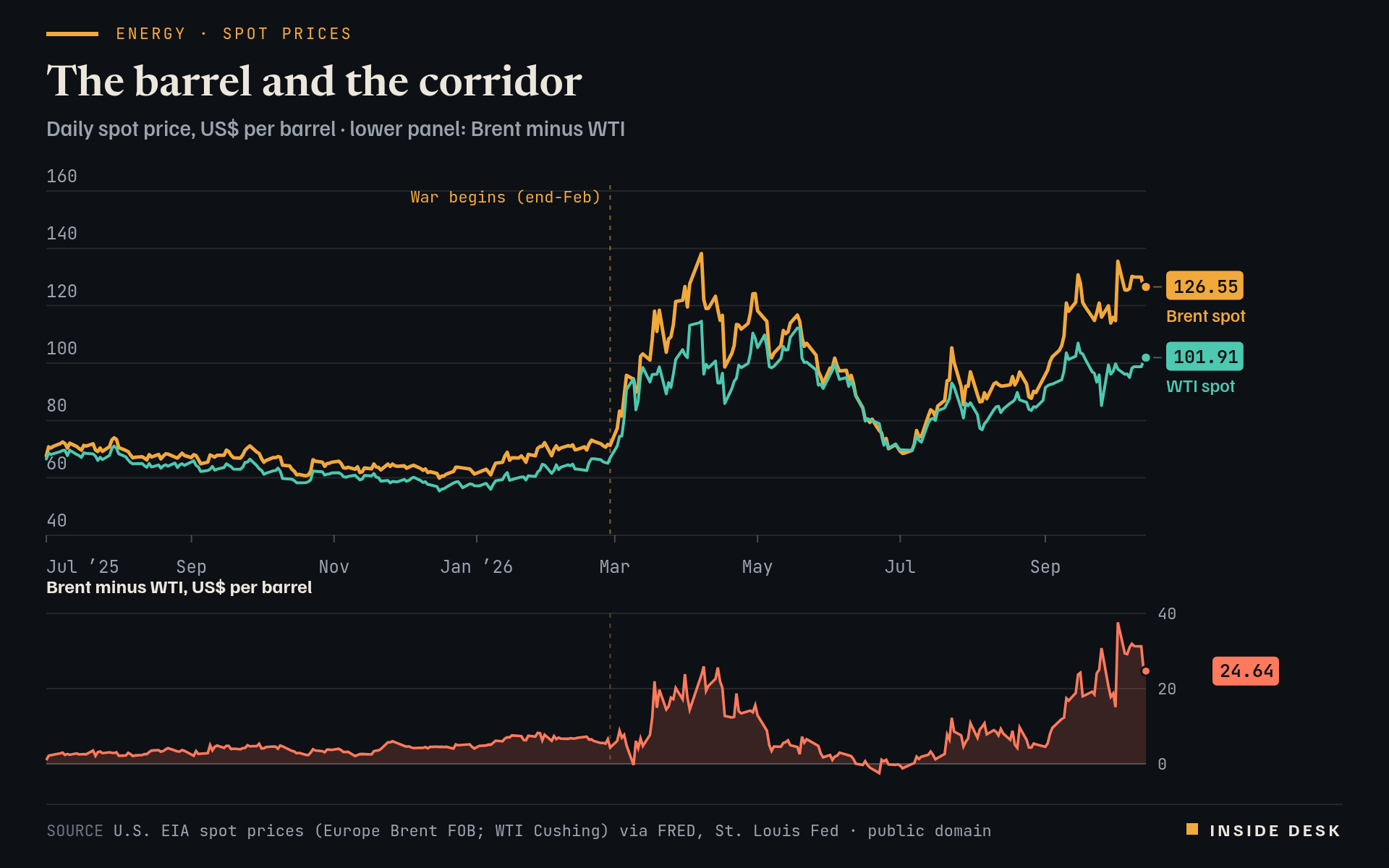
The second lives in the tank. The U.S. Energy Information Administration’s Europe Brent spot price, a physical barrel loaded at the North Sea, was $126.55 on Wednesday, the latest day published1. Different instruments, a day apart, so do not subtract them to the cent. But a gap of roughly twenty dollars between the barrel you can load now and the barrel you can load in December is not a rounding error. It is the market telling you, in cash, what the present costs compared with the future it hopes for.
Line chart of daily Brent and WTI spot prices since July 2025. Both trade between roughly $55 and $74 until the end of February 2026, then jump; Brent spot peaks at $138.21 on 7 April and is $126.55 on 14 October, while WTI is $101.91. The lower panel shows the Brent–WTI gap widening from about $4 before the war to $24.64.
Source U.S. EIA spot prices (Europe Brent FOB; WTI Cushing) via FRED, St. Louis Fed · public domain. EIA spot prices via FRED, Federal Reserve Bank of St. Louis. U.S. government data, public domain.
Data (CSV) · SVG · PNG

Latest values as a table
| Date | Brent spot | WTI spot | Brent minus WTI, US$ per barrel |
|---|---|---|---|
| 2026-10-07 | 126 | 95.02 | 30.98 |
| 2026-10-08 | 130.18 | 98.26 | 31.92 |
| 2026-10-09 | 130.03 | 98.73 | 31.3 |
| 2026-10-12 | 129.95 | 98.73 | 31.22 |
| 2026-10-13 | 125.78 | 100.86 | 24.92 |
| 2026-10-14 | 126.55 | 101.91 | 24.64 |
What the gap is made of. The present is expensive because the corridor is narrow. About 12.6 million barrels a day moved through the Strait of Hormuz on 13 October, according to Kpler data cited by BBC Verify, down from about 15 million at the end of September and against a pre-war baseline of roughly 17 million5. Attack reports to the UK’s maritime trade agency hit a weekly record of twelve between 5 and 11 October5. A December contract can price a negotiated reopening. A refinery that needs crude next week cannot run on a negotiation.
Why WTI is the tell. On the same Wednesday, EIA’s WTI spot, the American inland barrel at Cushing, was $101.91: $24.64 below Brent spot1,2. From July 2025 to the last trading day of February that gap averaged $4.29, on the desk’s arithmetic from the same EIA series; it peaked at $37.62 on 2 October. This is geography arriving as a price. A barrel in Oklahoma is a long way from a minefield. A barrel priced off the North Sea competes for the same European and Asian buyers who lost Gulf supply. This week WTI futures rose 5.6% while Brent rose 0.4%, helped by a large U.S. crude stock draw after hurricane-related production shut-ins3. The American barrel has its own weather.
Who pays the screen, and who pays the tank. Funds and hedgers trade the screen. Refiners, airlines, hauliers and anyone heating a house with oil pay something closer to the tank, with a lag. That is why the morning headline can say “oil eases” while your diesel invoice does not. European diesel refining margins fell almost 2% on Friday, to $78.67 a barrel, after the International Energy Agency agreed to release more diesel. In September they were as high as $953. Lower is not low.
The constructive read, and it is allowed. The screen is not lying; it is forecasting. A much cheaper December says the market expects the corridor to widen, through escorts, deals or plain adaptation. Brent spot has already come down from its 2026 peak of $138.21 on 7 April1. Emergency stocks are being released, and the IEA says total releases will exceed the 400 million barrels pledged in March6. The honest position is to hold both prices in your head at once: the future is priced as calmer, the present is not, and you live in the present first.
What the desk will not do is pretend the screen is the barrel. When the two prices converge it will be because tankers are moving, or because demand has been destroyed. Those are very different Tuesdays. The spot assessment, not the headline verb, will tell you which one arrived.
What to watch
- Hormuz flows against the roughly 17 million barrels a day of the pre-war baseline. The corridor, not the podium.
- EIA's next spot release (FRED lists 21 October): does Brent spot close the gap to futures from above or from below?
- European diesel margins after the IEA diesel release. Relief at the pump lags relief on the screen.
- The Brent–WTI spread. It narrows when geography stops being the price.
The screen is the forecast. The tank is the invoice. Pay the invoice first.
Sources
- Crude Oil Prices: Brent – Europe (DCOILBRENTEU), EIA spot price — U.S. EIA via FRED, St. Louis Fed, observation 14 Oct 2026.
- Crude Oil Prices: West Texas Intermediate – Cushing (DCOILWTICO) — U.S. EIA via FRED, St. Louis Fed, observation 14 Oct 2026.
- Oil eases but heads for small weekly gain as investors focus on Middle East supply — Reuters, via CNBC, 16 Oct 2026.
- Brent steady as US weighs easing shadow fleet sanctions — Reuters, via The Star, 16 Oct 2026.
- Ship attack reports near Hormuz reach record high as oil exports slow — BBC Verify, 16 Oct 2026.
- IEA Governing Board statement on energy markets and security — International Energy Agency, 15 Oct 2026.
Every figure in this piece traces to a source above or to the desk’s own arithmetic on those sources, marked as such. Quotations are short and attributed. Spot an error? Write to the desk; corrections are logged on the method page.
Commentary for information only. Not investment, legal, tax, medical or political advice. Not an offer or solicitation. Analysis may be incomplete or wrong. Charts show published public data, not a trading feed; binding numbers live with the institutions that publish them.