Evening edition · Friday, 16 October 2026
Podium vs Print: a 100-million-barrel answer to a 4.4-million-barrel-a-day question
The IEA's statement is accurate. The arithmetic is simply less comforting than the adjectives.
“Agreed to accelerate the release of the remaining volumes, with specific plans already in place, including over 20 million barrels of diesel as soon as possible.”
IEA Governing Board, 15 October 2026
12.6 mb/d
through the Strait of Hormuz, against a pre-war baseline of about 17 mb/d.
Kpler data, cited by BBC Verify, 13 October 2026
The podium, in its own words. On Thursday the IEA’s Governing Board said about 330 million barrels had been released under the March collective action, that roughly 100 million barrels remain, and that total releases will exceed the original 400 million because some members have given more than they pledged1. It promised over 20 million barrels of diesel “as soon as possible”1. Nothing in that statement is false.
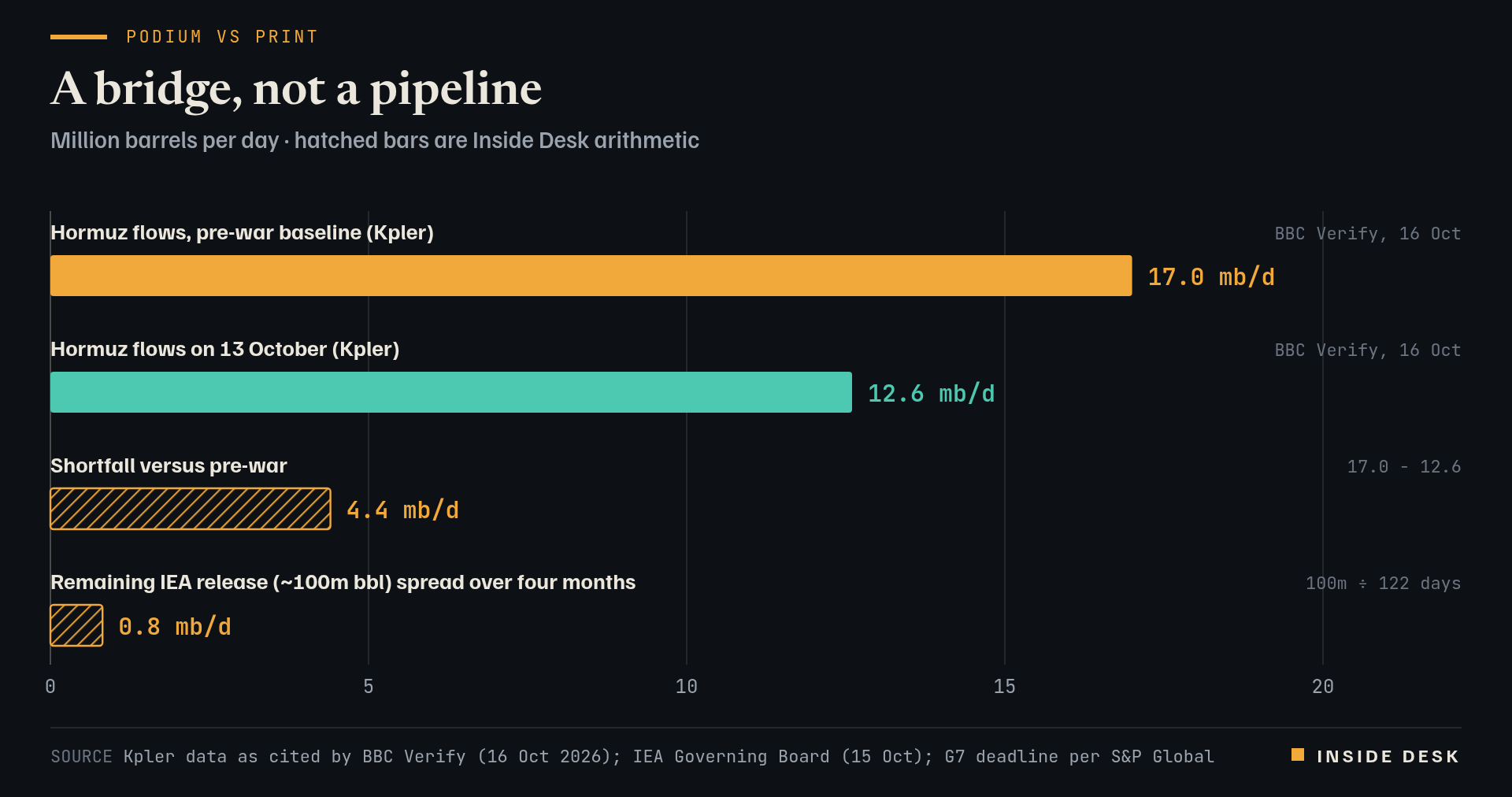
The print. Kpler data cited by BBC Verify put Hormuz flows at about 12.6 million barrels a day on 13 October, against a pre-war baseline of roughly 17 million2. That is a hole of about 4.4 million barrels, every day.
Bar chart in million barrels per day: pre-war Hormuz flows about 17.0, flows on 13 October 12.6, a shortfall of 4.4, and the remaining IEA emergency release of about 100 million barrels equal to roughly 0.8 per day if spread over four months — under a fifth of the gap.
Source Kpler data as cited by BBC Verify (16 Oct 2026); IEA Governing Board (15 Oct); G7 deadline per S&P Global. Figures as reported by the named organisations; facts cited with attribution.
Data (CSV) · SVG · PNG

Latest values as a table
| Value | |
|---|---|
| Hormuz flows, pre-war baseline (Kpler) | 17 mb/d |
| Hormuz flows on 13 October (Kpler) | 12.6 mb/d |
| Shortfall versus pre-war (Inside Desk arithmetic) | 4.4 mb/d |
| Remaining IEA release (~100m bbl) spread over four months (Inside Desk arithmetic) | 0.82 mb/d |
Same units, please. G7 leaders set a four-month deadline on 2 October for releasing the outstanding 100 million barrels, according to S&P Global’s Platts3. Spread over four months, about 122 days, that is roughly 0.8 million barrels a day: under a fifth of today’s gap. Released faster, it helps more for less long. Either way it is a bridge, not a pipeline.
The cushion is real. On 7 October the IEA said member governments still hold around 1.1 billion barrels of public emergency stocks, including over 200 million barrels of diesel4. Divide that by today’s gap and you get about eight months, on the desk’s arithmetic, before subtracting the barrels no government would ever leave itself without. Months, not weeks. That is the constructive half of the story, and it is true.
Verdict. The podium is accurate and insufficient, which is the normal condition of podiums. Releases buy time for the corridor to reopen; they do not reopen it. The market noticed, politely: European diesel margins slipped almost 2% on Friday, and one analyst quoted by Reuters said the release is unlikely to ease diesel tightness5.
What to watch
- The IEA's updated oil market assessment 'focusing on diesel', which it says it will report to G7 leaders.
- National release schedules: Spain, for one, said it would release 4.4 million barrels in October6.
- Daily Hormuz flows. Releases matter less the faster the corridor reopens.
A bridge is a fine thing to build. Just do not call it the far bank.
Sources
- IEA Governing Board statement on energy markets and security — International Energy Agency, 15 Oct 2026.
- Ship attack reports near Hormuz reach record high as oil exports slow — BBC Verify, 16 Oct 2026.
- IEA accelerates oil stock release, plans over 20 mil barrels of diesel — S&P Global Commodity Insights (Platts), 15 Oct 2026.
- Statement by IEA Executive Director on meeting of IEA Member governments on 7 October 2026 — International Energy Agency, 7 Oct 2026.
- Oil eases but heads for small weekly gain as investors focus on Middle East supply — Reuters, via CNBC, 16 Oct 2026.
- IEA to speed up oil stocks release including over 20 million barrels of diesel — Reuters, via MarketScreener, 15 Oct 2026.
Every figure in this piece traces to a source above or to the desk’s own arithmetic on those sources, marked as such. Quotations are short and attributed. Spot an error? Write to the desk; corrections are logged on the method page.
Commentary for information only. Not investment, legal, tax, medical or political advice. Not an offer or solicitation. Analysis may be incomplete or wrong. Charts show published public data, not a trading feed; binding numbers live with the institutions that publish them.