Morning edition · Monday, 2 November 2026
Seven in ten are stressed by the vote; eight in ten trust the count
On the eve of the US midterms, the anxiety is about the result. The machinery that produces it is trusted more than the mood suggests.
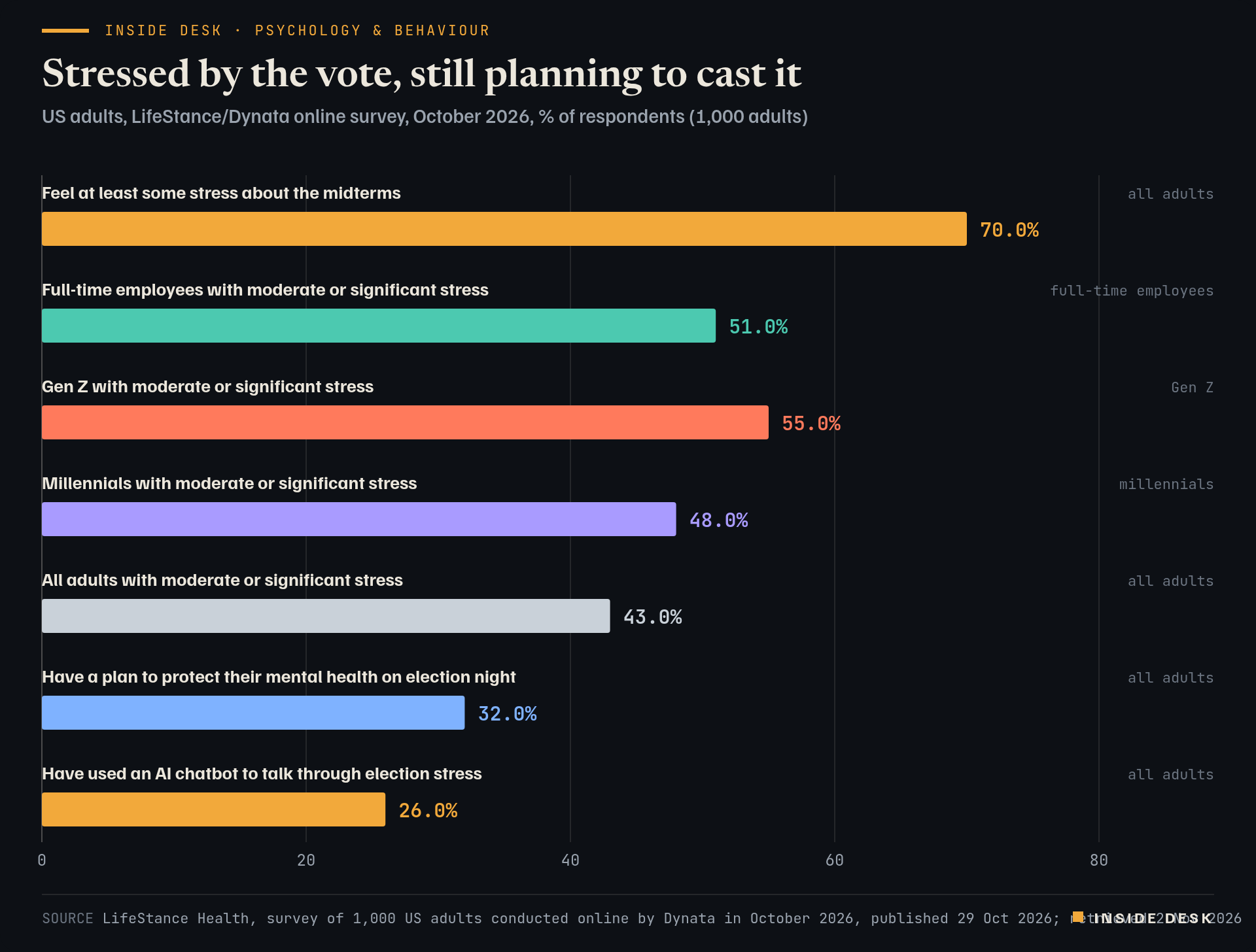
Tomorrow Americans vote in the midterm elections, and the feeling in the room is not hard to read. In a survey of 1,000 US adults conducted online by Dynata for LifeStance Health in October, 70% said they felt at least some stress or anxiety about the vote on 3 November, and 43% reported a moderate or significant amount1. That is the number that will be quoted this week. It is worth reading next to a second one.
Bar chart from a LifeStance survey of 1,000 US adults in October 2026: 70% feel at least some stress about the 3 November midterms; 55% of Gen Z, 51% of full-time employees, 48% of millennials and 43% of all adults report moderate or significant stress; 32% have a plan to protect their mental health on election night; 26% have used an AI chatbot to talk through election stress.
Source LifeStance Health, survey of 1,000 US adults conducted online by Dynata in October 2026, published 29 Oct 2026; retrieved 2 Nov 2026. Figures as reported by the named organisations; facts cited with attribution.
Data (CSV) · SVG · PNG

Latest values as a table
| Value | |
|---|---|
| Feel at least some stress about the midterms | 70% |
| Full-time employees with moderate or significant stress | 51% |
| Gen Z with moderate or significant stress | 55% |
| Millennials with moderate or significant stress | 48% |
| All adults with moderate or significant stress | 43% |
| Have a plan to protect their mental health on election night | 32% |
| Have used an AI chatbot to talk through election stress | 26% |
The mood. The stress is not evenly spread. More than half of Gen Z respondents (55%) and 48% of millennials reported moderate or significant stress1. Among full-time employees the figure was 51%, and 47% said they would probably or definitely take a mental health day after election day if they could1. Asked about the political climate in general, 42% said they felt anxious about the future and a quarter (25%) reported hopelessness or a sense of “doom”1.
Some of the coping is new. About one in four respondents (26%) said they had used an AI chatbot to talk through political or election stress, rising to 41% of Gen Z and 6% of baby boomers1. Fewer than one in three (32%) had a plan to protect their mental health on election night; another 27% said they had none but thought they should1. And the dread has a long tail: 37% said they were already dreading political conversations at family gatherings over the holidays, and 31% would rather wash all the dishes1.
A caution before going further. This is a company survey, by a mental health provider, with a stated interest in the subject1. Its numbers describe feelings honestly reported, not diagnoses. They are a thermometer, not a chart from a clinic.
The machinery. Now the second number. Pew Research Center surveyed 5,062 US adults, including 3,917 registered voters, from 28 September to 4 October2. It found that American voters “generally expect” the midterms to be run and administered well, and that this view is shared by similar majorities on both sides2. Nearly eight in ten voters (79%) were at least somewhat confident that votes cast in person would be counted as voters intend; among those backing Republican candidates it was 84%, among those backing Democrats 81%2.
The trust is not unconditional, and Pew is careful to say where it thins. Confidence that mail and absentee ballots will be counted as intended was 53% overall2. Among Democratic voters it was 64%, down from 88% in the 2022 midterms; among Republican voters it was 42%, modestly higher than before2. Roughly half of voters (52%) were confident the systems are free from hacking2. And the two sides worry about different things: 19% of Republican voters mentioned fraudulent or illegitimate votes, while Democratic voters were more likely to raise legitimate voters being denied access (10%) or interference in election administration by the Trump administration (11%)2. Pew notes its survey was taken before the Justice Department sued California on 15 October over mailed ballots2.
Still, the core holds. Two-thirds of voters were confident that people who try to intimidate voters at polling places will be stopped2. Seven in ten Democratic voters (70%) and 61% of Republican voters expected Americans to know who won within a day or two of election day2.
What the two numbers say together. Desk arithmetic: the share of adults stressed about the vote (70%)1 and the share of voters confident in the in-person count (79%)2 cannot both describe separate minorities. They come from different surveys and different samples, so they cannot be added or netted. But taken side by side, they imply that a great many Americans hold both views at once: anxious about who wins, and fairly calm about whether the win will be counted properly.
That is a healthier combination than the headlines suggest. Anxiety about outcomes is what people feel when an election matters. Distrust of the count is what they feel when the institution has failed. The surveys show plenty of the first and, for the in-person ballot at least, a minority of the second. The weak spots are specific and named: postal ballots, hacking, and a partisan split over who might be wrongly let in or kept out2. Specific worries can be answered by specific procedures, and that is the dull work of county clerks, poll workers and canvassing boards this week.
For you. If you follow the count from Europe tomorrow night, the useful habit is the one the clerks use: wait for the official tally, and separate how you feel about the result from what you know about the process. Your stress about the winner is your own business. Your confidence in the counting can rest on evidence, and the evidence, read carefully, is steadier than the mood.
What to watch
You can dread the result and still trust the people counting it; the second is the one that keeps a country standing.
Sources
- LifeStance Survey Finds 70% of Americans Are Stressed or Anxious About the 2026 U.S. Midterm Elections — LifeStance Health, 29 Oct 2026.
- Broad Public Confidence in Elections in the U.S. – but Partisans Differ Over Concerns About Access, Security — Pew Research Center, 20 Oct 2026.
Every figure in this piece traces to a source above or to the desk’s own arithmetic on those sources, marked as such. Quotations are short and attributed. Spot an error? Write to the desk; corrections are logged on the method page.
Commentary for information only. Not investment, legal, tax, medical or political advice. Not an offer or solicitation. Analysis may be incomplete or wrong. Charts show published public data, not a trading feed; binding numbers live with the institutions that publish them.