Morning edition · Thursday, 29 October 2026
Ordinary Ledger: one receipt, three different stories
On the morning the ECB meets, Germany's price index splits into lines that barely know each other: fuel up 36.8% in a year, food up 0.4%, the bill for heating and light down 1.9%.
Germany’s inflation rate is a single number, and it is a useful one. In September Eurostat’s harmonised index put it at 3.3%, up from 2.0% in February1. But nobody pays an average. You pay a fuel bill, a supermarket bill and an energy bill, and this autumn those three lines are telling three different stories. On the day the European Central Bank meets, it is worth reading them one at a time.
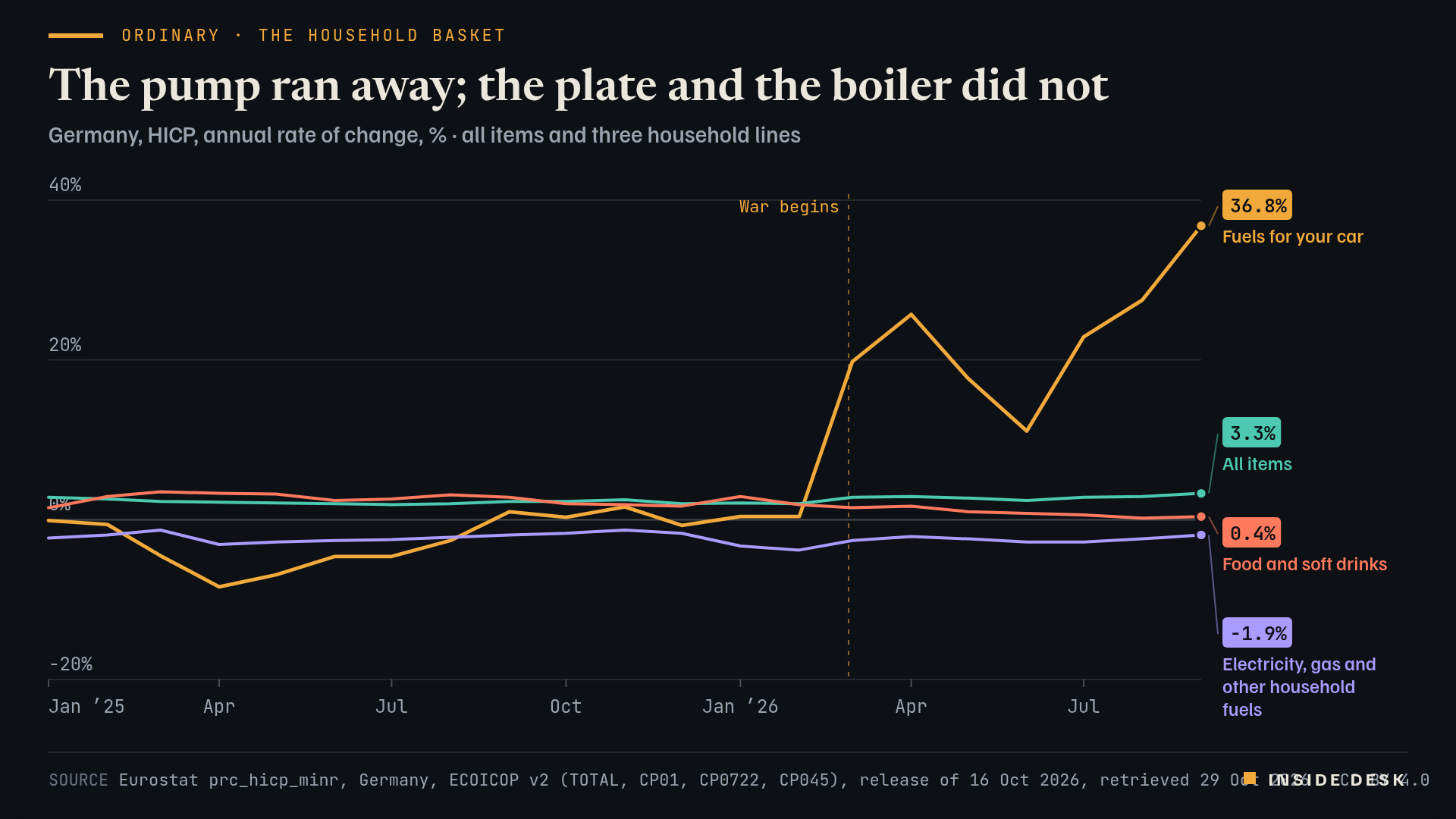
Line chart of annual price changes in Germany since January 2025, from Eurostat's harmonised index. Fuels for personal transport fall by up to 8.4% a year in April 2025, are near zero in early 2026, then jump to 19.8% in March 2026 and reach 36.8% in September 2026, the latest value. In September 2026 all items stand at 3.3%, food and non-alcoholic beverages at 0.4%, and electricity, gas and other household fuels at -1.9%, below zero throughout the period.
Source Eurostat prc_hicp_minr, Germany, ECOICOP v2 (TOTAL, CP01, CP0722, CP045), release of 16 Oct 2026, retrieved 29 Oct 2026 · CC BY 4.0. Eurostat. Reuse authorised under CC BY 4.0 (Commission Decision 2011/833/EU).
Data (CSV) · SVG · PNG

Latest values as a table
| Date | Fuels for your car | All items | Food and soft drinks | Electricity, gas and other household fuels |
|---|---|---|---|---|
| 2026-04-01 | 25.7 | 2.9 | 1.7 | -2.1 |
| 2026-05-01 | 17.7 | 2.7 | 1 | -2.4 |
| 2026-06-01 | 11.1 | 2.4 | 0.8 | -2.8 |
| 2026-07-01 | 22.9 | 2.8 | 0.6 | -2.8 |
| 2026-08-01 | 27.5 | 2.9 | 0.2 | -2.4 |
| 2026-09-01 | 36.8 | 3.3 | 0.4 | -1.9 |
The pump. Fuels for the car cost 36.8% more in September than a year earlier, the highest reading since at least the start of 20251. Before the war began in late February the same line was rising by 0.4% a year; by March it was up 19.8%1. The ADAC’s figures from Wednesday show where it stands now: a litre of Super E10 at €2.084 on the national average, diesel at €2.289, more than 20 cents apart2. The two are moving in opposite directions. E10 fell 2.6 cents in a week while diesel rose 3.4 cents, with Brent at about $114 a barrel2. The automobile club blames tight international diesel markets and the seasonal demand for heating oil, and reads the petrol move as a sign that there had been room for cuts2.
The plate. Food and non-alcoholic drinks cost 0.4% more than a year ago1. In March 2025 that line was rising at 3.5%1. For a household that spends more at the checkout than at the pump, this is the quiet good news of the year, and it gets few headlines because nothing happened. A supermarket that keeps its prices is not a story. It is a supply chain, a wholesale contract and a lot of people doing their jobs.
The boiler. Electricity, gas and other household fuels cost 1.9% less in Germany than a year ago1. That line has been below zero in every month since January 20251. Across the euro area as a whole, the same line rose 9.4%1. Desk arithmetic: that is a gap of 11.3 percentage points between what a German household and the average euro-area household pay for heat and light, in the same month, with the same war on the news. Eurostat’s table does not say why; it only records the difference. The point for you is simpler: a figure from Brussels or Frankfurt about “energy prices” may not describe your meter at all.
What the committee sees. The ECB has to set one rate for all of it. Newsquawk’s preview expects the deposit rate to stay at 2.50% today, after September’s quarter-point rise, with energy the main argument for doing more and France’s bond market the main argument for caution3. It notes that euro-area energy inflation reached 18.9% in September and added 1.71 points to the headline rate of 3.8%3. Desk arithmetic: take energy’s 1.71 points away and about 2.1 points of the 3.8% remain. It also recalls President Christine Lagarde’s recent observation that there has not yet been a material response in wages3. That is the sentence to hold on to. Fuel at 36.8% is a shock. A shock becomes inflation in the full sense only when it moves into payslips, rents and service prices, and does not come back out.
The dull defence. Nothing in this ledger is comfortable for a commuter who drives a diesel van. But the lines that are behaving matter as much as the one that is not. The checkout and the meter have not followed the pump, so far, and a shock that stays in one line is a shock a household can plan around. The central bank, whatever it decides at 14:15 CET, will announce it on a timetable everyone knew, explain it at 14:45 CET, and publish the reasons. That machinery is not exciting. It is the reason a jump at the pump does not have to become a jump in everything.
What you can do. Read your own three lines rather than the headline. If the car is the problem, the ADAC’s standing advice is to fill up shortly before noon, when prices are lowest in the daily cycle, and to compare stations; the price jumps at 12:00 and then eases back slowly2. If heating is your worry, look at your actual tariff and its end date before reading another national average. And tomorrow, when Destatis publishes its first October figures4, look past the first digit to the lines underneath. Nothing here is investment advice.
What to watch
An average is a peace treaty between prices that are not speaking to each other.
Sources
- HICP, monthly data, annual rate of change (prc_hicp_minr), Germany and euro area, September 2026 — Eurostat, release of 16 Oct 2026, retrieved 29 Oct 2026, 05:20 CET.
- Preise für Sprit entwickeln sich aktuell gegenläufig — ADAC, 28 Oct 2026.
- PREVIEW: ECB Policy Announcement due Thursday, 29th October 2026 — Newsquawk, 27 Oct 2026, 15:36 CET.
- Wochenvorschau: fixed release dates for week 44 — Destatis (Federal Statistical Office), updated 23 Oct 2026.
Every figure in this piece traces to a source above or to the desk’s own arithmetic on those sources, marked as such. Quotations are short and attributed. Spot an error? Write to the desk; corrections are logged on the method page.
Commentary for information only. Not investment, legal, tax, medical or political advice. Not an offer or solicitation. Analysis may be incomplete or wrong. Charts show published public data, not a trading feed; binding numbers live with the institutions that publish them.