Inside DeskANYWHERE

Twice-daily brief for people who prefer incentives to applause.

Berlin time Support (keeps it free)
Morning edition · Thursday, 29 October 2026 · 08:30 CET

One receipt, three stories; the ledger reads slower than the podium, and more honestly.

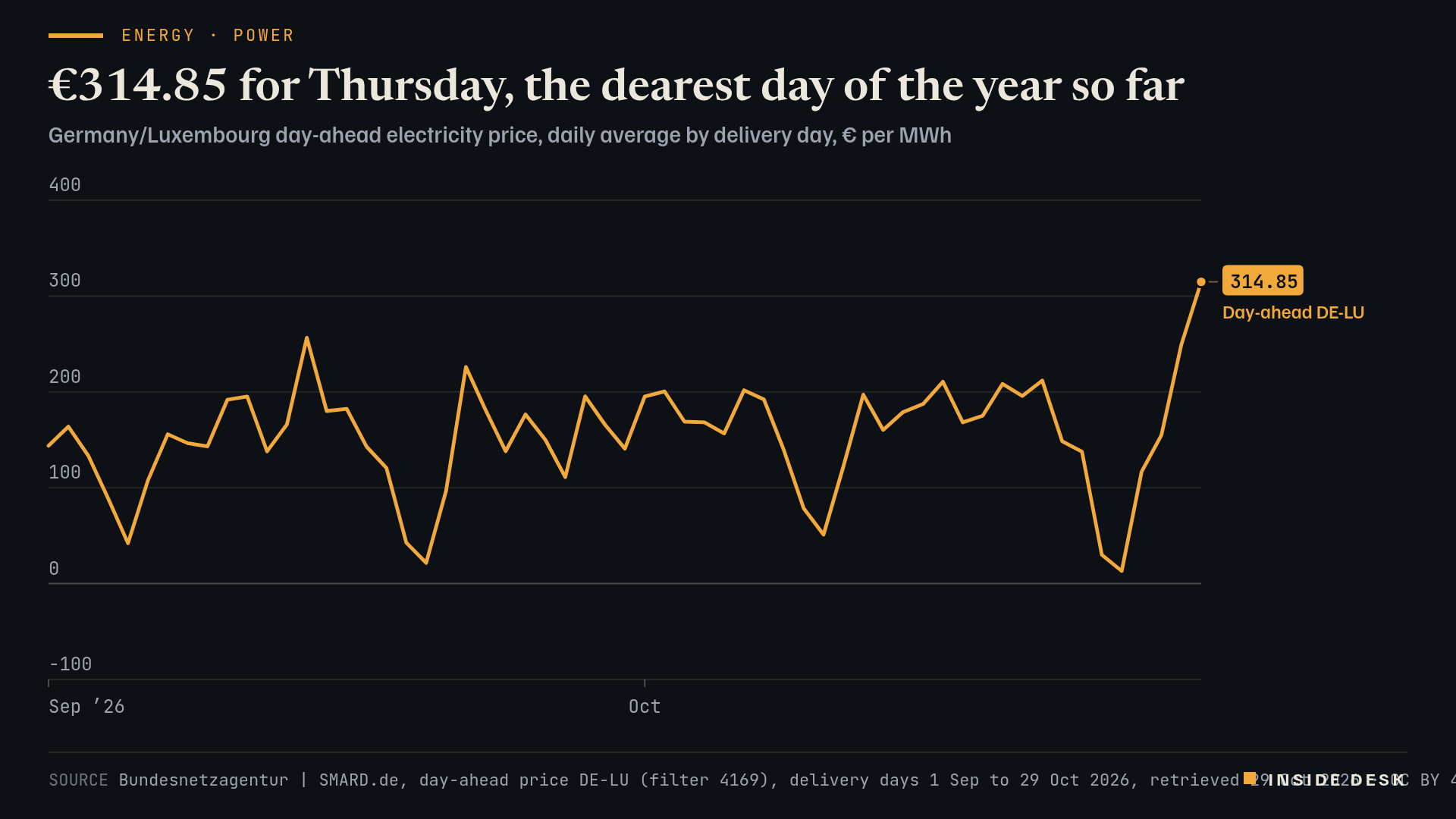
Germany's price index splits three ways on the morning the ECB meets: car fuel up 36.8% in a year, food up 0.4%, heating and light down 1.9%. Power for today cleared at €314.85, the Fed's chair met the payroll ledger, and Moscow counted drones by the hundred. Eleven desks, every number sourced.

Morning 08:30 · Evening 17:30 · Sunday 10:00, Berlin time

Read this edition as ePaper → PDF

ORDINARY · LEAD Chart

Ordinary Ledger: one receipt, three different stories

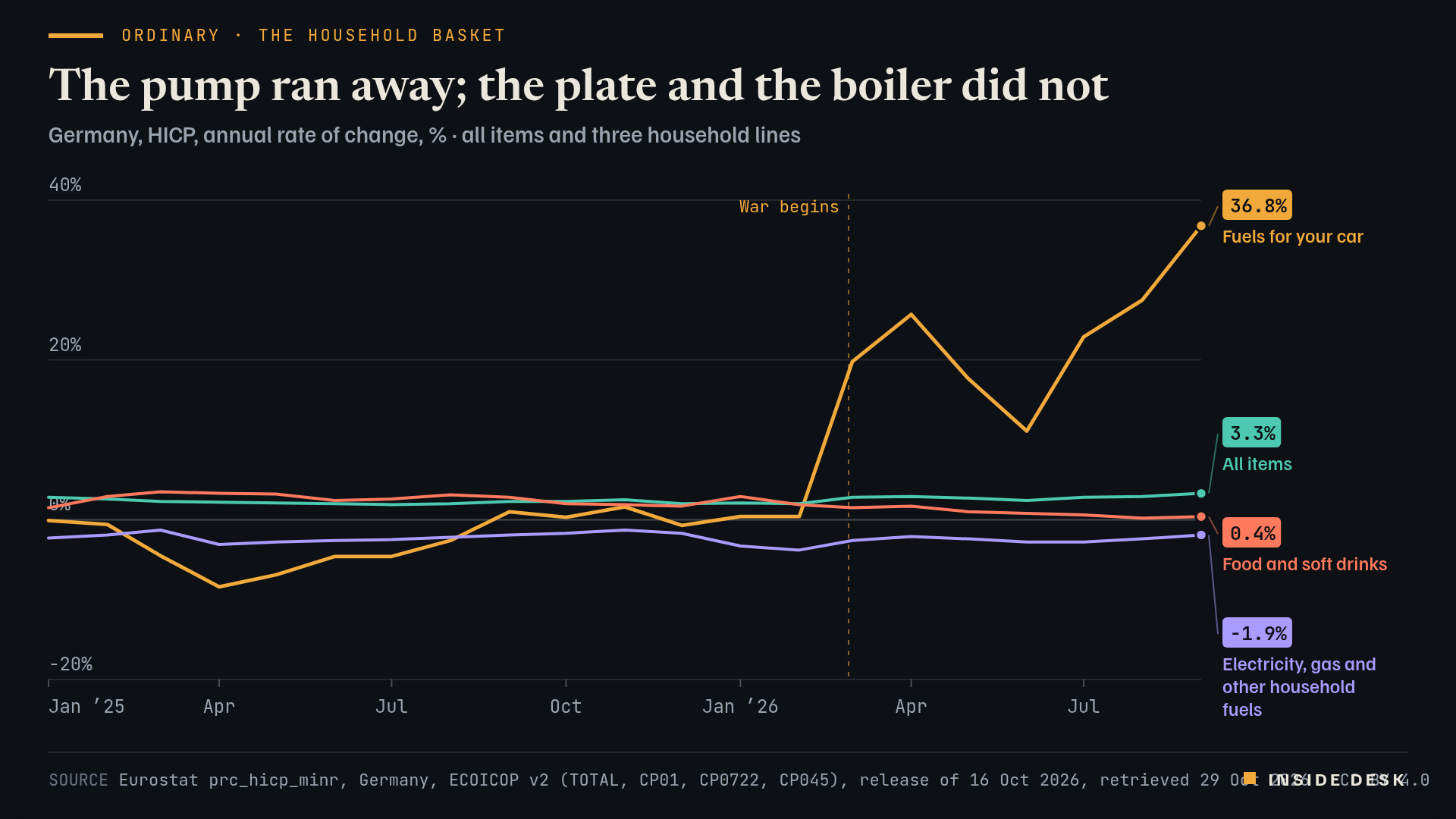
On the morning the ECB meets, Germany's price index splits into lines that barely know each other: fuel up 36.8% in a year, food up 0.4%, the bill for heating and light down 1.9%.

Germany's inflation rate is a single number, and it is a useful one. In September Eurostat's harmonised index put it at 3.3%, up from 2.0% in February. But nobody pays an average. You pay a fuel bill, a supermarket bill and an energy bill, and this autumn those three lines are telling three different stories. On the day the European Central Bank meets, it is worth reading them one at a time.

**The pump.** Fuels for the car cost 36.8% more in September than a year earlier, the highest reading since at least the start of 2025. Before the war began in late February the same line was rising by 0.4% a year; by March it was up 19.8%. The ADAC's figures from Wednesday show where it stands now: a litre of Super E10 at €2.084 on the national average, diesel at €2.289, more than 20 cents apart. The two are moving in opposite directions. E10 fell 2.6 cents in a week while diesel rose 3.4 cents, with Brent at about $114 a barrel. The automobile club blames tight international diesel markets and the seasonal demand for heating oil, and reads the petrol move as a sign that there had been room for cuts.

Ordinary & Inherited Life · 3 min · Read the piece →

Desk notes

End of edition · added

Before you close the tab

One thing you can do this week

This week, keep the receipt from your next fill-up and write the litres and the price per litre on the back. Over the seven days to Wednesday, the German average for Super E10 fell 4.7 cents while diesel rose 2.5 cents, Tankerkönig reports from official MTS-K data 2. A month of your own receipts tells you what your car actually costs, which no national average can.

A habit, not advice.

What went right

The Southampton Island caribou herd in Nunavut is showing encouraging signs of recovery, a Government of Nunavut study drawing on Inuit knowledge has found, with Coral Harbour hunters and Elders reporting healthy animals and strong calf survival 1. The island's original herd was gone by the mid-1950s; 48 caribou were brought back from Coats Island in 1967 at the request of Coral Harbour Inuit 1. After a decline in the 2000s, ending commercial harvesting and setting a total allowable harvest helped steady the herd, with aerial surveys counting 12,054 animals in 2019 and 12,651 in 2023 1. A quota, a survey and fifteen careful interviews: dull machinery, working 1.

The day in one sentence

Petrol got cheaper, heating got cheaper, diesel and power got dearer, and the Fed's chair said hiring had picked up: on ECB morning, the receipts disagreed with one another and agreed with the ledger.

In euros at home

Diesel cost €2.259 a litre on the German average on Wednesday, against €2.049 for Super E10, both a cent cheaper than the day before, Tankerkönig reports from official MTS-K data at 17:01 2. Over the past week the two went separate ways: E10 fell 4.7 cents and diesel rose 2.5 cents 2. ADAC's figures in today's lead are a separate measure and run a few cents higher. Desk arithmetic: a 50-litre tank of diesel at Wednesday's average costs about €112.95, some €10.50 more than the same tank of E10.

Desk arithmetic on the cited national averages. Prices differ by station, region and time of day. Nothing here is advice.

Small words

Total allowable harvest

A ceiling on how many animals of a population may be taken in a season, set by the people who manage it and shared out among hunters. On Southampton Island in Nunavut it is 1,000 caribou, and the territory's environment department is not recommending a change, though some residents would like household tags raised from four to six 1. It is a number agreed before the season, so that nobody has to argue during it.

Sources for this section

  1. Inuit knowledge reveals encouraging signs for Southampton Island caribou herd — Nunavut News, 28 Oct 2026
  2. Marktbriefing — Tankerkönig (MTS-K data), 28 Oct 2026, data 04:01 and 17:01 CET, retrieved 29 Oct 2026, 05:30 CET

Commentary for information only. Not investment, legal, tax, medical or political advice. "Desk arithmetic" is our own calculation from the cited figures.

Charts and data in this edition