Morning edition · Wednesday, 28 October 2026
The wind left on Tuesday, and Wednesday's bill came due
Germany's day-ahead power price rose from €13 on a stormy Sunday to €249 for today. The grid did exactly what it was built to do. The question is what you build so that it has to do it less often.
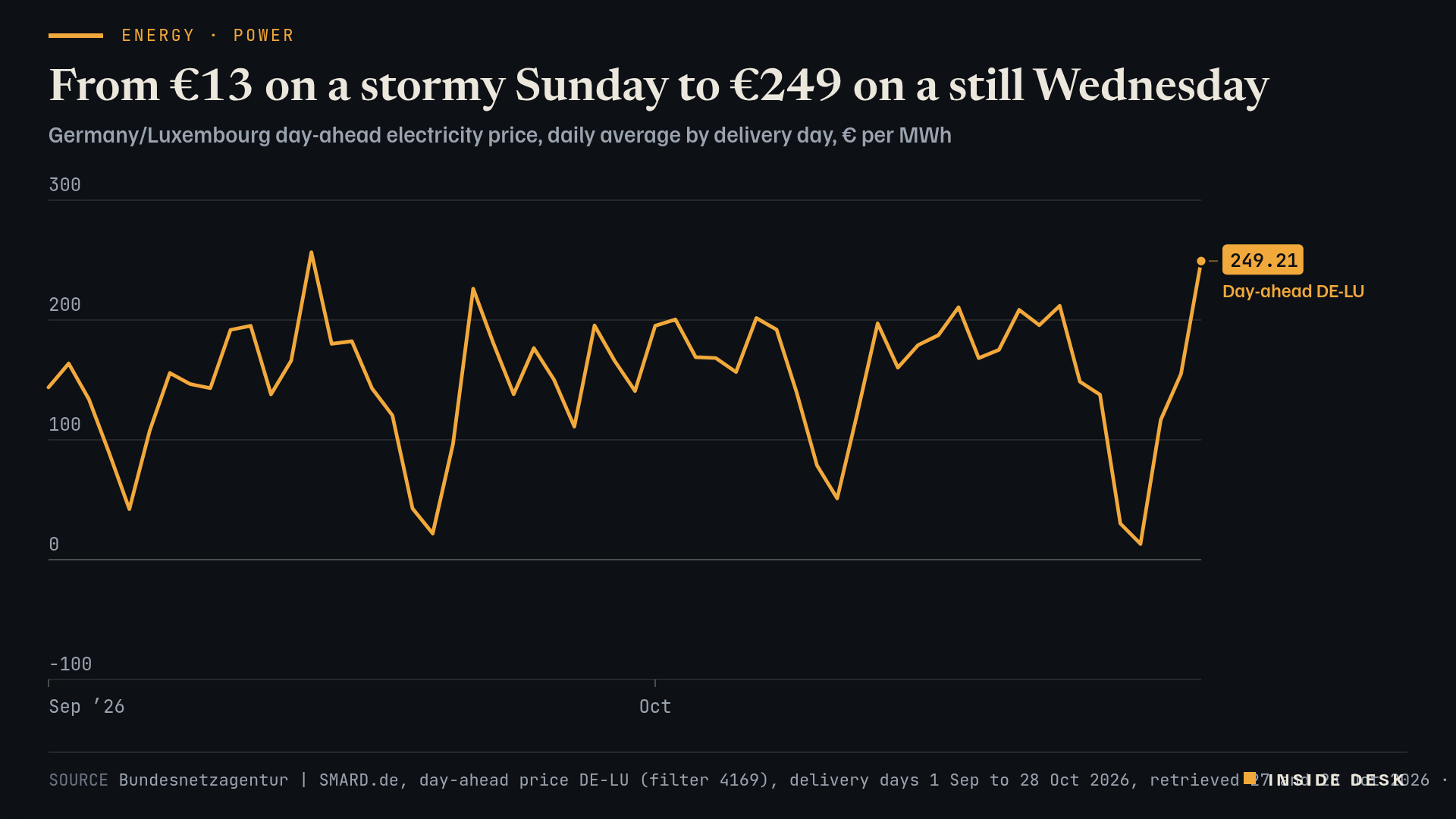
On Sunday, a storm blew across Germany and power was almost free. Today it is not. The German-Luxembourg day-ahead price for delivery on Wednesday 28 October averages €249.21 per megawatt hour, according to SMARD, the Bundesnetzagentur’s data portal1. On Sunday 25 October it averaged €13.121. It is the dearest day since 14 September, when the average reached €256.551. Desk arithmetic: today’s power costs about nineteen times Sunday’s.
Yesterday evening’s note reported the auction result. This morning SMARD has added the other half of the story: what the plants actually did on Tuesday, the day the wind dropped1. It explains the price better than any speech will today.
The wind halved. Onshore wind turbines generated 1,019,966 megawatt hours on Sunday and 440,623 MWh on Tuesday1. Offshore farms added 92,072 MWh on Sunday and 147,903 MWh on Tuesday1. Desk arithmetic: onshore output fell by about 57%, and wind as a whole went from about 1.11 million MWh to about 0.59 million. On Sunday, wind’s output equalled about 93% of the day’s grid load of 1,192,490 MWh. On Tuesday it equalled about 44% of 1,350,195 MWh1.
Line chart of the daily average German-Luxembourg day-ahead electricity price from 1 September to 28 October 2026, in euros per megawatt hour. It peaks at €256.55 on 14 September. It falls to €30.12 on Saturday 24 October and €13.12 on Sunday 25 October during the storm, recovers to €116.57 on Monday 26 October and €155.11 on Tuesday 27 October, and rises to €249.21 for delivery on Wednesday 28 October, the latest value and the highest since 14 September.
Source Bundesnetzagentur | SMARD.de, day-ahead price DE-LU (filter 4169), delivery days 1 Sep to 28 Oct 2026, retrieved 27 and 28 Oct 2026 · CC BY 4.0. Bundesnetzagentur | SMARD.de, market data. CC BY 4.0.
Data (CSV) · SVG · PNG

Latest values as a table
| Date | Day-ahead DE-LU |
|---|---|
| 2026-10-23 | 137.59 |
| 2026-10-24 | 30.12 |
| 2026-10-25 | 13.12 |
| 2026-10-26 | 116.57 |
| 2026-10-27 | 155.11 |
| 2026-10-28 | 249.21 |
Demand rose at the same time. Tuesday was a working day. Grid load was about 13% higher than on Sunday, by desk arithmetic from SMARD’s figures1. Less wind and more demand at once is the combination that empties a cheap order book. Solar helped a little in the daylight hours: 170,477 MWh on Tuesday, against 87,288 MWh on Sunday1. In late October that does not reach the evening.
The old plants filled the gap. Lignite generated 54,346 MWh on Saturday and 221,258 MWh on Tuesday1. Gas-fired plants went from 42,456 MWh to 144,502 MWh over the same days1. Desk arithmetic: lignite output about quadrupled, and gas output rose about 3.4 times. Gas matters most here, because the last plant needed to meet demand tends to set the price for every hour it runs, and that plant is often a gas plant.
And gas is dear. The November TTF contract, Europe’s benchmark gas price, closed at €96.68 per MWh on Monday, up 3.02% on Friday, and briefly touched €97.40 on Tuesday, 3e-news reports2. EU storage is about 75% full, the lowest level recorded for the season, and German storage just 61%, according to the same report, which also cites unplanned disruptions to Norwegian supply2. Overnight the oil market added its own worry. Brent rose $1.48 to $115.36 a barrel early on Wednesday, CNBC reports, after Yemen’s Houthis said they had hit Saudi Arabia’s biggest refinery with a missile3. Saudi authorities had not confirmed the strike3.
What it means for you. Desk arithmetic: at €249.21 per MWh, a kilowatt hour on the wholesale market costs about 24.9 cents today, before network charges, taxes and levies. On Sunday it cost about 1.3 cents. If you are on a fixed tariff, your supplier usually bought much of your power well in advance, and today’s auction reaches you slowly and averaged out. If you are on a dynamic tariff, the timing of the dishwasher actually matters this week. Check the hourly prices on SMARD before you plan heavy loads1.
The contrarian point. Days like today invite two speeches. One says wind power is unreliable because it stopped. The other says the market is broken because the price rose. Both miss what the numbers show. The system kept the lights on through a nineteenfold price swing without drama: the storm weekend switched the old coal plants down, and the still Tuesday switched them back up within days1. That is the dull machinery working.
What the swing really prices is the gap between Sunday and Wednesday. Every megawatt hour that could have been stored at €13 and sold at €249 is a business case, written in public, on a government data portal, every day. Batteries, flexible industrial shifts, heat stores and interconnectors are not slogans. They are the people who will earn that spread, and in earning it, narrow it.
The price for Thursday will be set at midday today1. Nobody needs to forecast it. You can read it on SMARD by lunchtime. Nothing here is investment advice.
What to watch
- Around 12:00 CET today: the day-ahead auction for Thursday 29 October, published on SMARD once it clears1.
- Wednesday's realised wind output, which SMARD adds to the daily series on Thursday1.
- Sunday: OPEC+ is expected to keep its December output targets unchanged, people familiar with the matter told Reuters3.
A price that jumps nineteenfold in three days is not a broken market. It is a market telling you, loudly, what storage is worth.
Sources
- Market data: day-ahead price DE-LU (daily and hourly); realised generation by source; grid load — Bundesnetzagentur / SMARD.de, retrieved 28 Oct 2026, 05:25 CET.
- New increase in gas price on TTF (96.68 EUR/MWh) and Balkan Gas Hub (86.68 EUR/MWh) on Tuesday, 27 October — 3e-news, 27 Oct 2026.
- Oil prices rise after attack on Saudi Arabian refinery reignites supply concerns — CNBC, 28 Oct 2026, 03:43 CET.
Every figure in this piece traces to a source above or to the desk’s own arithmetic on those sources, marked as such. Quotations are short and attributed. Spot an error? Write to the desk; corrections are logged on the method page.
Commentary for information only. Not investment, legal, tax, medical or political advice. Not an offer or solicitation. Analysis may be incomplete or wrong. Charts show published public data, not a trading feed; binding numbers live with the institutions that publish them.