Evening edition · Wednesday, 28 October 2026
Before the statement, the invoices: 3.7%, 6.3% and a hike in Ottawa
The Fed speaks at about 19:00 CET, after this edition. What sits on its desk is already public: shop prices, wholesale prices, a neighbour that moved this afternoon, and loan books in Frankfurt.
The Federal Reserve announces its decision at about 19:00 CET, an hour and a half after this edition goes out. So this is not a report of what it did. It is a list of what the committee had in front of it when it sat down, and almost all of that is public. You can read the same papers.
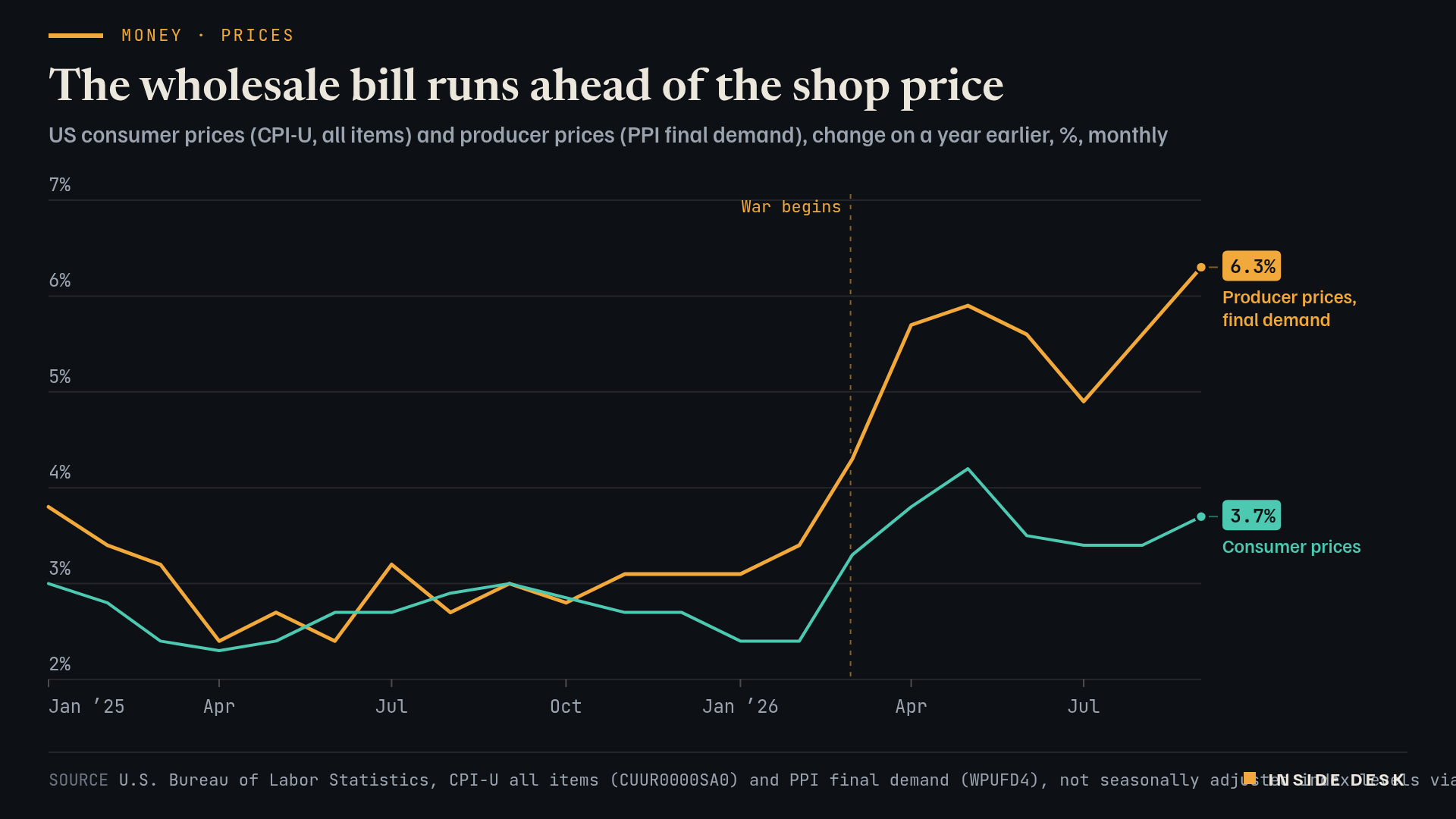
The shop price. US consumer prices rose 3.7% in the year to September, driven by energy, CNBC reports1. Desk arithmetic from the Bureau of Labor Statistics index levels gives the same 3.7%, up from 2.4% in January and February2. It is one of the longest runs of annual readings above 2% on record1.
The wholesale bill. The producer price index for final demand, which tracks what businesses charge each other, rose 6.3% in the year to September, the steepest twelve-month rise since 20221. Desk arithmetic: it was 3.1% in January, so the rate has roughly doubled in eight months, and it now runs 2.6 percentage points above the shop price2. That gap is the interesting number. A wholesale bill that rises faster than the shelf price is either squeezed out of margins or passed on later.
Line chart of the annual change in US consumer prices and producer prices for final demand, monthly since January 2025. In January 2025 consumer prices are up 3.0% on a year earlier and producer prices 3.8%. Both run between about 2.3% and 3.1% through 2025; no consumer price figure exists for October 2025. From March 2026 producer prices pull away: 4.3% in March, 5.9% in May and 6.3% in September 2026, the latest value. Consumer prices peak at 4.2% in May 2026 and stand at 3.7% in September 2026, the latest value, 2.6 percentage points below producer prices.
Source U.S. Bureau of Labor Statistics, CPI-U all items (CUUR0000SA0) and PPI final demand (WPUFD4), not seasonally adjusted index levels via the BLS public data API, retrieved 28 Oct 2026. Annual rates are desk arithmetic from the index levels. BLS published no October 2025 CPI index · U.S. government data, public domain. Figures as reported by the named organisations; facts cited with attribution.
Data (CSV) · SVG · PNG

Latest values as a table
| Date | Producer prices, final demand | Consumer prices |
|---|---|---|
| 2026-04-01 | 5.7 | 3.8 |
| 2026-05-01 | 5.9 | 4.2 |
| 2026-06-01 | 5.6 | 3.5 |
| 2026-07-01 | 4.9 | 3.4 |
| 2026-08-01 | 5.6 | 3.4 |
| 2026-09-01 | 6.3 | 3.7 |
Tomorrow’s print, already half known. The personal consumption expenditures index, the Fed’s preferred measure, is published on Thursday. Because economists build it from the CPI and PPI, its shape is largely known: headline inflation is expected to rise to 3.7% from 3.4%, and core inflation to 3.1%1. CNBC’s Steve Liesman notes that the three-month annualised core rate, which fell to 2.05% last month and was cited by doves, would jump to about 2.7% with a 0.3% monthly rise1. A measure that moves that much in one month is a weather vane, not a compass.
What the market expects. Futures price less than a 10% chance of a rise tonight, after September’s quarter-point increase to 3.75%–4%; traders expect the next rise in December1. Goldman Sachs reads the committee as hiking every other meeting and expects little new from the press conference1. JPMorgan’s analysts expect at least two dissents3. Michael Feroli, JPMorgan’s chief US economist, puts the awkward question plainly: why hike after a 0.2% core print in September but hold after an expected 0.3%1? Before the decision, the two-year Treasury yield was up 3.7 basis points at 4.774% and the ten-year at 5.03%1. Those yields are the market’s vote, cast in money.
A neighbour moved first. At 14:45 CET the Bank of Canada raised its policy rate by a quarter point to 2.5%4. Its reasoning is worth reading for the dull machinery in it: businesses “have mostly absorbed higher input costs so far”, but the Bank’s surveys suggest more of those costs will be passed on over the next year4. It raised rates “to reduce the risk” that high energy prices spread to everything else4. That is the wholesale-bill argument, made by a committee that has already voted.
Frankfurt reads loan books. The European Central Bank decides on Thursday. Its own data, published on Tuesday, show adjusted lending to euro-area households growing 3.1% a year in September and to firms 4.2%, both unchanged; broad money, M3, grew 3.5%5. Deposits placed by companies grew 5.3%, up from 4.7%5. Credit is still flowing at a steady pace. Whatever the Governing Council decides, it will not be reacting to a lending freeze.
What this means for you. Over the next 36 hours you will hear a great many adjectives. The useful information is in the documents: the producer price index, Thursday’s PCE, the two-year yield, and the line in each statement about costs being passed on. A committee that watches invoices is doing its job; the statement is how it explains the bill. If you have a variable-rate loan or are about to fix one, the two-year yield is often a better guide than any adjective at the press conference. Nothing here is investment advice.
What to watch
A committee can choose its adjectives. It cannot choose the invoices it is handed.
Sources
- Fed meeting live updates: No hike expected, but investors watching Warsh for what's next — CNBC, 28 Oct 2026, 16:22 CET.
- CPI-U all items (CUUR0000SA0) and PPI final demand (WPUFD4), index levels — U.S. Bureau of Labor Statistics, public data API, retrieved 28 Oct 2026, 16:27 CET.
- Global stocks get AI boost ahead of packed 48 hours — Reuters via Euronext, 28 Oct 2026, 12:24 CET.
- Text of the Bank of Canada's latest policy interest rate decision — The Canadian Press via BNN Bloomberg, 28 Oct 2026, 15:11 CET.
- Monetary developments in the euro area: September 2026 — European Central Bank, 27 Oct 2026.
Every figure in this piece traces to a source above or to the desk’s own arithmetic on those sources, marked as such. Quotations are short and attributed. Spot an error? Write to the desk; corrections are logged on the method page.
Commentary for information only. Not investment, legal, tax, medical or political advice. Not an offer or solicitation. Analysis may be incomplete or wrong. Charts show published public data, not a trading feed; binding numbers live with the institutions that publish them.