Evening edition · Tuesday, 27 October 2026
Wednesday's power is €249, and lignite is back at work
The auction for Wednesday cleared at €249.21 per megawatt hour, the dearest day since mid-September. The plants that sat out the storm weekend have returned, and even the cheapest hour now costs €190.
This morning’s piece called Tuesday’s €155 the end of the storm discount. The midday auction has since priced Wednesday, and the answer is steeper. The German-Luxembourg day-ahead price for delivery on Wednesday 28 October averages €249.21 per megawatt hour, according to SMARD, the Bundesnetzagentur’s data portal1. That is the highest daily average since 14 September, when it reached €256.551. Desk arithmetic: Wednesday costs about 61% more than Tuesday’s €155.11 and a little over twice Monday’s €116.57.
No cheap hour left. On Tuesday the midday hour, 12:00 to 13:00 CET, cleared at €43.501. On Wednesday the cheapest hour, 13:00 to 14:00 CET, clears at €189.91, and the dearest, 18:00 to 19:00 CET, at €343.091. Desk arithmetic: the evening peak is now about 1.8 times the cheapest hour, against six times on Tuesday. The spread narrowed because the floor rose, not because the evening got cheaper.
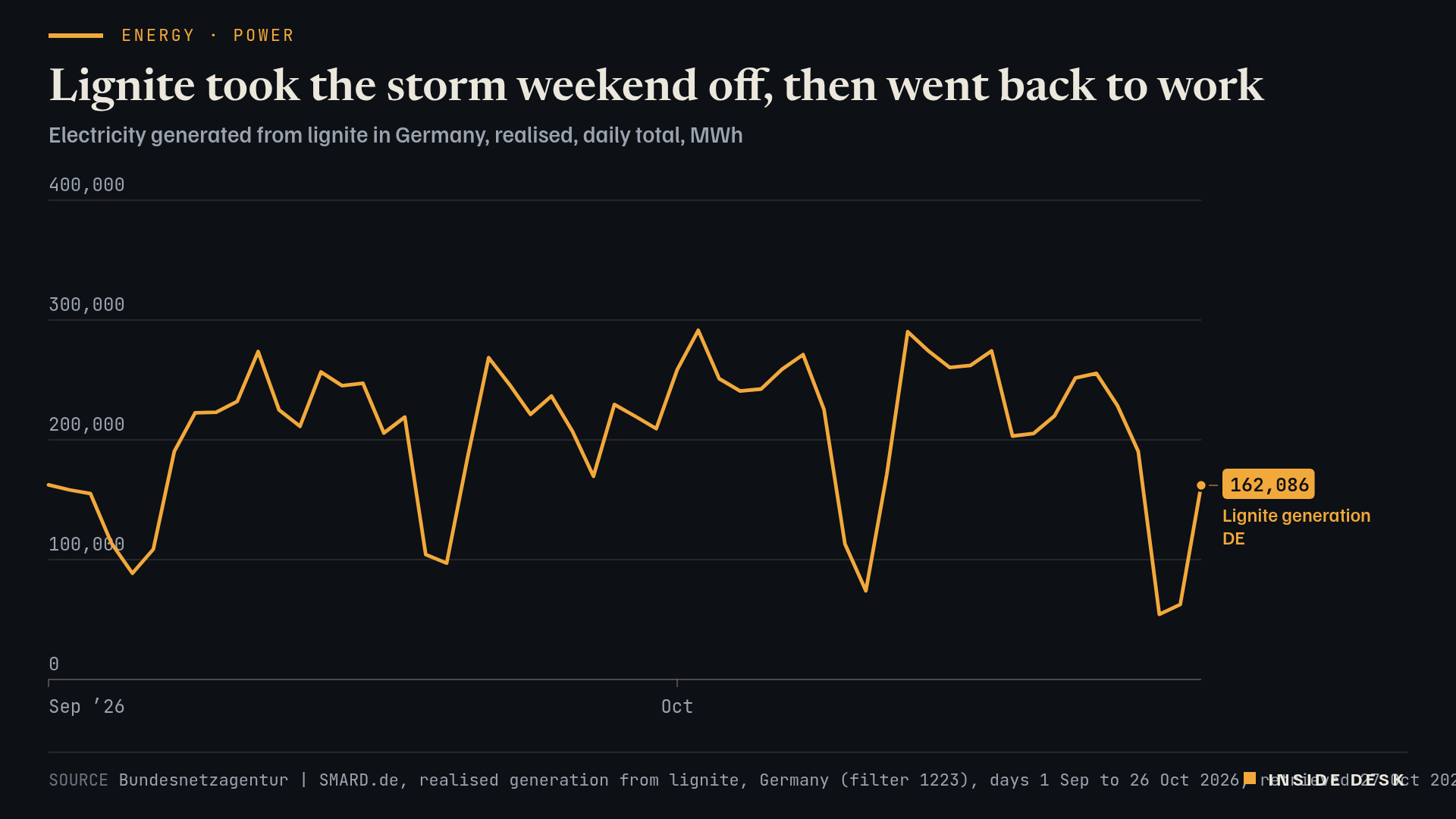
Who came back. The storm weekend showed what the system does when wind is plentiful: it switches off its oldest fuel. Lignite plants generated 54,346 megawatt hours on Saturday 24 October, the lowest day since 14 June, and 62,470 MWh on Sunday1. By Monday they were back at 162,086 MWh1. Desk arithmetic: lignite output roughly tripled in two days.
Line chart of daily electricity generation from lignite in Germany from 1 September to 26 October 2026, in megawatt hours. It averages about 197,771 MWh a day in September and peaks at 291,434 MWh on 2 October. It stands at 255,448 MWh on Wednesday 21 October, drops to 54,346 MWh on storm Saturday 24 October, the lowest day since 14 June 2026, and 62,470 MWh on Sunday 25 October, then climbs back to 162,086 MWh on Monday 26 October, the latest value.
Source Bundesnetzagentur | SMARD.de, realised generation from lignite, Germany (filter 1223), days 1 Sep to 26 Oct 2026, retrieved 27 Oct 2026 · CC BY 4.0. Bundesnetzagentur | SMARD.de, market data. CC BY 4.0.
Data (CSV) · SVG · PNG

Latest values as a table
| Date | Lignite generation DE |
|---|---|
| 2026-10-21 | 255448 |
| 2026-10-22 | 228797 |
| 2026-10-23 | 190392 |
| 2026-10-24 | 54345.5 |
| 2026-10-25 | 62469.9 |
| 2026-10-26 | 162086 |
The month in brown coal. The weekend dip hides the longer line. From 1 to 26 October lignite plants generated about 5,592 gigawatt hours, against about 4,932 GWh on the same days of 20251. Desk arithmetic: about 13% more this October. A dear gas market makes the old coal blocks competitive again, and the carbon bill follows.
None of this is a failure of the market. A price of €343 at 18:00 is a loud, public signal to anyone with a battery, a flexible factory shift or an interconnector to sell into. The answer to a still, dark evening is not a speech. It is storage that charged when Sunday’s wind was nearly free. Nothing here is investment advice.
What to watch
Cheap power on a windy Sunday is a gift. Cheap power on a still Wednesday has to be built.
Sources
- Market data: day-ahead price DE-LU (daily and hourly), realised generation from lignite — Bundesnetzagentur / SMARD.de, retrieved 27 Oct 2026, 16:35 CET.
Every figure in this piece traces to a source above or to the desk’s own arithmetic on those sources, marked as such. Quotations are short and attributed. Spot an error? Write to the desk; corrections are logged on the method page.
Commentary for information only. Not investment, legal, tax, medical or political advice. Not an offer or solicitation. Analysis may be incomplete or wrong. Charts show published public data, not a trading feed; binding numbers live with the institutions that publish them.