Evening edition · Tuesday, 27 October 2026
A queue is a vote of confidence
Israelis voted in record numbers by mid-afternoon. Both camps read the same turnout figure as a threat and a reason to hurry. Tonight's first numbers will be estimates; the habit worth keeping is to wait for the count.
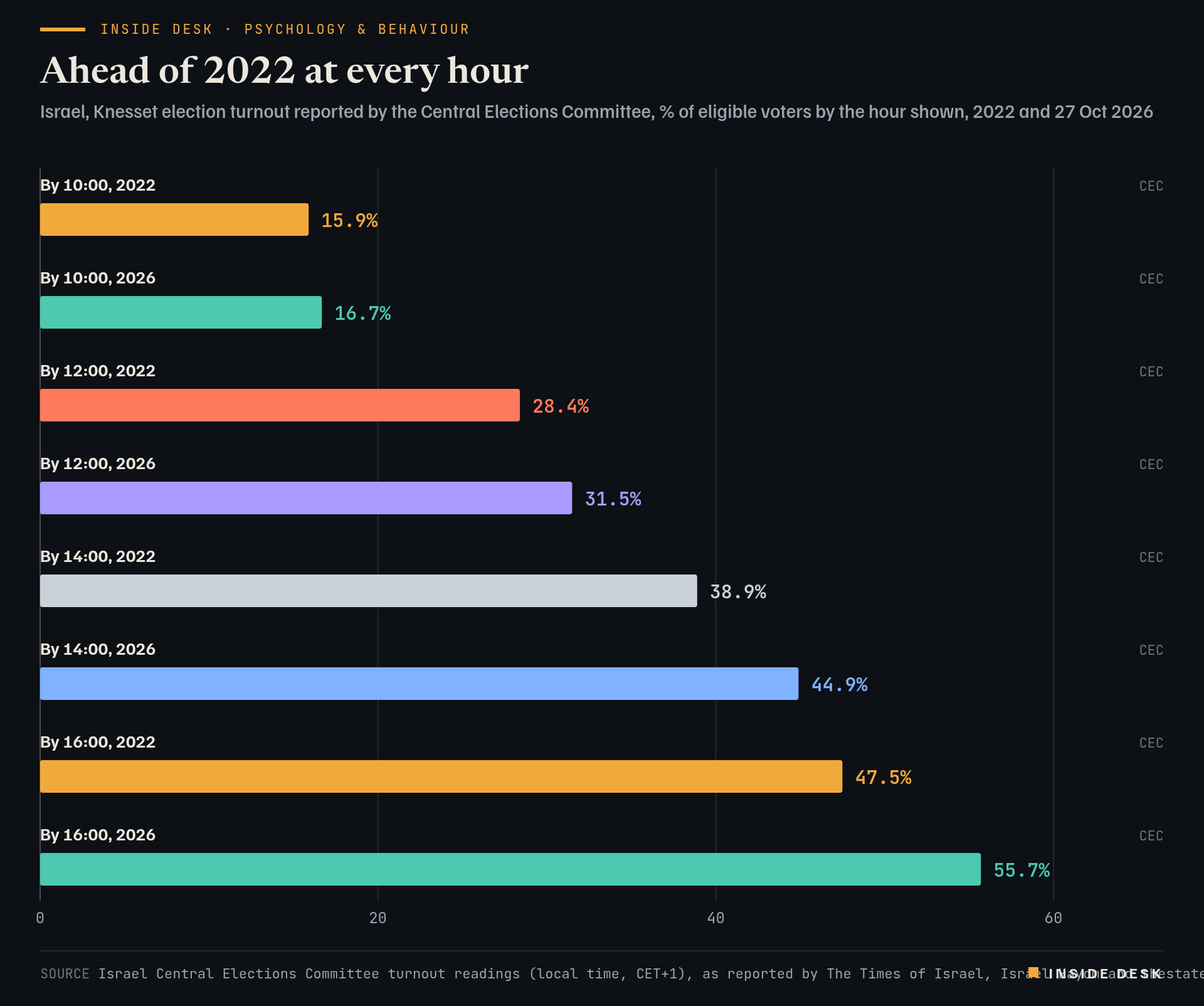
By 16:00 local time, 15:00 in Berlin, 55.7% of Israel’s eligible voters had cast a ballot, just over four million people1. The Central Elections Committee said that was the highest figure at that hour on its books; at the same point in 2022 it was 47.5%1. The records had been falling all day: 31.5% by noon, the highest at that hour in 53 years, and 44.9% by 14:00, about 3.29 million ballots2.
Desk arithmetic: 55.7 minus 47.5 is 8.2 percentage points ahead of 2022 at the same hour, and the gap widened at every reading the committee published3.
Bar chart of Israeli election turnout by the hour, 2022 against 27 October 2026. By 10:00 local time it was 15.9% in 2022 and 16.68% in 2026; by 12:00, 28.4% and 31.5%; by 14:00, 38.9% and 44.9%; by 16:00, 47.5% in 2022 and 55.7% in 2026, the latest reading.
Source Israel Central Elections Committee turnout readings (local time, CET+1), as reported by The Times of Israel, Israel Hayom and thestateofisrael.com, retrieved 27 Oct 2026 · polls close 22:00 local; final turnout not yet known. Figures as reported by the named organisations; facts cited with attribution.
Data (CSV) · SVG · PNG

Latest values as a table
| Value | |
|---|---|
| By 10:00, 2022 | 15.9% |
| By 10:00, 2026 | 16.68% |
| By 12:00, 2022 | 28.4% |
| By 12:00, 2026 | 31.5% |
| By 14:00, 2022 | 38.9% |
| By 14:00, 2026 | 44.9% |
| By 16:00, 2022 | 47.5% |
| By 16:00, 2026 | 55.7% |
One figure, two fears. Watch what the campaigns did with that number. Benjamin Netanyahu told right-wing voters to “race to the polls”, warned of high turnout in Arab and left-wing areas and claimed “they are trying to steal the election from us”, pointing to three Ra’am activists arrested on suspicion of bribing voters1. Gadi Eisenkot’s Yashar answered that the prime minister was laying the groundwork to contest the result, and told its own voters the margin “must be enormous”1. The committee said it had found no evidence of systematic tampering and was handling individual reports as they came in1.
This is the old behavioural loop of election days. A turnout figure is neutral; it does not say who voted. Yet each camp reads the other’s queue as a threat, and the threat becomes the reason to join the queue. Fear is a cheap mobiliser. It also leaves a residue: voters primed all day to expect theft are slower to accept a count that disappoints them.
The dull machinery did its job. The more useful story is the committee’s. Faced with lengthening lines, it changed its guidance so that polling officials could begin identifying the next voter while the current one was still behind the booth, and it made clear that anyone who arrives by 22:00 will be able to vote2. Not everyone had a smooth day. Haaretz and the Arab legal aid group Adalah relayed reports of waits of several hours and slow identity checks in Bedouin towns in the Negev and in Arab communities in the Galilee1. Those reports are now on the record, where complaints belong, rather than in a speech.
What you will see tonight, and how to read it. Israel has had a poll blackout since Friday night: no new poll results could be published until the stations close3. At 22:00 local, 21:00 CET, the television channels release exit polls, which are estimates from samples of voters, not results3. In 2022 the three main channels’ first exit polls gave the right-religious bloc 61 or 62 seats; it won 643. Meretz was given four or five seats by all three and finished below the threshold with none3. Soldiers’ and other double-envelope ballots are counted later at the Knesset, and official results are due by 4 November3.
Why does that matter? Because the first number sticks. In a Brennan Center experiment with 1,994 US registered voters, showing a candidate with 84% odds on a betting market raised the share who thought that candidate would win by 20 percentage points, whatever the polls said4. And a warning to be cautious about the odds made no difference to how much people relied on them4. Scepticism, in other words, is not a shield. A habit is.
The habit is boring and it works: treat tonight’s 21:00 figures as a forecast for a count that has not happened yet, and notice when a politician tells you the result before the committee does.
And give the queue its due. People do not stand for hours to post a ballot into a system they think is rigged. Whatever the speeches said today, four million votes by mid-afternoon are four million small acts of trust in an envelope, a ballot box and a count. That trust is the institution’s best asset. The way to keep it is to let the slow part, the counting, finish.
What to watch
- Israel's television exit polls at 22:00 local time, 21:00 CET: estimates from samples, not results3.
- Double-envelope ballots (soldiers, hospitals, prisons, missions abroad) are counted later at the Knesset; the Central Elections Committee publishes official results by Wednesday 4 November3.
- Whether the final turnout passes 2022's 70.6%3.
The loudest number tonight will be the first one. The truest will be the last.
Sources
- Turnout hits historic high as Israel votes; election committee rejects multiple claims of foul play — The Times of Israel, 27 Oct 2026, 15:27 CET.
- Israel 2026 elections hit record 44.9% turnout — Israel Hayom, 27 Oct 2026, 14:46 CET.
- Israel Election Results 2026: Live Count and Exit Polls — thestateofisrael.com, 27 Oct 2026, retrieved 16:30 CET.
- New Study Finds Prediction Markets Are Influencing Voters — and Voters Want Them Regulated — Brennan Center for Justice, 20 Oct 2026.
Every figure in this piece traces to a source above or to the desk’s own arithmetic on those sources, marked as such. Quotations are short and attributed. Spot an error? Write to the desk; corrections are logged on the method page.
Commentary for information only. Not investment, legal, tax, medical or political advice. Not an offer or solicitation. Analysis may be incomplete or wrong. Charts show published public data, not a trading feed; binding numbers live with the institutions that publish them.