Evening edition · Tuesday, 27 October 2026
Podium vs Print: "look through" and 3.8%
Lagarde says the energy shock is too large to look through, but a measured response will do. The September print says prices rise 3.8% a year against a deposit rate of 2.50%. Thursday is about which of the two sentences carries more weight.
“The energy shock is too large to “look through” but a measured response remains appropriate to keep inflation in check.”
Christine Lagarde, President of the ECB, statement to the IMF's International Monetary and Financial Committee, 17 October 2026
3.8%
Annual inflation in the euro area in September, up from 3.2% in August and 1.9% in February. The ECB deposit rate is 2.50%.
Eurostat, euro-area HICP, September 2026, Latest monthly value, retrieved 27 October 2026
The podium. “The energy shock is too large to ‘look through’ but a measured response remains appropriate to keep inflation in check,” Christine Lagarde told the IMF’s steering committee ten days ago1. In the same statement she said long-term interest rates have risen notably since September, and that this “will slow growth and reduce pass-through by more than projected”1.
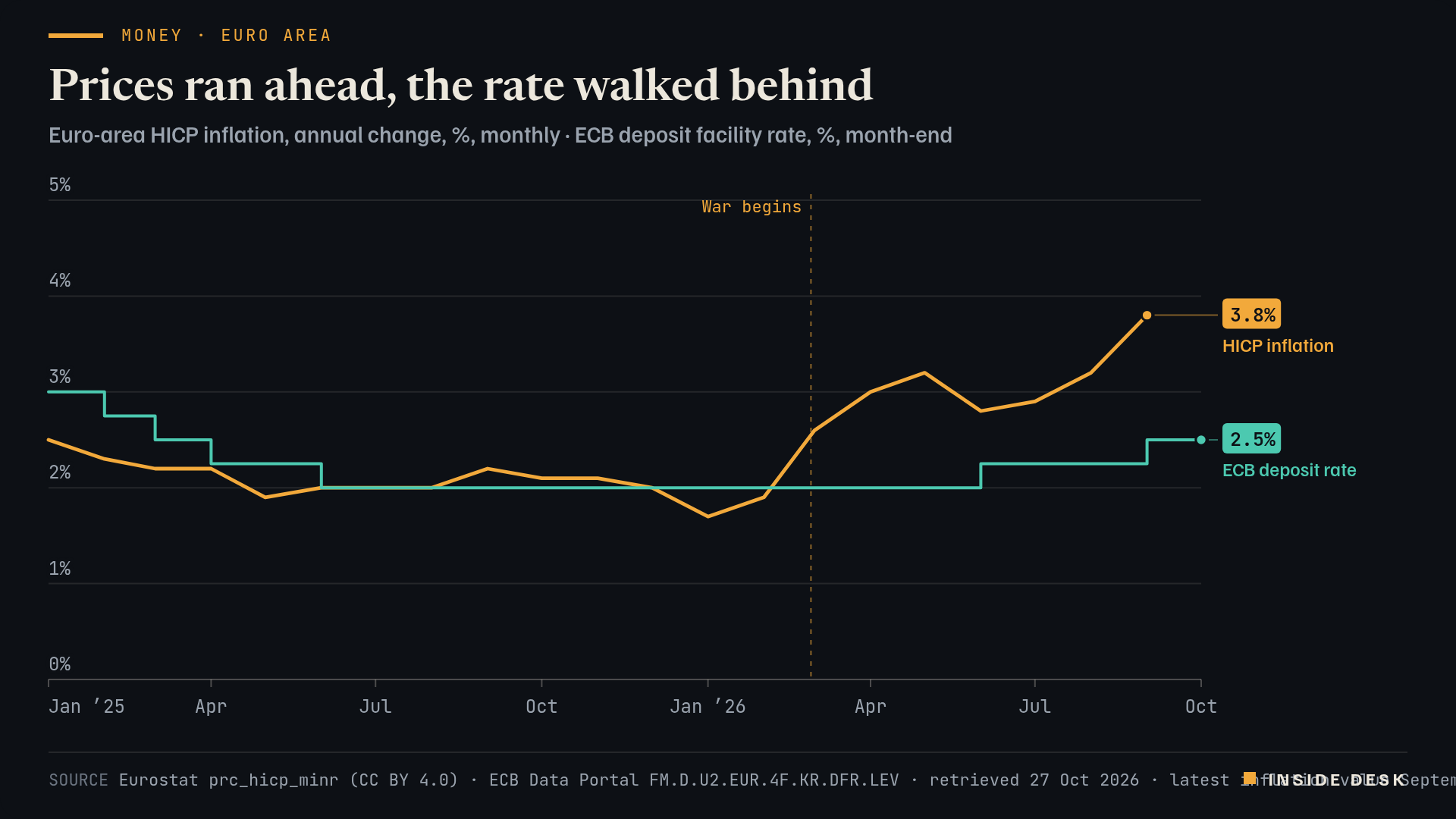
The print. Euro-area inflation was 3.8% in September, according to Eurostat’s monthly data, after 3.2% in August and 1.9% in February, the month the war began2. The ECB’s deposit rate has gone from 2.00% to 2.50% in two steps, in June and September5.
Line chart since January 2025 of euro-area HICP inflation and the ECB deposit rate. Inflation is 2.5% in January 2025, between 1.9% and 2.2% for the rest of 2025, 1.7% in January 2026 and 1.9% in February, then rises after the energy shock to 3.2% in May, 2.8% in June and 3.8% in September 2026, the latest value. The deposit rate falls from 3.00% to 2.00% by mid-2025, rises to 2.25% in June 2026 and to 2.50% in September 2026, where it stands in October 2026. The ECB decides on 29 October.
Source Eurostat prc_hicp_minr (CC BY 4.0) · ECB Data Portal FM.D.U2.EUR.4F.KR.DFR.LEV · retrieved 27 Oct 2026 · latest inflation value September 2026. Eurostat. Reuse authorised under CC BY 4.0 (Commission Decision 2011/833/EU). European Central Bank Data Portal. Reuse permitted with source acknowledgement.
Data (CSV) · SVG · PNG

Latest values as a table
| Date | HICP inflation | ECB deposit rate |
|---|---|---|
| 2026-05-01 | 3.2 | 2 |
| 2026-06-01 | 2.8 | 2.25 |
| 2026-07-01 | 2.9 | 2.25 |
| 2026-08-01 | 3.2 | 2.25 |
| 2026-09-01 | 3.8 | 2.5 |
| 2026-10-01 | – | 2.5 |
The gap. Desk arithmetic: inflation at 3.8% against a deposit rate of 2.50% leaves the real policy rate at about minus 1.3 points. On the face of it, money is still cheap. The president’s answer sits in her own text: the bond market has done part of the work, and wages have “so far shown no material response to the energy shock”1. MUFG Research calls the outlook “a more balanced trade-off” and expects a hold on Thursday and a hike in December3. Of 32 research houses counted by FinChiefs, all 32 expect a hold4.
The verdict. Both are true. The print measures what has already happened at the petrol pump and on the heating bill. The podium is about what has not happened yet: higher prices turning into higher wages and then into higher prices again. Core inflation, which leaves out energy and food, is 2.5%1. For you, the useful number on Thursday is not the rate, which is expected to stay put, but the sentence after it. Nothing here is investment advice.
What to watch
- Thursday's statement, 29 October: whether the word "measured" survives, and whether December is called open or likely.
- The October flash inflation estimate from Eurostat. MUFG expects headline inflation above 4% in the coming months3.
A central bank that looks through everything sees nothing. One that reacts to everything breaks something. The craft is in the middle, and it is dull to watch.
Sources
- IMFC Statement by Christine Lagarde — European Central Bank, 17 Oct 2026.
- HICP – monthly data (annual rate of change), prc_hicp_minr — Eurostat, retrieved 27 Oct 2026.
- ECB preview: A more balanced trade-off — MUFG Research, 27 Oct 2026.
- ECB meeting preview, 29 October 2026: what research expects — FinChiefs, 27 Oct 2026.
- Deposit facility rate, FM.D.U2.EUR.4F.KR.DFR.LEV — ECB Data Portal, retrieved 27 Oct 2026.
Every figure in this piece traces to a source above or to the desk’s own arithmetic on those sources, marked as such. Quotations are short and attributed. Spot an error? Write to the desk; corrections are logged on the method page.
Commentary for information only. Not investment, legal, tax, medical or political advice. Not an offer or solicitation. Analysis may be incomplete or wrong. Charts show published public data, not a trading feed; binding numbers live with the institutions that publish them.