Sunday long-read · Sunday, 18 October 2026
The Sunday Sequence: the week, in the order it reached the kitchen
The barrel moved first, the pump second, the stockpile third, the committees fourth and the podium last. The household pays at step two and is consulted at step five.
On Sundays the desk rearranges the week. Not by the size of the headline, but in the order the incentives actually moved: barrels, pumps, stockpiles, committees, podiums. The order matters more than any single number in it, because the order tells you who pays first and who speaks last.
1. The barrel moved first. By ADAC’s count, Brent closed on Tuesday at about $106 a barrel, up from a little over $100 the week before1. On Friday December Brent settled at $109.86, up 3.72% on the day and its highest close since mid-May; WTI rose 3.55% to $101.41, its first close above $100 in nearly a month2. Both had traded lower earlier in the session2. On Friday morning this desk wrote that the futures screen was pricing a calmer future than the physical tank. By the close the screen had walked some of the way towards the tank. That is what a gap closing from below looks like, and it is not the comfortable direction.
2. The pump moved second. ADAC’s weekly reading put diesel at €2.247 a litre, up 1.4 cents on the week, and Super E10 at €2.151, up 2.5 cents1. That is with the fuel-tax cut in place: since 1 October the energy tax on petrol and diesel is 14 cents lower, which ADAC puts at just under 17 cents a litre including VAT, until the end of December1. Relief is real. It is simply measured against a price you never get to see.
3. The stockpile moved third. On Thursday the International Energy Agency agreed to release more than 20 million barrels of diesel, with wholesale diesel above $200 a barrel in Singapore and around $220 in Europe and the US2. In the same week the agency said exports out of the Middle East had recovered to pre-crisis levels and that global oil storage was not tight, while also warning that the diesel shortage would persist well into next year2. Both statements can be true. Crude finds detours. Diesel has to be made, and a refinery is a factory, not a pipe.
4. The committees spoke fourth. In Bangkok on Friday, the Fed chair, Kevin Warsh, declined to signal anything: “I don’t prejudge meetings”3. On Saturday Christine Lagarde told the IMF’s steering committee that the energy shock is “too large to ‘look through’”, but that “a measured response remains appropriate”, and that wages have so far shown no material response4. Committees speak after prices on purpose. They are paid to wait for the second print, wages, not the first one, the barrel.
5. The podium came last. On Saturday Iran’s foreign minister said Tehran had sent Washington, through Qatar, a seven-day plan to reopen the Strait of Hormuz if its conditions were met. “The choice is now America’s,” he said5. The markets were closed. The first price to answer will be Monday’s, and it will answer in dollars, not adjectives.
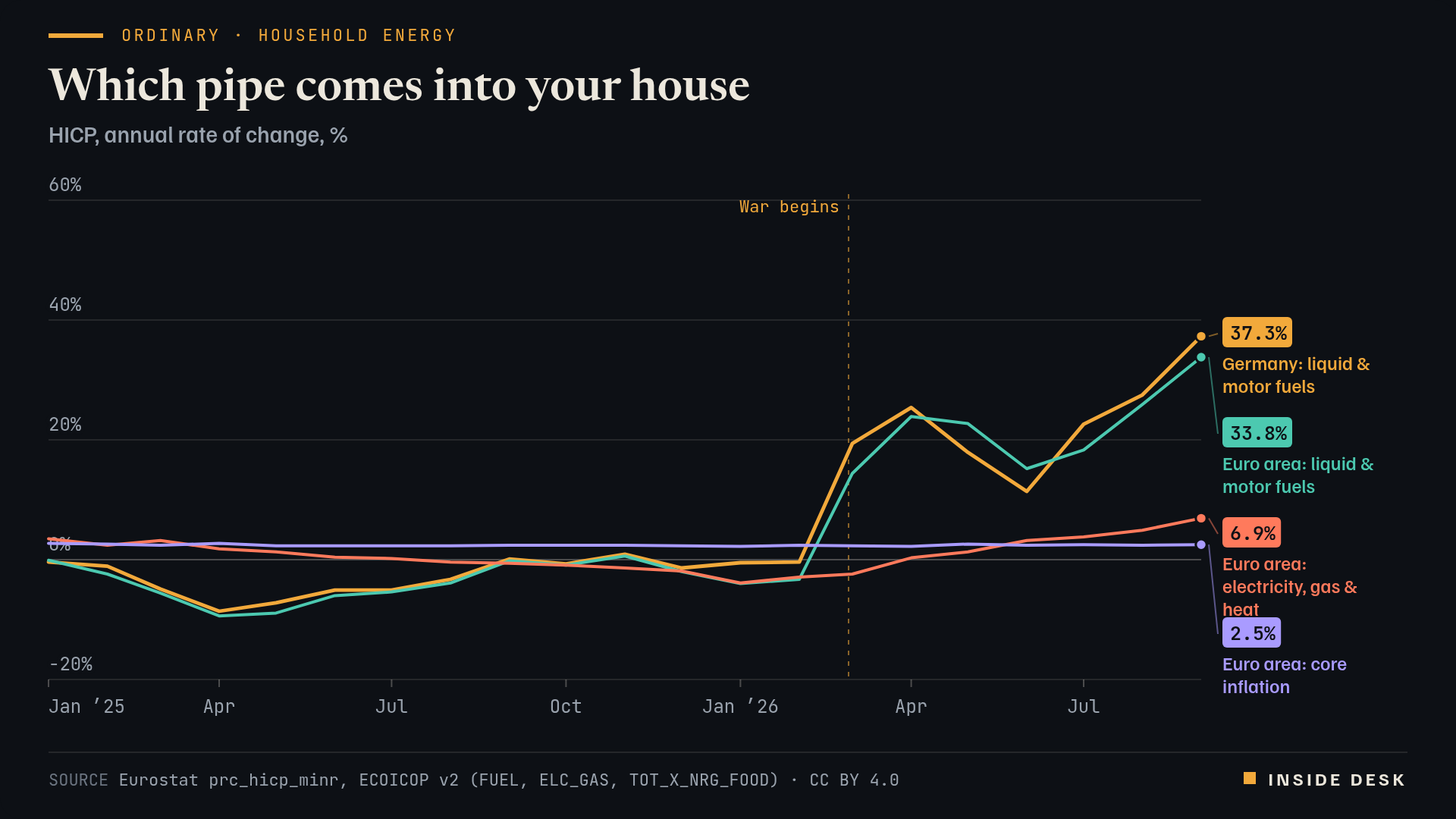
Line chart of annual price changes since January 2025. Liquid and motor fuels fall by up to about 9% a year in spring 2025, then jump after the war begins, reaching +33.8% in the euro area and +37.3% in Germany in September 2026. Electricity, gas and heat rise far less, to +6.9%, and core inflation stays near 2.5%.
Source Eurostat prc_hicp_minr, ECOICOP v2 (FUEL, ELC_GAS, TOT_X_NRG_FOOD) · CC BY 4.0. Eurostat. Reuse authorised under CC BY 4.0 (Commission Decision 2011/833/EU).
Data (CSV) · SVG · PNG

Latest values as a table
| Date | Germany: liquid & motor fuels | Euro area: liquid & motor fuels | Euro area: electricity, gas & heat | Euro area: core inflation |
|---|---|---|---|---|
| 2026-04-01 | 25.4 | 23.9 | 0.3 | 2.2 |
| 2026-05-01 | 17.9 | 22.7 | 1.3 | 2.6 |
| 2026-06-01 | 11.4 | 15.2 | 3.2 | 2.4 |
| 2026-07-01 | 22.6 | 18.3 | 3.8 | 2.5 |
| 2026-08-01 | 27.5 | 25.9 | 4.9 | 2.4 |
| 2026-09-01 | 37.3 | 33.8 | 6.9 | 2.5 |
Where the household sits. Between step two and step four. You pay at the pump before any committee has decided whether the pump matters. Eurostat’s September figures show the split inside one house: liquid and motor fuels up 33.8% on a year across the euro area, electricity, gas and heat up 6.9%, core inflation near 2.5%7. The pipe that comes into your house decides your month more than the average does. That is not a scandal; it is the design. A central bank that moved on every barrel would be a weather vane, and weather vanes are poor at keeping prices stable.
The constructive half. The same order works in reverse. Relief, when it comes, travels the same road: barrel first, pump after, committee later, podium claiming credit at the end. You do not need to guess when. You only need to know which number to watch first, and it is never the speech.
The Friday calls, scored. A desk that makes calls should keep the receipts.
- “The screen is the forecast. The tank is the invoice.” Open. Futures rose towards spot by Friday’s close2, but the spot price for that day is not yet published. We will score it after the EIA release.
- “The average stock had a better day than the index” (Thursday). Not repeated. On Friday slightly more than half of the stocks in the S&P 500 fell, and the index lost 1.1%6. It was a day, not a regime, and we said so too quietly.
- “The committee is behind the print, on purpose.” Holding. Saturday’s statement says so in the committee’s own words: no evidence yet of significant pass-through to other prices and wages beyond what was already projected4.
None of this is advice. It is an order of events, and the order is the most honest thing the week produced.
What to watch
- Monday's first oil print after Saturday's seven-day plan. The podium spoke while the screens were dark; the screen answers first.
- ADAC's next weekly pump reading: does Friday's barrel arrive at the pump, and how fast?
- EIA's next Brent spot release (FRED lists 21 October), to score Friday's screen-versus-tank call properly.
- The Fed (27–28 October) and the ECB (28–29 October): committees that wait for wages, not for barrels.
Read the week in the order the money moved. The speech is always the last thing to arrive and the first thing you hear.
Sources
- Tanken in Deutschland: Benzinpreis und Dieselpreis steigen leicht an — ADAC, 14 Oct 2026.
- Oil touches $110 on continued uncertainty over Middle East supplies — The National, 16 Oct 2026, updated 17 Oct.
- Fed's Warsh withholds rate signal, praises recent global tightening — CNBC, 16 Oct 2026.
- IMFC Statement by Christine Lagarde, President of the ECB — European Central Bank, 17 Oct 2026.
- Iran says it sent Washington Hormuz reopening plan via mediator Qatar — Iran International, 17 Oct 2026.
- US markets are weighed down by an extended sell-off in the tech sector — Associated Press, 16 Oct 2026.
- HICP – monthly data, annual rate of change (prc_hicp_minr) — Eurostat, released 16 Oct 2026.
Every figure in this piece traces to a source above or to the desk’s own arithmetic on those sources, marked as such. Quotations are short and attributed. Spot an error? Write to the desk; corrections are logged on the method page.
Commentary for information only. Not investment, legal, tax, medical or political advice. Not an offer or solicitation. Analysis may be incomplete or wrong. Charts show published public data, not a trading feed; binding numbers live with the institutions that publish them.