Morning edition · Thursday, 12 November 2026
844 confirmed cases in a week, 16 deaths so far, and hospital wards that are still quiet: flu starts its German season on schedule
The Robert Koch Institute's weekly report shows influenza rising for a second week, at about the level of a year ago. The useful news is how ordinary that is.
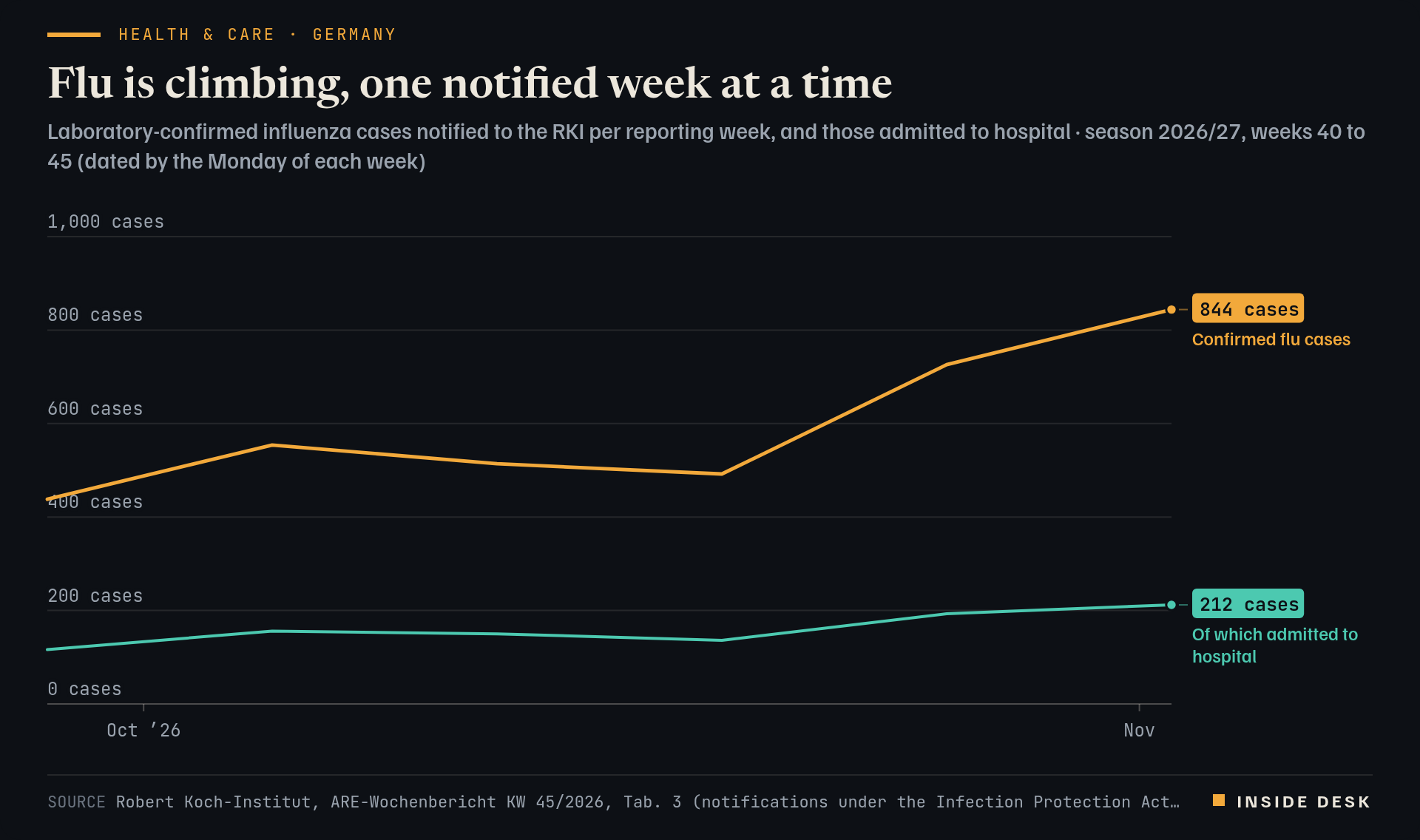
Flu has begun its season in Germany, and it has done so on the timetable. In reporting week 45, 2 to 8 November, 844 laboratory-confirmed influenza cases were notified to the Robert Koch Institute, up from 726 the week before and 492 the week before that1. The RKI says the numbers are rising again and are “similar to last year at this time”1. Since the season’s count began in week 40, 3,569 cases have been notified, and 16 deaths with confirmed influenza, mostly in people aged 60 or over1.
Line chart of weekly laboratory-confirmed influenza cases notified to the Robert Koch Institute in Germany, reporting weeks 40 to 45 of 2026. Cases move between 438 and 554 in the first four weeks, rise to 726 in week 44 and reach 844 in week 45 (2 to 8 November 2026), the latest value. Hospital admissions among them rise from 116 in week 40 to 212 in week 45.
Source Robert Koch-Institut, ARE-Wochenbericht KW 45/2026, Tab. 3 (notifications under the Infection Protection Act, data as of 10 Nov 2026); retrieved 12 Nov 2026. Late notifications can still change the latest and earlier weeks.. Figures as reported by the named organisations; facts cited with attribution.
Data (CSV) · SVG · PNG

Latest values as a table
| Date | Confirmed flu cases | Of which admitted to hospital |
|---|---|---|
| 2026-09-28 | 438 | 116 |
| 2026-10-05 | 554 | 156 |
| 2026-10-12 | 514 | 150 |
| 2026-10-19 | 492 | 136 |
| 2026-10-26 | 726 | 193 |
| 2026-11-02 | 844 | 212 |
Read the hospital figure with its footnote. Of the 504 cases this week with information on hospital status, 212, or 42%, were admitted1. That is a share of people who were tested and reported, not of everyone with flu, and the RKI notes that from this season it is calculated only among cases with that information, so it cannot be compared with earlier seasons’ reports1. Notified cases are the tip of what doctors test; the base of the pyramid is far wider.
That base is measured too. The RKI’s GrippeWeb panel puts acute respiratory illness at about 6,600 per 100,000 people in week 45, up from 5,700, which it translates into roughly 5.5 million new respiratory illnesses in a week, within the usual range for the season1. Most of that is not flu: in the doctors’ sentinel samples, rhinoviruses and enteroviruses led at 33%, influenza followed at 10%, and RSV was at 1%1. The flu viruses found so far are mainly A(H1N1)pdm091.
The part worth underlining is the quiet one. In hospitals, the incidence of severe acute respiratory infection stayed stable at a low level in week 45, and 4% of those patients had an influenza diagnosis1. Nine flu outbreaks with at least five cases have been reported this season, none of them in week 45 so far1. A surveillance system that tells you calmly, every week, that a predictable thing is happening predictably is doing exactly what you pay it for. The rest is up to the ordinary machinery: appointments, stock in pharmacies, and the GP’s calendar.
What to watch
A season that arrives on time is not a crisis. It is a calendar, and calendars can be prepared for.
Sources
- ARE-Wochenbericht des RKI, 45. Kalenderwoche (2.11. bis 8.11.2026) — Robert Koch-Institut, data as of 10 Nov 2026; retrieved 12 Nov 2026, 05:12 CET.
Every figure in this piece traces to a source above or to the desk’s own arithmetic on those sources, marked as such. Quotations are short and attributed. Spot an error? Write to the desk; corrections are logged on the method page.
Commentary for information only. Not investment, legal, tax, medical or political advice. Not an offer or solicitation. Analysis may be incomplete or wrong. Charts show published public data, not a trading feed; binding numbers live with the institutions that publish them.