Evening edition · Wednesday, 11 November 2026
€199.05 for Thursday: a third off in one auction
Wednesday's auction priced Thursday's power at €117.60 less than Wednesday's. Most of Thursday's hours now clear below Wednesday's cheapest one.
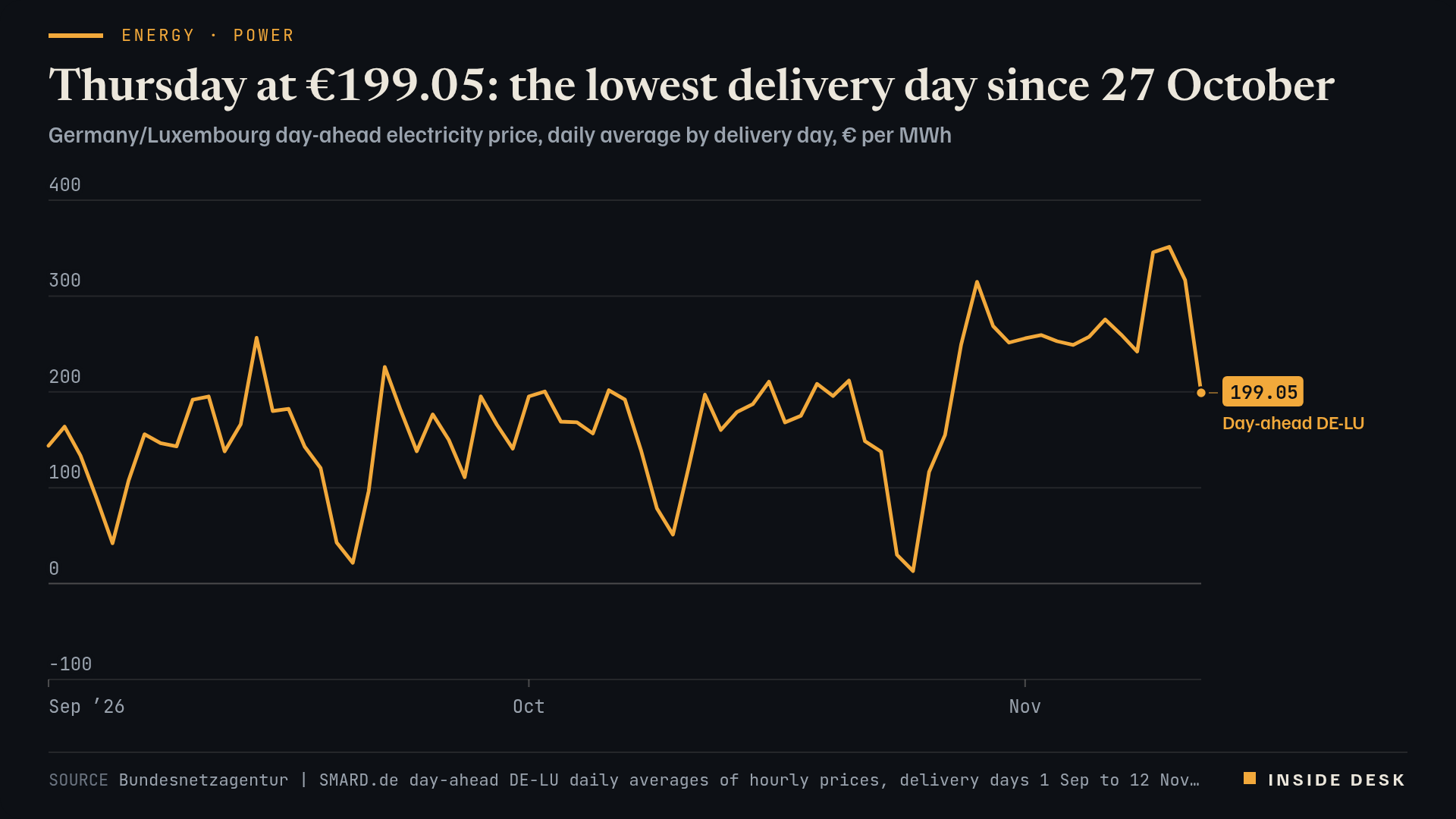
Thursday’s electricity was auctioned on Wednesday, and it came out cheap by the standards of this fortnight. The German-Luxembourg day-ahead price for delivery on Thursday 12 November averages €199.05 per megawatt hour, against €316.65 for Wednesday and a record €351.48 for Tuesday1. Desk arithmetic: that is €117.60, or about 37.1%, below Wednesday, and the lowest delivery day since €155.12 on Tuesday 27 October1.
Line chart of the daily average German-Luxembourg day-ahead electricity price from 1 September to 12 November 2026, in euros per megawatt hour. It falls to €13.12 on Sunday 25 October, climbs to €314.85 on Thursday 29 October, stays between €242.13 and €275.64 from 2 to 8 November, then reaches €345.64 on 9 November and a record €351.48 on 10 November. Wednesday 11 November is €316.65. The latest value is €199.05 for delivery on Thursday 12 November, €117.60 below Wednesday and the lowest delivery day since €155.12 on Tuesday 27 October.
Source Bundesnetzagentur | SMARD.de day-ahead DE-LU daily averages of hourly prices, delivery days 1 Sep to 12 Nov 2026 (Thursday 12 Nov €199.05, auction of 11 Nov), retrieved 11 Nov 2026, 16:31 CET · CC BY 4.0. Bundesnetzagentur | SMARD.de, market data. CC BY 4.0.
Data (CSV) · SVG · PNG

Latest values as a table
| Date | Day-ahead DE-LU |
|---|---|
| 2026-11-07 | 259.83 |
| 2026-11-08 | 242.13 |
| 2026-11-09 | 345.64 |
| 2026-11-10 | 351.48 |
| 2026-11-11 | 316.65 |
| 2026-11-12 | 199.05 |
The cheapest hour became the average. Wednesday’s cheapest hour, 03:00, cleared at €200.391. Thursday’s whole-day average is below that. Desk arithmetic: 14 of Thursday’s 24 hours clear below Wednesday’s best hour. The cheapest is 23:00 at €140.25; the dearest is 08:00 at €244.821. Wednesday’s dearest hour, 17:00, cost €447.651. On Thursday the same hour costs €222.30.
The evening lost its sting. This is the part that matters for a household. Thursday’s four evening hours from 16:00 to 19:00 clear between €199.19 and €225.651; on Wednesday every one of them was above €390. Desk arithmetic: Thursday’s evening averages about €215.79. The country still cooks, heats and charges at teatime; on Thursday it will simply pay less for doing so.
What we do not know yet. SMARD’s generation forecast for Thursday had not been published when we checked; its latest wind figures still end with Wednesday, when onshore and offshore together were forecast at about 148.1 GWh2. So you should treat any confident story about why Thursday is cheaper with care until the forecast is out. An auction result is a fact. An explanation offered before the data is a guess.
For you. On a fixed tariff, a single cheap day changes nothing on this month’s bill. On a dynamic tariff, Thursday is the friendliest day of the week so far: the late evening from 21:00 clears between €140.25 and €165.391, so that is the window for the washing machine and the car. And €199.05 is still about 20 cents a kilowatt hour before grid fees and taxes, not a bargain. Nothing here is investment advice.
What to watch
A price that falls by a third in one day was never a law of nature. It was an auction.
Sources
- Marktdaten: Großhandelspreise DE/LU day-ahead, hourly (filter 4169) — Bundesnetzagentur | SMARD.de, retrieved 11 Nov 2026, 16:31 CET.
- Marktdaten: Prognostizierte Erzeugung (wind onshore, wind offshore, solar), hourly — Bundesnetzagentur | SMARD.de, retrieved 11 Nov 2026, 16:33 CET.
Every figure in this piece traces to a source above or to the desk’s own arithmetic on those sources, marked as such. Quotations are short and attributed. Spot an error? Write to the desk; corrections are logged on the method page.
Commentary for information only. Not investment, legal, tax, medical or political advice. Not an offer or solicitation. Analysis may be incomplete or wrong. Charts show published public data, not a trading feed; binding numbers live with the institutions that publish them.