Sunday long-read · Sunday, 8 November 2026
The Sunday long read: oil answered the ballot box, the power price answered the weather
Brent had its steepest weekly fall since April 2020. German day-ahead power did not notice: every delivery day from Monday to Saturday cleared above €248 a megawatt-hour. Two markets, two masters, and one household bill that answers to neither this month.
If you had only read the oil pages this week, you would think energy had become cheap. It has not. It has become two things at once, and the useful work this Sunday is to keep them apart.
The barrel. Front-month Brent for January delivery lost $15.11 over the week, or 13.32%, to settle at $98.32 a barrel on Friday, according to Dow Jones Market Data1. That was its largest weekly percentage fall since the week ending 24 April 2020, and it ended a six-week winning streak1. The decisive day was Wednesday, after the US midterm results: Brent fell 8.7% to $94.62, its lowest settlement since 31 August2. Markets read the result as a rebuke of the war with Iran, and the vice-president read it the same way: “The reason we lost is the war,” JD Vance wrote2.
Then the barrel did what barrels do when the facts have not changed as much as the mood. It rose for two sessions, by $3.701, because tankers kept being attacked in the Strait of Hormuz and the Bab al-Mandeb, and because the president said on Thursday that “now we will make a decision” between a settlement and further strikes2. Brent is still 54.52% above where it stood a year ago1. A 13% fall from a high place is a fall, not a landing.
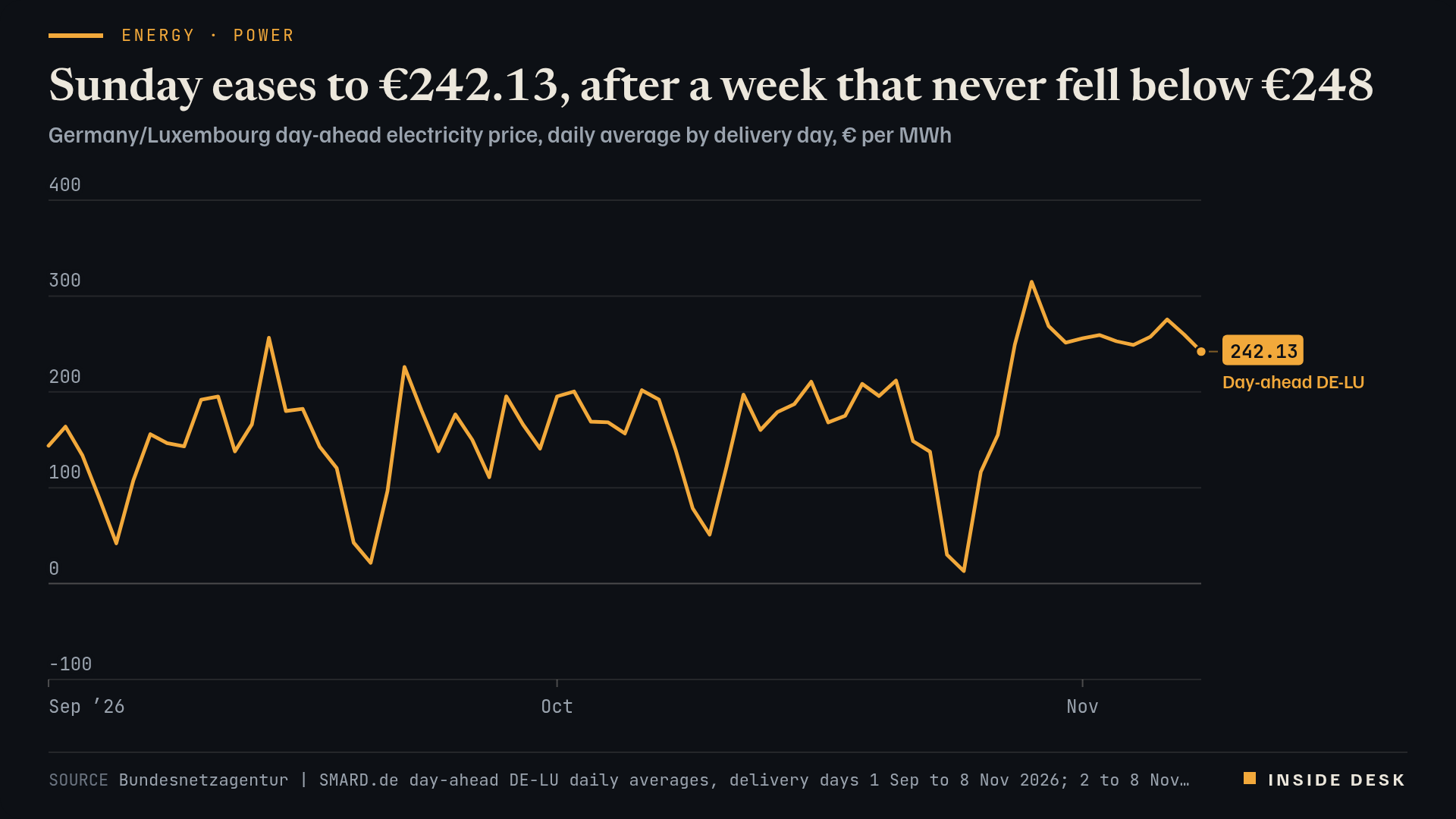
The wire. Now look at the other chart in this edition. The German-Luxembourg day-ahead price, the wholesale auction that sets the next day’s electricity, cleared at €259.31 a megawatt-hour for Monday, €252.85 for Tuesday, €248.99 for Wednesday, €257.38 for Thursday, €275.64 for Friday and €259.83 for Saturday3. Today, Sunday, it is €242.13, with the cheapest hour at 13:00 and the dearest at 18:003. A year ago the same Sunday cost €106.503.
Line chart of the daily average German-Luxembourg day-ahead electricity price from 1 September to 8 November 2026, in euros per megawatt hour. It falls to €13.12 on Sunday 25 October during the storm, climbs to €314.85 on Thursday 29 October, and stays between €248.99 and €275.64 on every delivery day from 2 to 7 November. The latest value is €242.13 for delivery on Sunday 8 November, more than twice the €106.50 a year earlier and well above September's average near €145.
Source Bundesnetzagentur | SMARD.de day-ahead DE-LU daily averages, delivery days 1 Sep to 8 Nov 2026; 2 to 8 Nov values as published by contracting.green from SMARD (Sunday 8 Nov €242.13, auction of 7 Nov), retrieved 8 Nov 2026 · CC BY 4.0. Bundesnetzagentur | SMARD.de, market data. CC BY 4.0.
Data (CSV) · SVG · PNG

Latest values as a table
| Date | Day-ahead DE-LU |
|---|---|
| 2026-11-03 | 252.85 |
| 2026-11-04 | 248.99 |
| 2026-11-05 | 257.38 |
| 2026-11-06 | 275.64 |
| 2026-11-07 | 259.83 |
| 2026-11-08 | 242.13 |
Read the week in that order and the story is plain. Wednesday’s power, auctioned at noon on Tuesday, dipped by 1.5%3. Friday’s, auctioned on Thursday after oil had already crashed, rose 7.1% to the week’s high3. The two series did not move together because they do not answer to the same master. Oil answers to Washington, Tehran and the shipping lanes. German power in November answers to wind, darkness and the gas plants that fill the evening when the turbines are slow. That is why the dearest hour is 18:00 nearly every day: it is when you come home, switch on the light and cook, and when the sun has already gone.
Keep the scale in view, too. The auction price is only the energy share of your bill. Households paid on average 36.18 cents per kilowatt-hour in the first half of 2026, including taxes, levies and grid fees, according to Eurostat figures cited alongside the SMARD data3. Sunday’s €242.13 per megawatt-hour is 24.21 cents per kilowatt-hour before any of those are added3. Gas at the Dutch TTF hub averaged €86.81 per megawatt-hour in October, on the same page’s figures3. Gas still sets the evening price, and gas is not cheap.
The pump. The household does feel oil, but with a lag and through a filter. ADAC’s weekly survey on Wednesday found Super E10 at €2.041 a litre, 4.3 cents cheaper than a week earlier, and diesel at €2.260, down 2.9 cents4. The club pointed out that Brent had fallen about ten dollars in a week and said further price cuts “should be possible”, especially for diesel, which still costs almost 22 cents more than E104. Note the tense. The barrel moves in seconds; the price board moves when the forecourt’s stock and its competitors move. That lag is not a conspiracy. It is inventory, and it works in both directions.
The war that is about heat. There was a second energy war this week, and it was not about barrels. Overnight into Saturday Russia launched 172 drones and 36 ballistic missiles at Ukraine, President Zelenskyy said, and only four of the missiles were intercepted5. “The capital is facing serious difficulties with its electricity, water, and heat supplies,” he wrote, adding that substations had been hit in five regions5. Kyiv’s mayor called the energy situation “extremely difficult”5. US-brokered talks between Russia and Ukraine are due in Abu Dhabi on Tuesday5. In Europe we argue about the price of a megawatt-hour; in Kyiv the question this weekend is whether there is one at all.
The meeting that is about the wires. On Monday, COP31 opens in Antalya6. One of the host’s prominent aims is a voluntary goal on electrification, and Reuters puts its finger on the catch: unless the electricity is low-carbon, more of it does not curb emissions6. Turkey generated 34% of its power from coal last year, according to the think tank Ember, making it Europe’s biggest coal-fired generator6. Its energy minister says the country aims for 10 gigawatts of nuclear capacity by 2040, which Reuters calculates would roughly equal today’s coal-fired output6. That is a plan with a date on it, which is more than most speeches will offer this fortnight.
What the week argues. Three lessons, none of them exciting.
First, an oil price is a vote on the future, and votes can be counted again. The same week that sent Brent to $94.62 on Wednesday sent it back near $98 by Friday1,2. Treat any single day as a mood, not a price.
Second, your electricity is not priced in Brent. In a German November it is priced in wind and gas, hour by hour, and the hour that costs most is the one you use most3. That is not a reason for alarm. It is a reason to know your tariff, and if you have a dynamic one, to know when 13:00 comes round.
Third, the machinery that protects households is slow on purpose. A fixed contract buys its power months ahead, so a dear week in the wholesale market reaches you, if at all, at the next price change3. A forecourt sells the fuel it already bought4. These buffers annoy us when prices fall and save us when they rise. They were designed by people who expected weeks exactly like this one.
So when someone tells you this week that energy has turned, ask which energy. The barrel turned. The wire did not. And the bill on your doormat will answer to a contract signed long before either of them moved. Nothing here is investment advice.
What to watch
- Monday's day-ahead auction, which closes at noon and publishes shortly after; the result sets Monday's wholesale power price3.
- Whether Washington chooses a deal or renewed strikes on Iran; President Trump said on Thursday a decision would come soon2.
- COP31 in Antalya from Monday to 20 November, where host Turkey has proposed a voluntary goal on electrification6.
A barrel of oil can change its mind in a week. A power station, a pipe and a heating contract take a winter.
Sources
- Front Month ICE Brent Crude Fell 13.32% This Week to Settle at $98.32 — Data Talk — Dow Jones Market Data via Morningstar, 6 Nov 2026.
- Oil prices post sharp weekly drop on Trump's election rout — The National, 6 Nov 2026, updated 7 Nov 2026, 04:58 CET.
- Strompreis Börse heute & morgen (Day-Ahead DE/LU, daily notices 2 to 7 Nov 2026) — contracting.green, from Bundesnetzagentur | SMARD.de, updated 7 Nov 2026, 18:44 CET, retrieved 8 Nov 2026.
- Kraftstoffpreise: Rückgang bei Benzin und Diesel — ADAC, 4 Nov 2026.
- Zelenskyy accuses Russia of escalating strikes ahead of peace talks — Al Jazeera (with AFP, AP and Reuters), 7 Nov 2026.
- Turkish villagers demand COP31 leaders see for themselves devastation caused by coal — Reuters via The Straits Times, 8 Nov 2026, 08:03 CET.
Every figure in this piece traces to a source above or to the desk’s own arithmetic on those sources, marked as such. Quotations are short and attributed. Spot an error? Write to the desk; corrections are logged on the method page.
Commentary for information only. Not investment, legal, tax, medical or political advice. Not an offer or solicitation. Analysis may be incomplete or wrong. Charts show published public data, not a trading feed; binding numbers live with the institutions that publish them.