Sunday long-read · Sunday, 8 November 2026 · 10:23 CET
Oil answered the ballot box. The power price answered the weather
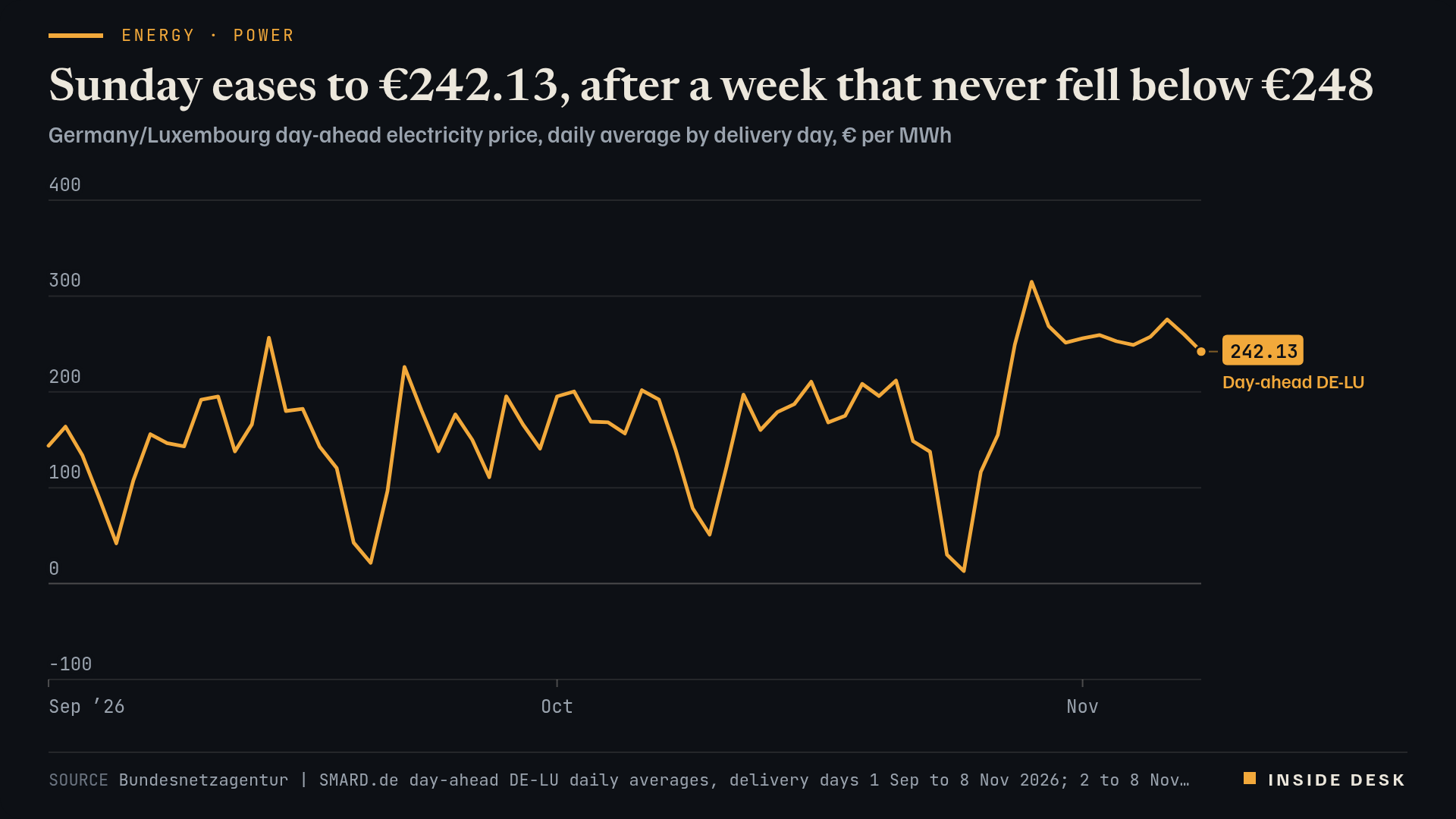
Brent had its steepest weekly fall since April 2020 after the midterms, yet German wholesale power never cleared below €242 a megawatt-hour all week. Chips crashed and bounced, COP31 opens in Antalya on Monday, and the week's most useful numbers were the dull ones: a 2.9% contribution rate, 190,000 soldiers and €2.15 off a tank.
Morning 08:30 · Evening 17:30 · Sunday 10:00, Berlin time
Brent had its steepest weekly fall since April 2020. German day-ahead power did not notice: every delivery day from Monday to Saturday cleared above €248 a megawatt-hour. Two markets, two masters, and one household bill that answers to neither this month.
If you had only read the oil pages this week, you would think energy had become cheap. It has not. It has become two things at once, and the useful work this Sunday is to keep them apart.
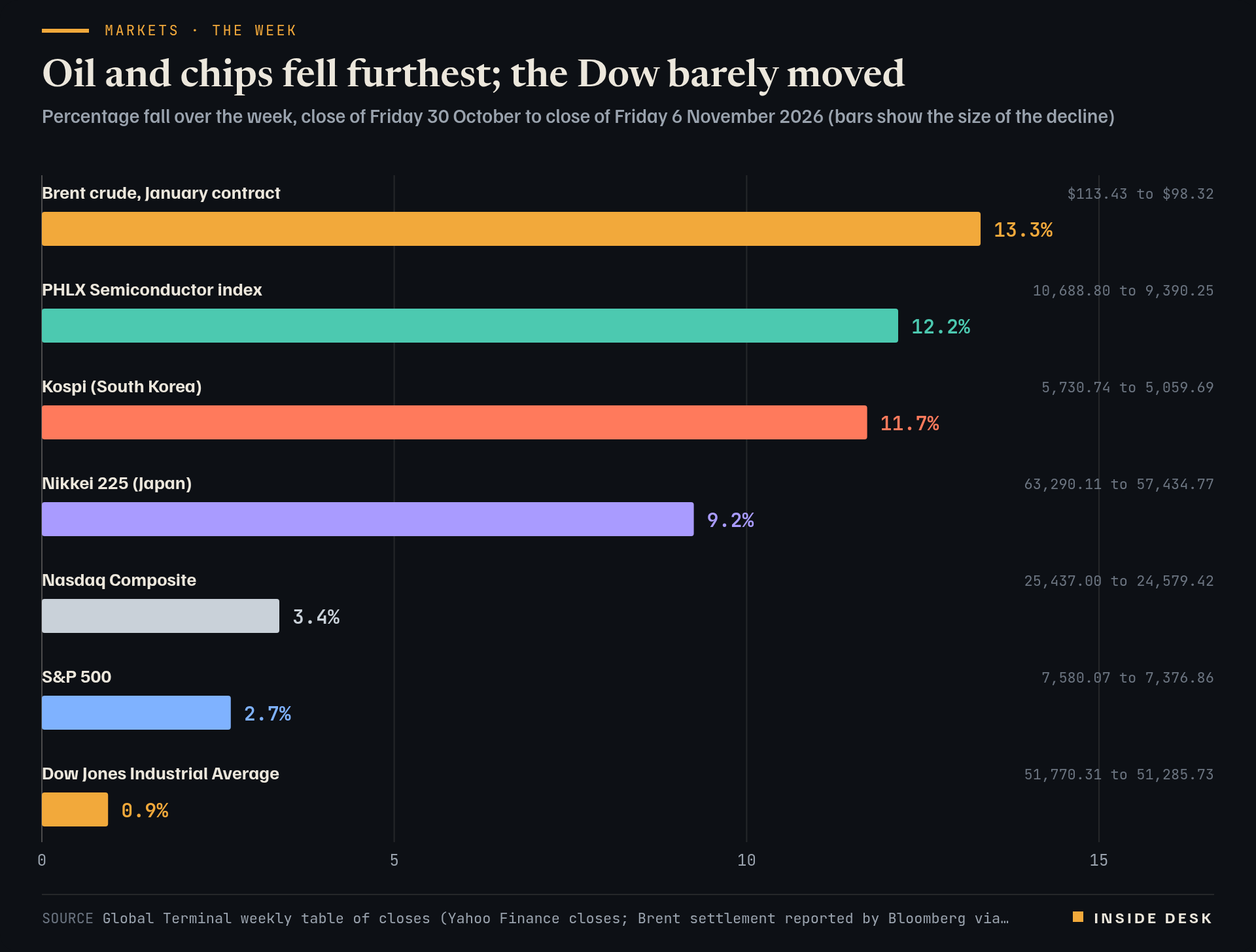
**The barrel.** Front-month Brent for January delivery lost $15.11 over the week, or 13.32%, to settle at $98.32 a barrel on Friday, according to Dow Jones Market Data. That was its largest weekly percentage fall since the week ending 24 April 2020, and it ended a six-week winning streak. The decisive day was Wednesday, after the US midterm results: Brent fell 8.7% to $94.62, its lowest settlement since 31 August. Markets read the result as a rebuke of the war with Iran, and the vice-president read it the same way: "The reason we lost is the war," JD Vance wrote.
The S&P 500 lost 2.68% on the week, its worst since April 2025. The total hides the order: Wednesday's best day in three months came before Thursday's worst in 19.
Washington's midterms took 13% off Brent in a week. Over the same days, missiles flew at Riyadh, tankers burned in Hormuz and a seafarer died in the Gulf. The supply map has its own calendar.
The coalition's amendment to the intelligence-services law lets the BND enter homes in secret, gives the Verfassungsschutz a look at organised crime, and adds a 'freeze' for telecoms data. The safeguards are in the sub-clauses, so that is where we read.
A global survey finds people rate their own relationships and sense of meaning highly, and their country's politics and economy poorly. The young score lowest on vitality. Hybrid workers beat fully remote ones.
Payrolls beat, unemployment fell to 4.1%, and traders raised their bets on a Fed hike next month. Yields still ended the week lower. The rate desk's week was about the same two numbers the stock desk ignored.
Oil fell hard this week. The household ledger shows what reached you: a few cents a litre at the pump, nothing yet on the electricity bill, and heating oil that barely moved.
While the AI trade crashed and bounced, the industry's real constraint was quietly priced elsewhere: in the plants that glue chips together. Advanced packaging revenue is set to overtake the traditional kind this year.
The health ministry has set the average additional contribution for statutory insurance at 2.9%, unchanged. Spending is expected to grow by under 3% next year after almost 7% this year. Your own fund still sets its own rate.
Nearly 200 countries meet from 9 to 20 November. The host wants a voluntary target for more electrification. The test is what generates the electricity: last year a third of Turkey's came from coal.
On Sunday evening, write three numbers on one card: what a litre of fuel cost the last time you filled up, the price per kilowatt-hour on your electricity contract, and how full your heating-oil tank is or what your gas meter reads. Do the same next Sunday. After a month you will know which of this winter's headlines actually reached your house, and which only reached the news.
A habit, not advice.
What went right
Researchers in Hannover and Würzburg note that prospective studies put malnutrition among hospital patients at 30% to 70% at least, yet only 1.16% to 1.30% of inpatients are diagnosed with it. Instead of stopping at the warning, Hannover Medical School signed a contract with the Techniker Krankenkasse so that insured patients are screened for malnutrition on admission, during longer stays and at discharge, with the insurer paying for it, and the data will go to the body that sets hospital quality rules 1. A study found a gap; a clinic and an insurer wrote a contract to close it.
The day in one sentence
Oil fell hard on an American vote, German electricity stayed dear because November is dark and still, and the numbers that will matter most this winter were the quiet ones: a stable health-insurance rate, a record headcount in the army, and two euros off a tank of petrol.
In euros at home
ADAC's survey on Wednesday put Super E10 at €2.041 a litre, 4.3 cents cheaper than a week earlier, and diesel at €2.260, 2.9 cents cheaper 2. Desk arithmetic: on a 50-litre tank that is €2.15 saved on petrol and €1.45 on diesel. For electricity, Sunday's wholesale average of 24.21 cents per kilowatt-hour compares with a household average of 36.18 cents including taxes, levies and grid fees in the first half of 2026 3; on a fixed contract, this week's wholesale moves do not reach your bill until your supplier's next price change 3.
Desk arithmetic on the cited figures.
Small words
Day-ahead auction
Every day at noon, Europe's power exchanges hold an auction for each quarter-hour of the next day. Generators say what they will sell and at what price, buyers say what they need, and the auction finds the price that clears. In Germany and Luxembourg the result is published shortly after midday, which is why this edition can tell you on Sunday morning that Sunday's power averages €242.13 a megawatt-hour, but not yet what Monday's will be.
Strompreis Börse heute & morgen — contracting.green, from Bundesnetzagentur | SMARD.de and Eurostat, updated 7 Nov 2026, 18:44 CET, retrieved 8 Nov 2026
Commentary for information only. Not investment, legal, tax, medical or political advice. "Desk arithmetic" is our own calculation from the cited figures.