Morning edition · Friday, 6 November 2026
Four percent off the index, and a jobs print at half past two
Wall Street's AI sell-off cut the S&P by about 4.4% and put the Nasdaq into a correction. Friday's US payrolls are the next number the committees will read.
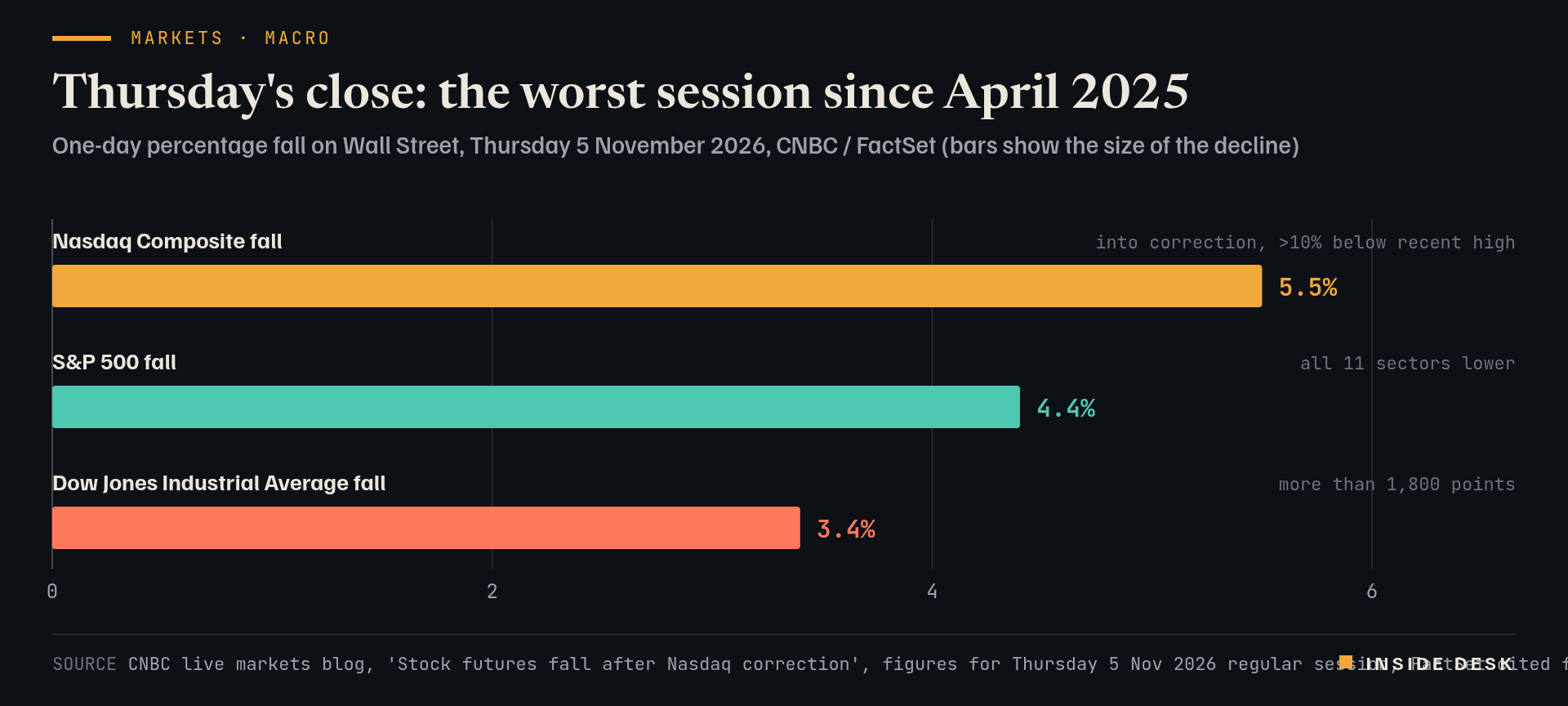
On Thursday Wall Street had its worst session since April 20251. The Nasdaq Composite fell about 5.5% and closed more than 10% below its recent high, which is the textbook definition of a correction1. The S&P 500 lost about 4.4%; the Dow fell more than 1,800 points, or about 3.4%1. All eleven sectors of the S&P finished lower1. Futures after the close pointed a little lower still1.
Bar chart of Thursday 5 November 2026 one-day percentage falls on Wall Street: Nasdaq Composite 5.5 percent (into correction territory), S&P 500 4.4 percent, Dow Jones Industrial Average 3.4 percent, per CNBC. The three major averages posted their worst session since April 2025, FactSet cited.
Source CNBC live markets blog, 'Stock futures fall after Nasdaq correction', figures for Thursday 5 Nov 2026 regular session; FactSet cited for worst-since-April-2025 comparison; retrieved 6 Nov 2026 · reported figures. Figures as reported by the named organisations; facts cited with attribution.
Data (CSV) · SVG · PNG

Latest values as a table
| Value | |
|---|---|
| Nasdaq Composite fall | 5.5% |
| S&P 500 fall | 4.4% |
| Dow Jones Industrial Average fall | 3.4% |
What the market was pricing. The trigger was not a surprise from a company. It was a reading of Tuesday’s midterms. Democrats’ gains in the House and Senate, and in statehouses such as Texas, revived traders’ fears that data-centre construction and the AI build-out could slow under tighter rules1,3. Shares tied to that build-out led the fall: Micron and Advanced Micro Devices each dropped about 17%, Nvidia about 9%, and the so-called Magnificent Seven lost more than $1 trillion of market value between them1. Nvidia turned negative for the year1. President Trump blamed the Democrats for “one of the Worst Days in History”; FactSet’s quieter label was simply the worst session since April 20251.
What travels overnight. By Friday morning in Asia the same story had a second chapter. South Korea’s Kospi plunged more than 6% at one point and later more than 8%, enough to trip circuit breakers; Japan’s Nikkei 225 fell into a bear market, more than 20% below its June peak1. Chip names from SK Hynix to TSMC and SoftBank were cut hard1. That is how a New York afternoon becomes a Tokyo morning: the same argument, a different opening bell. Europe closed mixed on Thursday — Spain up, Germany and Britain slightly down — before the full force of the Nasdaq session was in1.
What arrives at 14:30. The October US jobs report is due at 8:30 a.m. Eastern, 14:30 in Berlin2. Economists polled for the Dow Jones consensus expect about 59,000 nonfarm jobs and an unemployment rate still at 4.2%1,2. That would be sparse by the standards of a decade ago, and roughly in line with a labour market that has been adding only about 35,000 jobs a month on average since early 20252. Layoffs remain low — initial claims fell to 189,000 last week — while long-term unemployment has been rising2. Markets were pricing roughly a 70% chance of a quarter-point Federal Reserve rise on 9 December before the print1. The Bank of England, for its part, has already moved: Bank Rate is 4% as of Thursday [see Money].
The constructive reading. A one-day liquidation is loud; it is not yet a verdict on the machinery underneath. Payrolls, claims, openings and wages are duller, and they are what the Fed actually debates. Data-centre politics is real — voters rejected or restricted projects in 40 of 41 local ballot measures counted by Ballotpedia and CNBC3 — but a ballot measure is not a national ban, and a sell-off is not a statute. For you, the useful habit on a morning like this is narrow: wait for the jobs table before you rewrite the story of the week. The index tells you how scared people were at 22:00 Berlin time. The payrolls table tells you whether the labour market still looks like the one the committees have been describing. Nothing here is investment advice.
What to watch
- Friday 14:30 CET: the Bureau of Labor Statistics October nonfarm payrolls; Dow Jones consensus is about 59,000 jobs and unemployment steady at 4.2%2.
- Whether Friday's Asia session stays as hard as the early prints: South Korea's Kospi and Japan's Nikkei both fell sharply after the Nasdaq correction1.
A correction is a percentage. A committee still wants a payroll.
Sources
- Stock futures fall after Nasdaq correction; Japan's Nikkei 225 enters bear market: Live updates — CNBC, 5 Nov 2026, updated 8:54 p.m. ET / 6 Nov early CET.
- The October jobs report is out Friday. Here's everything to expect — CNBC, 5 Nov 2026, 4:32 p.m. ET.
- Voters rebuff data centers in every ballot measure except one during the 2026 midterms — CNBC, updated 5 Nov 2026, 1:08 p.m. ET.
Every figure in this piece traces to a source above or to the desk’s own arithmetic on those sources, marked as such. Quotations are short and attributed. Spot an error? Write to the desk; corrections are logged on the method page.
Commentary for information only. Not investment, legal, tax, medical or political advice. Not an offer or solicitation. Analysis may be incomplete or wrong. Charts show published public data, not a trading feed; binding numbers live with the institutions that publish them.