Evening edition · Thursday, 5 November 2026
$305bn a year needed, about $30bn sent: the adaptation bill arrives four days before Antalya
UNEP's Adaptation Gap Report says even a tripling of public money would cover a fifth to under a third of what developing countries need by 2035. The more useful pages are about pipes, laws and procedures.
Every year the UN Environment Programme sends the world an invoice, and every year the world pays a fraction of it. The 2026 edition of its Adaptation Gap Report, published in Nairobi on Wednesday and titled, with some candour, “Ready? Not”, puts the bill at around $305 billion a year by 20351. That is UNEP’s central estimate of what developing countries will need to adapt to heat, drought, flood and rising seas, drawn from national climate plans, national adaptation plans and models1. It largely leaves out the private sector’s own needs, which UNEP says could almost double the figure1.
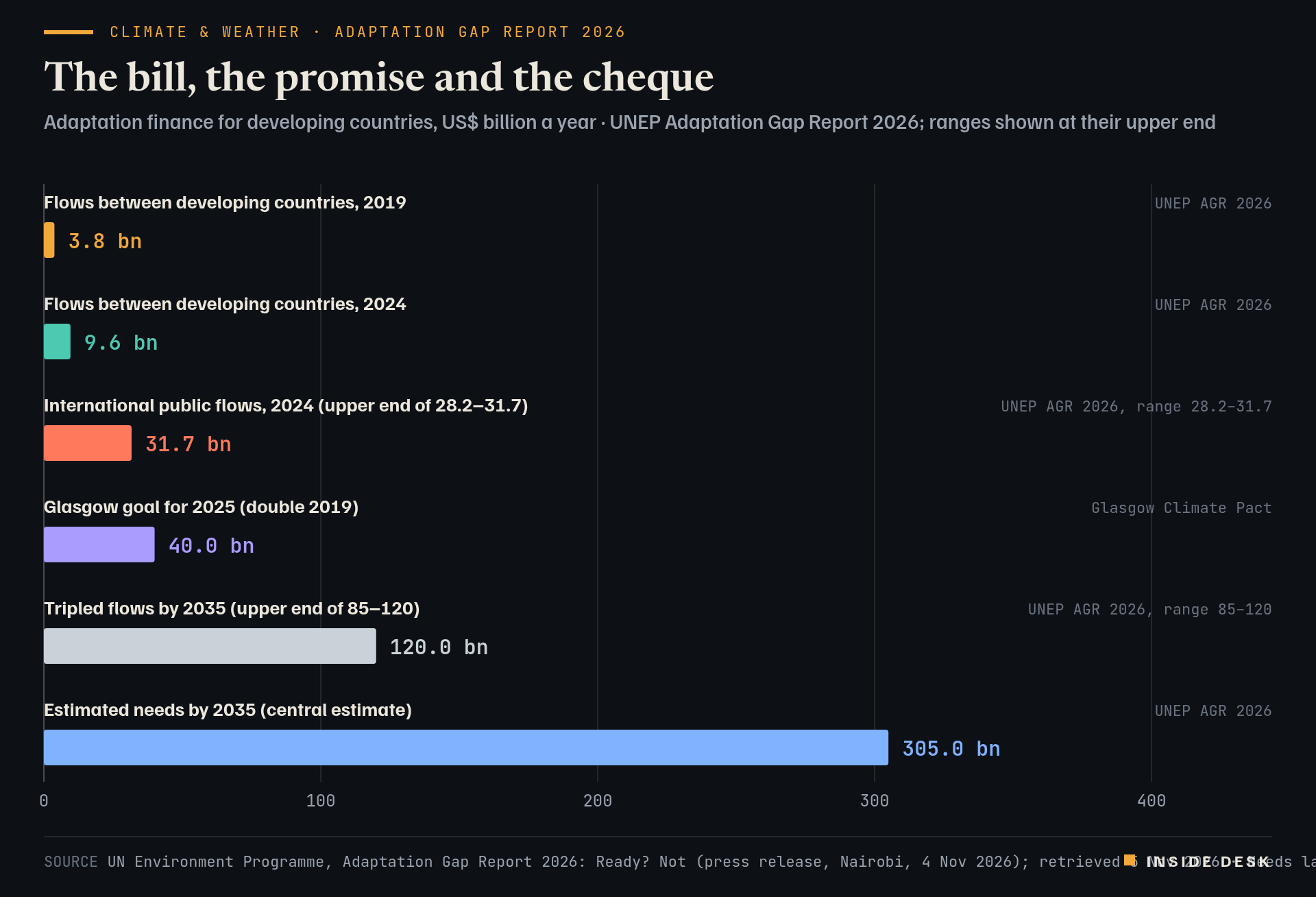
Against that, international public adaptation finance from developed to developing countries reached $28.2 to $31.7 billion in 20241. That was one billion dollars more than the year before1. Desk arithmetic: even at the upper end, the 2024 flows were about a tenth of the 2035 need.
Bar chart of adaptation finance for developing countries in US dollars a year, from UNEP's Adaptation Gap Report 2026. Flows between developing countries rose from 3.8 billion in 2019 to 9.6 billion in 2024. International public flows from developed countries were 28.2 to 31.7 billion in 2024 (bar at 31.7). The Glasgow goal for 2025 is 40 billion. Tripling by 2035 would give 85 to 120 billion (bar at 120). Estimated needs by 2035, the largest bar, are about 305 billion a year.
Source UN Environment Programme, Adaptation Gap Report 2026: Ready? Not (press release, Nairobi, 4 Nov 2026); retrieved 5 Nov 2026 · Needs largely exclude the private sector's own needs.. Figures as reported by the named organisations; facts cited with attribution.
Data (CSV) · SVG · PNG

Latest values as a table
| Value | |
|---|---|
| Flows between developing countries, 2019 | 3.8 bn |
| Flows between developing countries, 2024 | 9.6 bn |
| International public flows, 2024 (upper end of 28.2–31.7) | 31.7 bn |
| Glasgow goal for 2025 (double 2019) | 40 bn |
| Tripled flows by 2035 (upper end of 85–120) | 120 bn |
| Estimated needs by 2035 (central estimate) | 305 bn |
The tripling, and what it buys. At COP30 in Belém last year, governments agreed in the so-called Global Mutirão decision to make efforts to at least triple adaptation finance by 20351,2. Depending on the starting point, current flows or the Glasgow Climate Pact, that would mean $85 to $120 billion a year by 20351. Adjusted for inflation, UNEP says, that would meet just 20 to 29 per cent of needs1. “The world is not ready to adapt to current climactic conditions, never mind what overshoot of 1.5°C will bring,” said Inger Andersen, UNEP’s executive director1.
Where the money already goes further. For the least developed countries and small island states, tripling flows could meet 49 to 83 per cent of their needs1. Those are the places with the least room to borrow and the most coastline per citizen, and there the gap is closable with sums donors already discuss. UNEP also notes, less happily, that flows to those two groups have fallen from a 2022 peak when they should be rising1.
Money is also starting to move sideways rather than only from north to south. Contributions between developing countries, through multilateral development banks and direct South–South cooperation, rose from $3.8 billion in 2019 to $9.6 billion in 20241. Desk arithmetic: that is about two and a half times as much in five years. Multilateral development banks are likely to have increased their adaptation lending significantly in 2025, and the Glasgow pledge to double finance from 2019 levels to $40 billion by 2025 could still be met1. Whether it is depends on bilateral donors as aid budgets shrink1.
The dull machinery. The report’s most constructive section is not about dollars. Progress, it says, depends on institutions that turn priorities into built things, and governments are already strengthening them: climate framework laws, platforms where officials learn from one another, coordination across ministries and levels of government, and dedicated mechanisms to raise and manage climate finance1. That is the unglamorous part of adaptation. A sea wall needs a land register, a procurement office and a maintenance budget before it needs a ribbon. Countries that build that machinery first tend to spend money faster when it arrives.
The queue at the counter. The weakest link is losses and damages, the harm adaptation cannot prevent. The first round of the Fund for responding to Loss and Damage received requests worth $2.8 billion against an initial envelope of $342 million1,2. Desk arithmetic: requests were about eight times the money on offer. UNEP calls for simpler access procedures, predictable support and a say for affected communities1. A fund that is oversubscribed eight times is a fund people trust enough to apply to. The task now is to stock the shelves and shorten the forms.
What Antalya can do with this. COP31 opens on Monday, 9 November, and runs to 20 November3. Climate Home News reports that the EU says it is coming without new money, and that African and other developing countries will push for a number to be put on the tripling goal, along with a baseline and a route to it3. African negotiators have asked for adaptation finance to be added to the formal agenda3. Other business includes how to put the 59 adaptation indicators agreed last year into practice, and giving the Adaptation Fund a mandate to receive the proceeds of a 5% levy on UN carbon markets3. That last item is a small, automatic revenue stream, the kind of plumbing that keeps paying after the speeches end.
For you, in Germany, the $305 billion is less distant than it looks: better-protected ports, crops and supply chains abroad make the goods you buy more reliable. Adaptation finance is, among other things, an insurance premium on the world’s inventories.
The report’s title is “Ready? Not”1. It is an accurate answer to today’s question. The rest of the report describes how the answer changes: laws passed, offices staffed, funds that are oversubscribed because they work. That is slower than a summit communiqué. It is also more durable.
What to watch
A promise is a number; a project is a number with a bank account attached.
Sources
- As world heads for overshoot of 1.5°C, adaptation is too slow — UN Environment Programme, 04 Nov 2026.
- 'The world is not ready': Climate adaptation cash falls far short as warming heads past 1.5°C — UN News, 04 Nov 2026.
- COP31 Briefing: What to expect from the Antalya climate summit? — Climate Home News, 05 Nov 2026.
Every figure in this piece traces to a source above or to the desk’s own arithmetic on those sources, marked as such. Quotations are short and attributed. Spot an error? Write to the desk; corrections are logged on the method page.
Commentary for information only. Not investment, legal, tax, medical or political advice. Not an offer or solicitation. Analysis may be incomplete or wrong. Charts show published public data, not a trading feed; binding numbers live with the institutions that publish them.