Evening edition · Thursday, 5 November 2026
€275.64 for Friday, and even its cheapest hour beats 28 of September's 30 days
Germany's day-ahead auction priced Friday at the highest daily average since 29 October. The floor of the day, not just the peak, is what has moved.
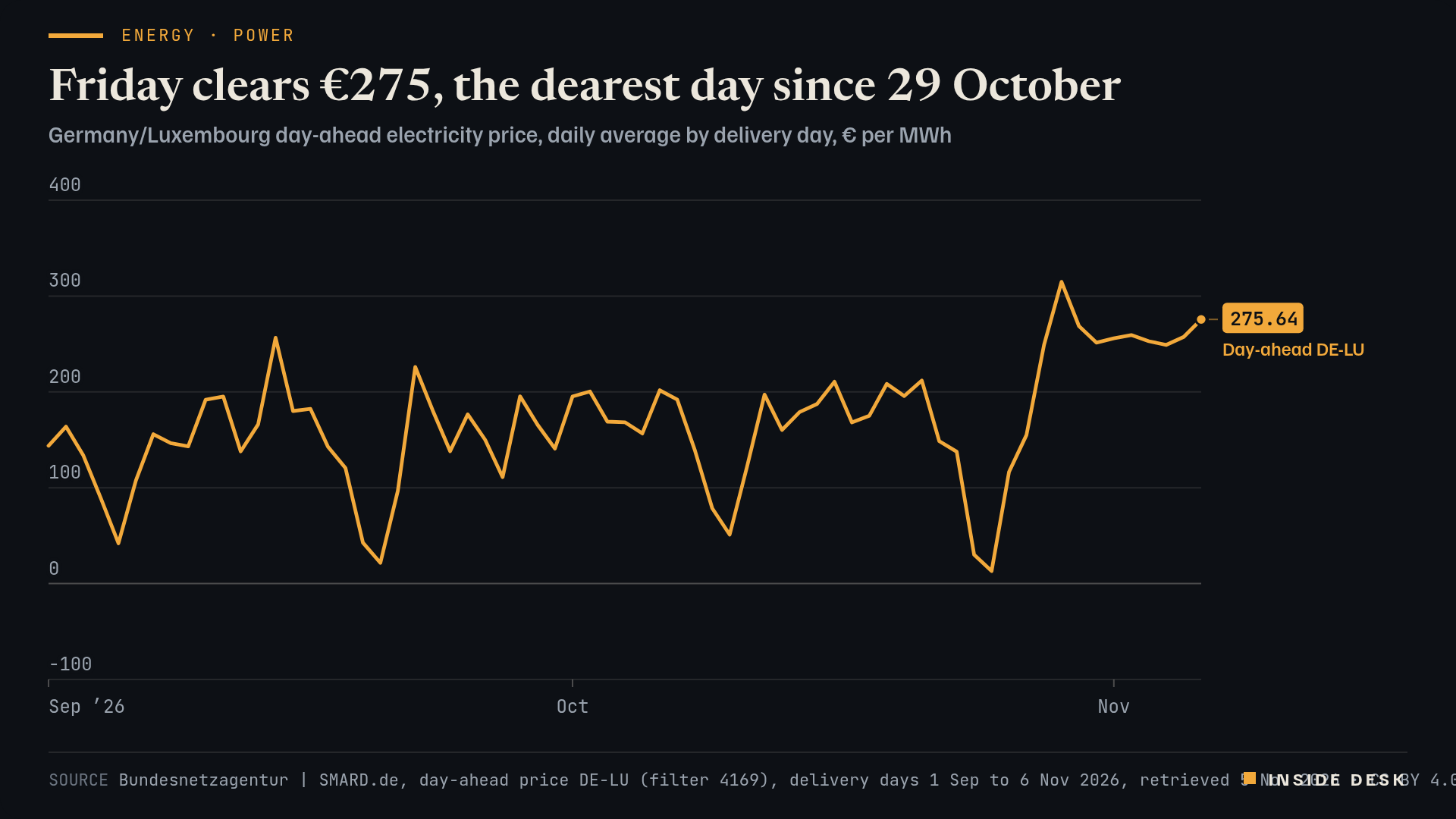
The day-ahead auction for Friday 6 November settled at an average of €275.64 per megawatt hour for Germany and Luxembourg, SMARD data show1. That is €18.26 above Thursday’s €257.38 and the highest daily average since the €314.85 of Thursday 29 October1. Desk arithmetic: it is about 1.9 times September’s average of €144.82.
Line chart of the daily average German-Luxembourg day-ahead electricity price from 1 September to 6 November 2026, in euros per megawatt hour. It falls to €30.12 on Saturday 24 October and €13.12 on Sunday 25 October during the storm, then climbs to €314.85 on Thursday 29 October, the highest daily average of 2026 so far. From 29 October every delivery day has stayed near or above €250, with Wednesday 4 November at €248.99 and Thursday 5 November at €257.38, and the latest value is €275.64 for delivery on Friday 6 November, the highest since 29 October.
Source Bundesnetzagentur | SMARD.de, day-ahead price DE-LU (filter 4169), delivery days 1 Sep to 6 Nov 2026, retrieved 5 Nov 2026 · CC BY 4.0. Bundesnetzagentur | SMARD.de, market data. CC BY 4.0.
Data (CSV) · SVG · PNG

Latest values as a table
| Date | Day-ahead DE-LU |
|---|---|
| 2026-11-01 | 255.91 |
| 2026-11-02 | 259.31 |
| 2026-11-03 | 252.85 |
| 2026-11-04 | 248.99 |
| 2026-11-05 | 257.38 |
| 2026-11-06 | 275.64 |
The shape of the day. The hourly curve has the familiar two humps. Prices climb from €229.65 at 05:00 to €323.06 at 07:00, ease to €226.97 at noon when the sun does some work, and then rise into the evening, peaking at €357.12 for the hour from 18:001. The spread between the dearest and the cheapest hour is €134.741.
The floor is the news. Friday’s cheapest hour, €222.38 at 03:00, would have been an expensive whole day in September: only two September delivery days, the 14th and the 22nd, averaged more1. A high peak says that demand is stretching supply for a few hours. A high floor says power is expensive even at night, when demand is lowest. The fuel side offered no relief on Thursday: the Dutch TTF gas benchmark was about €89.35 per megawatt hour in the afternoon, up 1.5% on the day, and Brent was back up 2.7% at $97.202.
What it means for you. Most households do not pay the day-ahead price; their supplier buys ahead and smooths it. If you have a dynamic tariff, the instruction is unchanged and unglamorous: the hours before 06:00 and around midday are the least bad, and the 17:00 to 20:00 block is where a dishwasher or an electric car costs the most1. The auction is published every day around noon. It is one of the most useful free documents in the country.
What to watch
The peak hour makes the headline. The cheapest hour tells you what the system now needs to run at all.
Sources
- Großhandelspreise, day-ahead DE-LU (filter 4169), hourly and quarter-hourly, delivery 1 Sep to 6 Nov 2026 — Bundesnetzagentur | SMARD.de, retrieved 05 Nov 2026, 16:30 CET.
- Brent crude rebounds above $97 as energy prices recover some losses — Anadolu Agency, 05 Nov 2026, 14:30 CET.
Every figure in this piece traces to a source above or to the desk’s own arithmetic on those sources, marked as such. Quotations are short and attributed. Spot an error? Write to the desk; corrections are logged on the method page.
Commentary for information only. Not investment, legal, tax, medical or political advice. Not an offer or solicitation. Analysis may be incomplete or wrong. Charts show published public data, not a trading feed; binding numbers live with the institutions that publish them.