Evening edition · Wednesday, 4 November 2026
264,417 visits, ten days each, and up to eight in ten diagnoses made on the ward
Heart failure hospital visits in the UK rose 52% in a decade, more than twice as fast as hospital visits overall. The striking number is not the rise. It is where the diagnosis gets made.
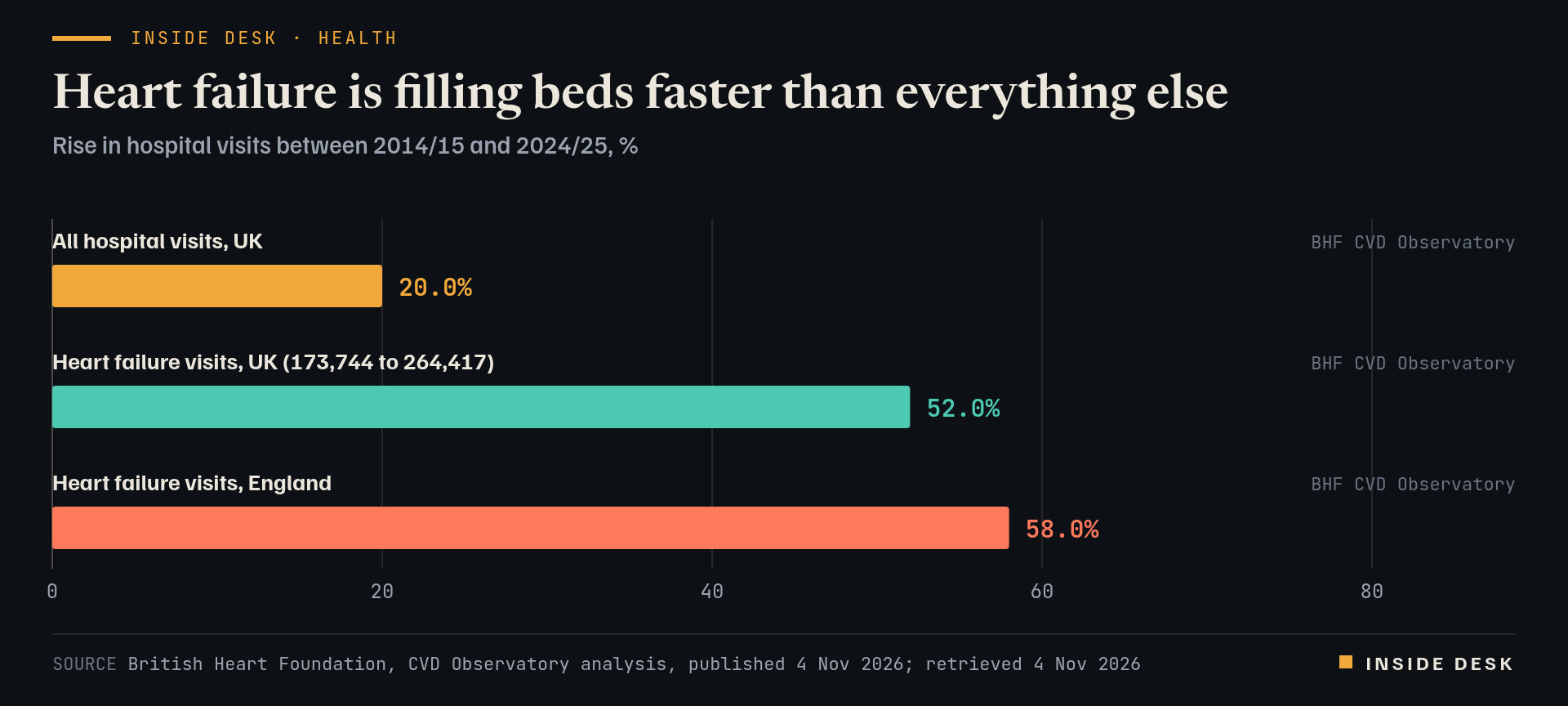
On Wednesday the British Heart Foundation opened a new data platform, its CVD Observatory, and the first figure it put on the table was a record1. In 2014/15, UK hospitals recorded 173,744 visits for heart failure. In 2024/25 they recorded 264,417, a rise of 52%1. Over the same decade, hospital visits of every kind rose by 20%1. England’s rise was the steepest of the four nations, at 58%1.
Bar chart: between 2014/15 and 2024/25, all UK hospital visits rose by 20%, UK hospital visits for heart failure rose by 52%, from 173,744 to 264,417, and heart failure visits in England rose by 58%, the steepest of the UK nations.
Source British Heart Foundation, CVD Observatory analysis, published 4 Nov 2026; retrieved 4 Nov 2026. Figures as reported by the named organisations; facts cited with attribution.
Data (CSV) · SVG · PNG

Latest values as a table
| Value | |
|---|---|
| All hospital visits, UK | 20% |
| Heart failure visits, UK (173,744 to 264,417) | 52% |
| Heart failure visits, England | 58% |
Desk arithmetic: that is 90,673 more visits a year than a decade ago, or about 724 a day in 2024/25. The BHF says heart failure patients stay in hospital for around ten days, about twice the average stay1. Desk arithmetic again, and only roughly, since “around ten days” is an average: 264,417 visits at ten days each comes to about 2.6 million bed days a year, and the decade’s growth alone adds roughly 900,000.
It would be easy to read this as a story about hearts getting worse. Read the charity’s own explanation first. The rise, it says, reflects an ageing and growing population, “more people surviving heart attacks”, and stark health inequalities1. The middle item matters. A country that saves more people from heart attacks will have more people living with damaged hearts afterwards. Some of this line is the bill for a success, and you should not want it gone at the price of the success.
The number that is not in the headline. Further down the release is the figure that changes the argument. Research suggests that up to 80% of heart failure diagnoses in England are made in hospital, even though 40% of those patients had symptoms that should have triggered an earlier diagnosis1. That is the real story. The condition affects more than a million people in the UK1. Most of them are not found at a desk with a stethoscope and a referral form. They are found on a ward, already breathless and swollen.
The BHF’s chief scientific and medical officer, Professor Bryan Williams, put it plainly: “Most hospital visits for heart failure could be prevented”1. Too often, he told the Mirror, someone is only diagnosed “when they are already seriously unwell”2.
The patient story the charity published is a case study in how that happens, not in negligence. Szandra Tar, 35, from Grangemouth, was fit and played volleyball1. Her symptoms began with shoulder aches at the end of 2024. By early 2025 she was out of breath after a short walk. A GP call in June 2025 ended with over-exercising or anxiety as the explanation1. By July she could not climb a flight of stairs, her face had swollen, and the swelling was put down to the heat or antibiotics1. It was only when a doctor listened to her chest and heard a fast resting heart rate that she was sent to hospital, where she spent 11 days on a cardiology unit1. She now has an implanted defibrillator, lifelong medication and a genetic diagnosis that her children are being tested for1.
Nobody in that story was a villain. Each explanation was plausible on its own. What was missing was a routine that makes the less likely explanation get checked: breathless plus swollen plus worse, so listen to the chest and check the heart. The BHF’s own warning signs are simple enough to print on a fridge magnet: breathlessness, chest pain and swelling from fluid retention, and urgent advice if symptoms are “new, persistent or getting worse”2.
What the response looks like. Notice what is being proposed, because it is pleasingly dull. The charity wants earlier diagnosis and better management “in the community to keep people out of hospital”1. The Department of Health and Social Care points to its Cardiovascular Disease Modern Service Framework, meant to “identify and treat people earlier”2. The government’s ten-year plan aims to cut early deaths from heart disease and stroke by a quarter, and the Mirror reports its first three years focus on managing blood pressure, cholesterol and diabetes outside hospital2. None of that will make a speech go viral. All of it is the kind of work that shows up, years later, as a line bending.
And the observatory itself is part of the answer. “When data is fragmented, it is harder to see the full picture,” the charity argues; trends get missed and inequalities stay hidden1. A register that counts the same thing the same way every year is not glamorous. It is how you find out whether the framework works, or whether it is a nice document.
The BHF says heart failure diagnoses could double by 20401. That is its projection, not ours, and it is the reason the 80% matters more than the 52%. You cannot make the population younger, and you would not want fewer heart-attack survivors. You can move the moment of diagnosis from the ward to the surgery. If you, or someone you look after, has breathlessness that is new or getting worse, swollen ankles or a belly that will not fit last week’s trousers, do not wait for it to explain itself. Ask for the chest to be listened to.
What to watch
A bed is the most expensive place to learn a name you could have heard in a surgery.
Sources
- Heart failure hospital visits rise to record high, finds CVD Observatory — British Heart Foundation, 4 Nov 2026.
- Heart failure hospitalisations surge as woman, 35, tells of shock at life-threatening diagnosis — The Mirror, 4 Nov 2026, 01:18 CET.
Every figure in this piece traces to a source above or to the desk’s own arithmetic on those sources, marked as such. Quotations are short and attributed. Spot an error? Write to the desk; corrections are logged on the method page.
Commentary for information only. Not investment, legal, tax, medical or political advice. Not an offer or solicitation. Analysis may be incomplete or wrong. Charts show published public data, not a trading feed; binding numbers live with the institutions that publish them.