Evening edition · Friday, 30 October 2026
$91 billion, a quiet year by the invoices, and 55% nobody insured
Aon's nine-month catastrophe tally is the lowest since 2019. The number that matters for you is the gap underneath it.
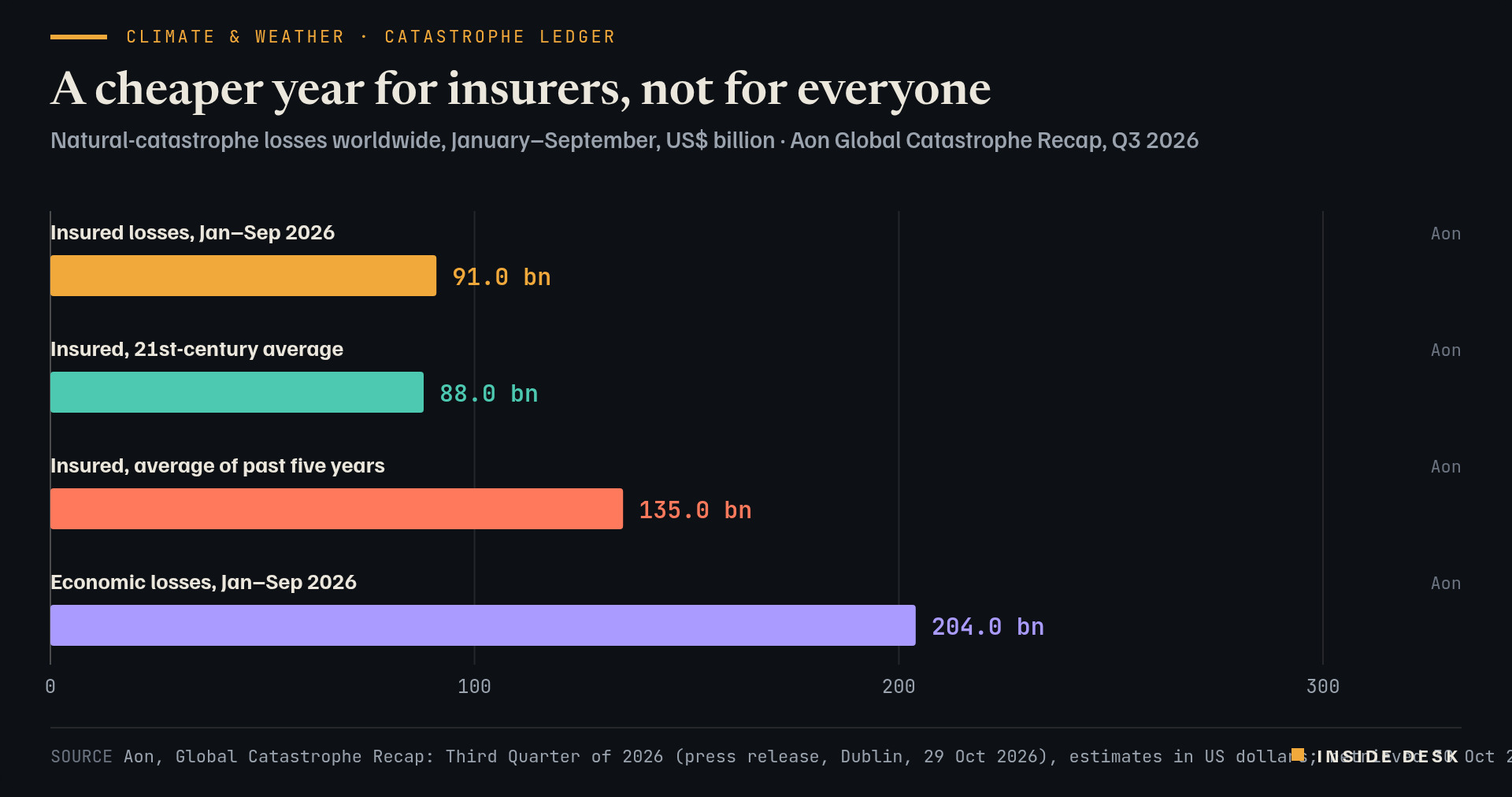
The broker Aon has done the year’s sums so far, and they are calmer than the headlines of the summer suggested. Insured losses from natural disasters reached an estimated $91 billion in the first nine months of 20261. That is slightly above the 21st-century average of $88 billion, the lowest for the period since 2019, and well below the $135 billion average of the past five years1. The third quarter alone cost insurers $29 billion, 31% below the long-term average, and no single event cost them more than $10 billion2.
Quiet totals hide busy ledgers. Twenty-three events produced insured losses of at least $1 billion each, against a historical average of 141. Severe convective storms, the hail, wind and tornado kind, were again the costliest peril, accounting for roughly $55 billion of insured losses2. The costliest insured event of the year so far was not a hurricane but Europe’s drought, at more than $8.5 billion; France alone recorded about $5 billion in insured losses, a record1. Subsidence is a slow peril: it cracks a wall one dry summer at a time.
Bar chart of worldwide natural-catastrophe losses for January to September, in US dollars. Insured losses in 2026 were an estimated 91 billion, against a 21st-century average of 88 billion and a past-five-year average of 135 billion. Economic losses in the same nine months of 2026, the latest figure, were about 204 billion.
Source Aon, Global Catastrophe Recap: Third Quarter of 2026 (press release, Dublin, 29 Oct 2026), estimates in US dollars; retrieved 30 Oct 2026 · Early estimates, subject to revision.. Figures as reported by the named organisations; facts cited with attribution.
Data (CSV) · SVG · PNG

Latest values as a table
| Value | |
|---|---|
| Insured losses, Jan–Sep 2026 | 91 bn |
| Insured, 21st-century average | 88 bn |
| Insured, average of past five years | 135 bn |
| Economic losses, Jan–Sep 2026 | 204 bn |
Now the gap. Economic losses reached about $204 billion, and roughly 55% of that was not covered by insurance1. Desk arithmetic: $204 billion minus $91 billion leaves about $113 billion paid by households, firms and governments directly. The extremes sit in Latin America. Aon puts June’s earthquake in Venezuela at about $25 billion in economic losses, with only a small insured share because cover there is thin; Colombia’s August quake cost about $9.6 billion, and there established reinsurance programmes and reserves are expected to carry much of it1.
“Moderate global totals can mask significant regional impacts and emerging concentrations of risk,” said Michal Lörinc, Aon’s head of catastrophe insight1. The weather helped, too: the Atlantic got through September without a single hurricane, only the fourth time since 1950, which Aon links to a very strong El Niño1.
For you, the useful line is the dull one. Check what your home policy says about subsidence, hail and natural hazards (in Germany, “Elementarschäden”), because a quiet year is only cheap for the losses that were insured.
What to watch
A cheap year for insurers is not a cheap year; it is a year someone else paid.
Sources
- $91 Billion Global Insured Catastrophe Losses by End of Q3 as Regional Risks Intensify: Aon Report — Aon plc, 29 Oct 2026.
- Aon: Global Insured Catastrophe Losses Reach $91B, Lowest Since 2019 — Claims Journal, 29 Oct 2026.
Every figure in this piece traces to a source above or to the desk’s own arithmetic on those sources, marked as such. Quotations are short and attributed. Spot an error? Write to the desk; corrections are logged on the method page.
Commentary for information only. Not investment, legal, tax, medical or political advice. Not an offer or solicitation. Analysis may be incomplete or wrong. Charts show published public data, not a trading feed; binding numbers live with the institutions that publish them.