Morning edition · Monday, 26 October 2026
The referees meet in the same week as the invoices
Oil eased on Monday morning because mediators flew to Tehran. The US ten-year yield closed Friday back at 5.00%. This week three central banks set the price of money and three hyperscalers show what they spent it on.
Monday began with a small relief and a long diary. Brent crude slipped about 1% to $115.48 a barrel in early Asian trade, after reports that Qatari mediators were in Tehran on Sunday in an effort, coordinated with the United States, to calm the region1. A later Reuters update had it 1.6% lower at $114.882. Last week Brent rose 6.2%, its highest weekly close since mid-2022, because Houthi attacks in Saudi Arabia raised the fear for supply1. Those attacks did not stop over the weekend; Saudi Arabia said it intercepted drones and ballistic missiles aimed at Riyadh and the south on Sunday4. So the barrel came down a dollar or two on a flight plan, not on a ceasefire. You should price it that way too.
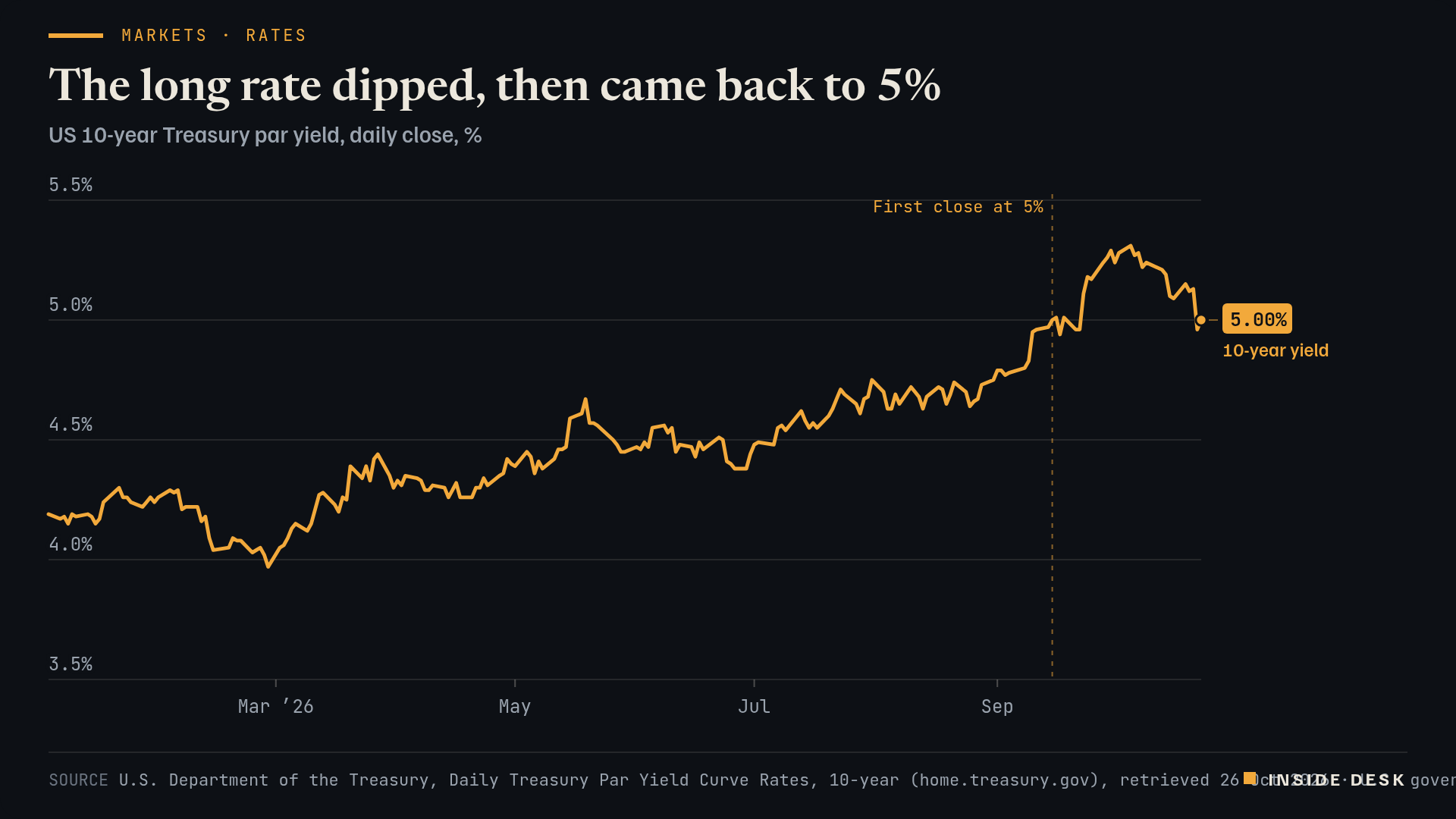
The long rate is the referee. The US ten-year Treasury yield closed Friday at 5.00%, according to the Treasury’s own daily curve, after 4.96% on Thursday, the lowest close since 22 September3. It peaked at 5.31% on 5 October and started the year at 4.19%3. Reuters notes that Treasuries rallied last week before “running into renewed selling on Friday”1.
Line chart of the daily US 10-year Treasury par yield since January 2026. It starts the year at 4.19% on 2 January, is at its low of 3.97% on 27 February, rises through the summer to 4.75% at the end of August, closes at 5.00% for the first time on 15 September, peaks at 5.31% on 5 October, falls to 4.96% on Thursday 22 October and is back at 5.00% on Friday 23 October 2026, the latest value.
Source U.S. Department of the Treasury, Daily Treasury Par Yield Curve Rates, 10-year (home.treasury.gov), retrieved 26 Oct 2026 · U.S. government data, public domain. Figures as reported by the named organisations; facts cited with attribution.
Data (CSV) · SVG · PNG

Latest values as a table
| Date | 10-year yield |
|---|---|
| 2026-10-16 | 5.09 |
| 2026-10-19 | 5.15 |
| 2026-10-20 | 5.12 |
| 2026-10-21 | 5.13 |
| 2026-10-22 | 4.96 |
| 2026-10-23 | 5 |
That line matters more than any index. A ten-year yield of 5% is the rate against which every other promise is measured: the mortgage, the corporate bond, the data centre that pays back in 2032. When it rises, a distant profit is worth less today. When it falls, as on Thursday, the distant profit looks better and tech shares breathe. Friday’s 5.00% says the bond market has not yet decided which week it is in.
Three committees in three days. The US Federal Reserve meets from Wednesday; futures imply about a 90% chance it holds its target range at 3.75% to 4.00%6. The ECB’s Governing Council meets in Frankfurt on Wednesday and Thursday5. The Bank of Japan decides this week too6. Reuters quotes JPMorgan’s Bruce Kasman: “a relatively shallow rate hike cycle is underway”, with the big three likely on hold for now1. Markets imply about an 80% chance that the Fed moves in December, and “much the same” for the BoJ and the ECB1. New Zealand is widely expected to raise its rate on Wednesday1. A hold, in other words, is not a cut. It is a pause with the next step already in the minutes.
Three invoices. The same week, about a third of the S&P 500 reports, including Alphabet, Microsoft and Amazon1. Consensus, per Reuters, is $90.6 billion of revenue for Microsoft, $202 billion for Amazon and $128 billion for Alphabet1. Their capital spending is the other half of the AI story: the bills paid to chipmakers, builders and utilities. Asia is already nervous. South Korea’s main index has shed almost a fifth of its value this month, and Japan’s Nikkei lost 4.0% last week1. Tokyo Electron fell 3.24% in early trade on Monday6.
What to do with all this. Nothing quick. The diary this week is a good one, because it is full of dull, scheduled things: decisions at fixed times, statements with numbered paragraphs, earnings reports with audited lines. The war produces headlines at random; the institutions produce documents on time. When the two disagree, the documents usually win, a little later than the headlines suggest.
The one number to watch is not an index level but the ten-year yield on Thursday evening, after the ECB and the Fed have both spoken and the first hyperscaler has shown its capital spending. If it is still near 5%, the market has heard the committees and the companies and stayed calm. If it moves sharply, someone said something that was not in the minutes. Nothing here is advice.
What to watch
- The Fed on Wednesday: futures put the chance of a hold at about 90%6; the sentence about December matters more than the decision.
- The ECB on Thursday, decision at 14:15 CET after two days of meetings in Frankfurt5.
- Microsoft, Alphabet and Amazon: consensus revenue of $90.6 billion, $128 billion and $202 billion1.
A committee that does nothing on Wednesday can still be the most important thing that happens all week. Read the minutes, not the mood.
Sources
- Asian shares make cautious start, Brent eases from six-month high — Reuters via Euronext, 26 Oct 2026, 01:46.
- Stocks trade cautiously in Asia, Brent off six-month top — Reuters via Investing.com, 26 Oct 2026.
- Daily Treasury Par Yield Curve Rates, 2026 — U.S. Department of the Treasury, retrieved 26 Oct 2026.
- Saudi Arabia says it intercepted missiles and drones from Iran-backed Houthis — CNBC, 25 Oct 2026.
- Weekly schedule — European Central Bank, last modified 25 Oct 2026.
- Asian Markets Today: Nikkei, Kospi fall as chip stocks drag — NDTV Profit, 26 Oct 2026.
Every figure in this piece traces to a source above or to the desk’s own arithmetic on those sources, marked as such. Quotations are short and attributed. Spot an error? Write to the desk; corrections are logged on the method page.
Commentary for information only. Not investment, legal, tax, medical or political advice. Not an offer or solicitation. Analysis may be incomplete or wrong. Charts show published public data, not a trading feed; binding numbers live with the institutions that publish them.