Evening edition · Wednesday, 21 October 2026
Podium vs Print: cheap power has not reached Germany's auction yet
An ECB blog published on Wednesday says renewables are pulling wholesale electricity prices down in many countries. Germany's day-ahead auction says October has so far cost about 80% more than the same days last year. Both are true, and the gap between them has a name: grids.
“The expansion of renewable generation capacity is reducing wholesale electricity prices in many countries.”
Óscar Arce, Gerrit Koester and Beatrice Pierluigi, ECB economists, writing on The ECB Blog, 21 October 2026
€169.93/MWh
The daily day-ahead price averaged €169.93 per megawatt hour over 1 to 21 October 2026, against €94.14 for the same days of 2025; delivery on 21 October cleared at €211.94.
Bundesnetzagentur / SMARD.de, day-ahead price for the Germany-Luxembourg zone, delivery days 1 to 21 October 2026
The podium. On Wednesday three ECB economists published a long blog post on why the euro area has withstood this year’s energy shock better than feared1. One passage is about electricity. “The expansion of renewable generation capacity is reducing wholesale electricity prices in many countries,” they write, because more renewables mean fewer hours in which a gas plant sets the price1. The evidence they cite is specific. In Spain the share of hours in which gas set the price fell from around 80% in 2020 to just above 20% in the first nine months of 2026; in France it fell from around 60% to around 20%1. Unlike in 2021–22, they say, the latest shock hit countries with more renewable and nuclear power less hard1.
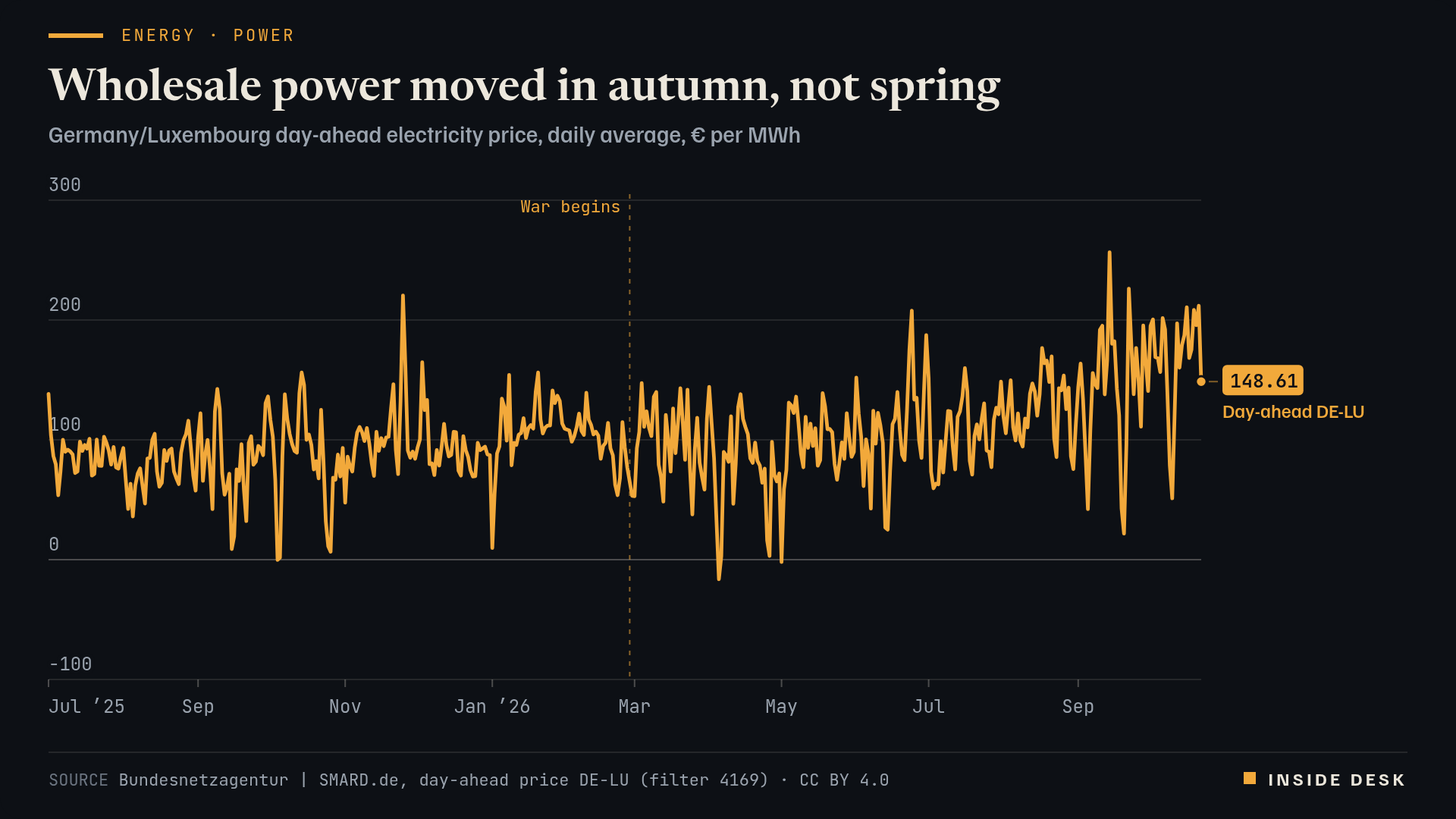
The print. Germany’s day-ahead auction tells the other half. The daily average price for the Germany-Luxembourg zone was €169.93 per megawatt hour over 1 to 21 October 2026, against €94.14 for the same days of 20252. Desk arithmetic: that is about 80% higher. Wednesday’s delivery day cleared at €211.942. September averaged €144.82, with a high of €256.55 on 14 September2.
Line chart of the daily average German-Luxembourg day-ahead electricity price since July 2025, in euros per megawatt hour. Monthly averages stay mostly between about €77 and €110 through July 2026, including the months after the war begins at the end of February; the daily low is −€16.34 on 5 April. The price climbs from August, averaging €144.82 in September with a daily high of €256.55 on 14 September, and €169.93 over 1 to 21 October, against €94.14 over the same days of 2025. The latest value, for delivery on 21 October 2026, is €211.94.
Source Bundesnetzagentur | SMARD.de, day-ahead price DE-LU (filter 4169) · CC BY 4.0. Bundesnetzagentur | SMARD.de, market data. CC BY 4.0.
Data (CSV) · SVG · PNG

Latest values as a table
| Date | Day-ahead DE-LU |
|---|---|
| 2026-10-17 | 168.27 |
| 2026-10-18 | 175.21 |
| 2026-10-19 | 208.44 |
| 2026-10-20 | 195.66 |
| 2026-10-21 | 211.94 |
| 2026-10-22 | 148.61 |
The gap. The two are not contradicting each other as much as it looks. The blog does not name Germany, and its claim is about structure, measured over years1. The auction is about this autumn, in one bidding zone, on days when the wind and the sun decide how often gas is needed at the margin. The chart shows the shape plainly: through the spring and early summer, months after the shock began, German power mostly stayed between about €77 and €110; it was the autumn, with a second wave of higher gas prices, that lifted it1,2.
Verdict. The podium is right about the direction, and the print is right about the bill. What closes the gap is in the same blog post: “further integration of EU electricity markets, including more cross-border interconnections and investment in grids”, so that cheaper renewable electricity “could flow where it is needed”1. That is dull machinery: cables, substations, permits. It is also the only part of the argument that turns a Spanish average into a German invoice. Nothing here is advice.
What to watch
A trend is measured in decades and paid for in days.
Sources
- Resilience of the euro area economy – weathering one shock, preparing for the next — European Central Bank (The ECB Blog), 21 Oct 2026.
- Market data: day-ahead wholesale price, Germany/Luxembourg (filter 4169) — Bundesnetzagentur / SMARD.de, retrieved 21 Oct 2026.
Every figure in this piece traces to a source above or to the desk’s own arithmetic on those sources, marked as such. Quotations are short and attributed. Spot an error? Write to the desk; corrections are logged on the method page.
Commentary for information only. Not investment, legal, tax, medical or political advice. Not an offer or solicitation. Analysis may be incomplete or wrong. Charts show published public data, not a trading feed; binding numbers live with the institutions that publish them.