Evening edition · Wednesday, 25 November 2026
35, 25, 20, 15: Washington prices 'overcapacity' by the economy
The US trade office proposed new tariff caps for 14 economies under a 1974 statute. They are proposals, they come with exemptions, and nothing changes before a hearing on 25 January.
The US Trade Representative, Jamieson Greer, determined on Wednesday that the policies of 14 economies relating to ‘structural excess capacity’ in manufacturing are unreasonable and burden American commerce, and proposed tariffs on each of them under Section 301 of the Trade Act of 19741. Mexico and Norway, investigated since March, got no determination for now1.
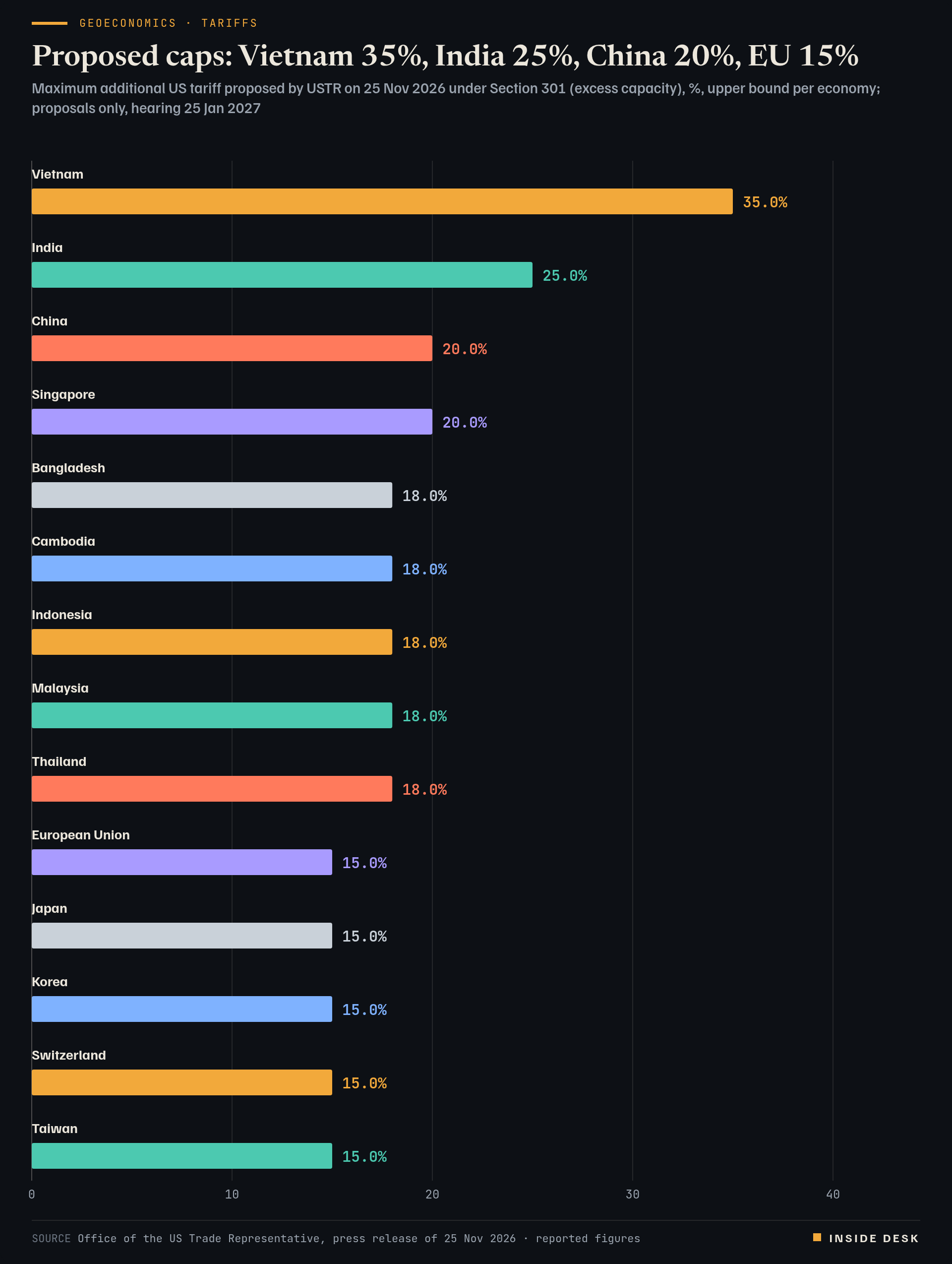
Bar chart of the maximum additional US tariffs proposed on 25 November 2026 under Section 301 for 14 economies: Vietnam up to 35 percent, India up to 25 percent, China and Singapore up to 20 percent, Bangladesh, Cambodia, Indonesia, Malaysia and Thailand up to 18 percent, and the European Union, Japan, Korea, Switzerland and Taiwan up to 15 percent. These are proposals open for comment, with exemptions, netted against some existing duties; none is in force.
Source Office of the US Trade Representative, press release of 25 Nov 2026 · reported figures. Figures as reported by the named organisations; facts cited with attribution.
Data (CSV) · SVG · PNG

Latest values as a table
| Value | |
|---|---|
| Vietnam | 35% |
| India | 25% |
| China | 20% |
| Singapore | 20% |
| Bangladesh | 18% |
| Cambodia | 18% |
| Indonesia | 18% |
| Malaysia | 18% |
| Thailand | 18% |
| European Union | 15% |
| Japan | 15% |
| Korea | 15% |
| Switzerland | 15% |
| Taiwan | 15% |
The proposed caps run from 15% for the European Union, Japan, Korea, Switzerland and Taiwan, through 18% for Bangladesh, Cambodia, Indonesia, Malaysia and Thailand, and 20% for China and Singapore, to 25% for India and 35% for Vietnam1. All are upper bounds, netted against some existing duties and with exemptions in annexes1. Greer told CNBC the rates are ‘not really additive’: ‘In effect, it’ll look more like a top up’2. China is the exception; a US official said its 20% would come on top of first-term tariffs of roughly 25%, taking the rate to about 45%2.
Read the timetable before the headline. Comments are due by 5 January, hearings begin on 25 January, and Greer said none of it would take effect ‘earlier than a couple months from now’1,2. China’s foreign ministry said the ‘overcapacity’ ‘does not really exist’2. For a German exporter the EU line matters most: 15%, net of most-favoured-nation rates, in line with the framework deal the two sides already signed1.
What to watch
A proposal with a hearing date is not yet a price. It is an invoice draft, and drafts get edited.
Sources
- USTR Makes Determinations and Proposes Actions in 14 Section 301 Investigations Relating to Structural Excess Capacity and Production in Manufacturing Sectors — Office of the United States Trade Representative, 25 Nov 2026.
- U.S. proposes new tariffs on 14 trading partners, including China and the EU — CNBC, 25 Nov 2026, 14:11 CET, updated.
- Trump unveils new tariffs to fight excess factory capacity, undeterred by midterms defeat — Reuters, 25 Nov 2026.
Every figure in this piece traces to a source above or to the desk’s own arithmetic on those sources, marked as such. Quotations are short and attributed. Spot an error? Write to the desk; corrections are logged on the method page.
Commentary for information only. Not investment, legal, tax, medical or political advice. Not an offer or solicitation. Analysis may be incomplete or wrong. Charts show published public data, not a trading feed; binding numbers live with the institutions that publish them.