Evening edition · Wednesday, 25 November 2026
€291.77 for Thursday, smoke over Ras Tanura: the cold week's two price tags
German power for Thursday costs the most since 11 November, and Brent rose on a refinery claim. One price is about weather and wiring, the other about fear. Only one of them comes with a meter.
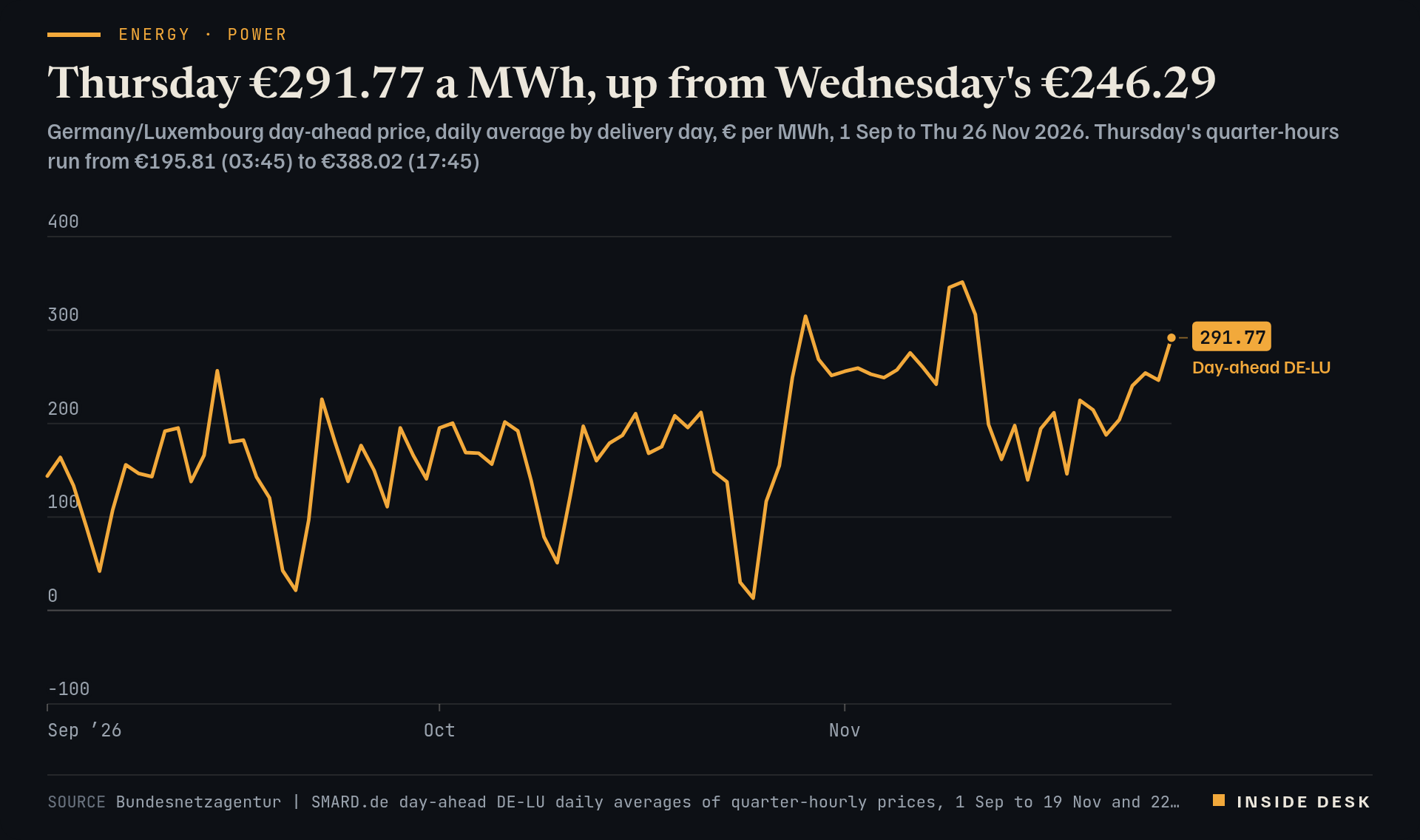
Thursday’s electricity in the German-Luxembourg day-ahead auction averages €291.77 a megawatt hour, up from €246.29 for Wednesday1. Desk arithmetic: that is 18.5% more in a day, and the highest daily average since Wednesday 11 November. The cheapest quarter-hour is €195.81 at 03:45; the dearest is €388.02 at 17:45, when offices, kitchens and street lights all want power at once and the sun has long gone1.
Line chart of the daily average German-Luxembourg day-ahead electricity price from 1 September to 26 November 2026, in euros per megawatt hour. Prices mostly ran between about €100 and €210 in September and October, climbed above €250 from late October, peaked at €351.48 on Tuesday 10 November, fell to €139.70 on Sunday 15 November, were €240.42 on Monday 23 and €254.15 on Tuesday 24 November, were €246.29 on Wednesday 25 November, and stand at €291.77 for the latest delivery day, Thursday 26 November, the highest daily average since 11 November.
Source Bundesnetzagentur | SMARD.de day-ahead DE-LU daily averages of quarter-hourly prices, 1 Sep to 19 Nov and 22 Nov 2026 retrieved 22 Nov 2026; 20, 21 Nov retrieved 23 Nov; 23 to 25 Nov via Fraunhofer ISE Energy-Charts (data: Bundesnetzagentur | SMARD.de), retrieved 24 Nov 2026, 17:26 CET; 26 Nov retrieved 25 Nov 2026, 17:31 CET · CC BY 4.0. Bundesnetzagentur | SMARD.de, market data. CC BY 4.0.
Data (CSV) · SVG · PNG

Latest values as a table
| Date | Day-ahead DE-LU |
|---|---|
| 2026-11-21 | 187.88 |
| 2026-11-22 | 204.08 |
| 2026-11-23 | 240.42 |
| 2026-11-24 | 254.15 |
| 2026-11-25 | 246.29 |
| 2026-11-26 | 291.77 |
Nothing dramatic happened to the grid. It is simply the last week of November behaving like the last week of November. The weather service expects snow in south-east Bavaria on Thursday, 5 to 10 centimetres and locally up to 15 in 12 to 18 hours, with possible freezing drizzle in the south and east, and a raised risk of glaze in the north-west on Sunday night5. Cold, still, grey days ask more of gas plants and less of wind and solar, and the auction prices that honestly. The evening peak is the expensive part. The night is not.
The second price tag of the day came from the Gulf. Yemen’s Houthis said on Wednesday that they had attacked Saudi Arabia’s Ras Tanura refinery, the kingdom’s largest, and that fires had broken out2,4. The Saudi-led coalition said its air defences destroyed four drones over Ras Tanura and that fragments fell, with no injuries in a first assessment; it did not say the refinery had been hit2,4. NASA satellite imagery reviewed by Reuters showed thick black smoke covering about 600 square kilometres around the site2. Aramco and the Saudi government did not comment2.
The refinery processes 550,000 barrels a day, about 16% of Saudi refining capacity, and the terminal next to it can load about 6.5 million barrels a day of crude, mostly for Asian buyers2,4. It has been hit before this year: Aramco shut the refinery after an Iranian drone attack on 2 March, and loadings at the terminal resumed only in late June4.
Brent responded the way markets respond to smoke. It traded at $93.60 a barrel at 16:16 Berlin time, up $2.20 or 2.41%, with WTI at $83.512. Reuters had Brent at $93.06 half an hour earlier, up 1.82%3. An analyst at PVM called it a rising geopolitical risk premium and added that traders covering short positions before the American Thanksgiving holiday could add to the move3.
Look at what sat underneath the headline, though. The American Petroleum Institute counted US crude stocks up by 126,000 barrels in the week to 20 November, against an average analyst estimate of a 1.5 million barrel rise3. An economist at NLI Research told Reuters that perceptions of a global supply glut since the IEA’s report this month had kept prices in check3. OPEC+ meets on Sunday, with the UAE no longer bound by its quotas and Iraq asking for more3.
So you have two prices moving on the same Wednesday for different reasons. German power rose because the weather is cold and the evening is dark: a cause you can see from the window, and one that passes when the wind returns. Brent rose because of a claim that one side made and the other did not confirm, in a market that otherwise worries about too much oil, not too little. The first will be settled by Friday’s auction. The second will be settled by an inspection report, if anyone publishes one.
The dull lesson is the useful one. A household on a fixed tariff will not see Thursday’s €388.02 at all; it pays a price agreed months ago, which is exactly what fixed tariffs are for. A household on a dynamic tariff can move the dishwasher to 03:45. And a refinery that has been attacked twice this year and restarted twice is less a sign that the system is breaking than a reminder of how many people work to keep it running.
This is reporting, not investment advice.
What to watch
- Thursday's noon auction for Friday, when the weather service expects no notable weather after Thursday's snow in south-east Bavaria5.
- Any statement from Saudi Aramco on Ras Tanura's refinery and terminal; until then the damage is a claim and a satellite picture.
- The OPEC+ meetings on Sunday 29 November, which decide 2027 output policy3.
A fear premium is priced in an afternoon. A cold week is paid for by the quarter-hour.
Sources
- Day-ahead auction prices DE-LU, delivery days 25 and 26 Nov 2026 — Fraunhofer ISE Energy-Charts (data: Bundesnetzagentur | SMARD.de), retrieved 25 Nov 2026, 17:31 CET.
- Oil Jumps Over 2% as Saudi Arabia Downs Drones Over Ras Tanura — OilPrice.com, 25 Nov 2026, 16:30 CET.
- Oil prices rise over 1% after Houthis say they attacked Saudi refinery — Reuters via Euronext, 25 Nov 2026, 15:54 CET.
- Saudi defences destroy drones in Ras Tanura as footage shows smoke from refinery — The National, 25 Nov 2026.
- Wochenvorhersage Wettergefahren Deutschland — Deutscher Wetterdienst, issued 25 Nov 2026, 11:00 CET.
Every figure in this piece traces to a source above or to the desk’s own arithmetic on those sources, marked as such. Quotations are short and attributed. Spot an error? Write to the desk; corrections are logged on the method page.
Commentary for information only. Not investment, legal, tax, medical or political advice. Not an offer or solicitation. Analysis may be incomplete or wrong. Charts show published public data, not a trading feed; binding numbers live with the institutions that publish them.