Evening edition · Tuesday, 24 November 2026
Seven rises for the ifo, minus 1.31% for the DAX: two kinds of number
Germany's business mood is the best since the spring of 2023. Frankfurt's shares fell as the AI trade unwound. Both are true.
Germany’s companies are in a better mood than at any time since the spring of 2023. The ifo business climate rose to 90.6 points in November from a revised 90.1 in October, its seventh rise in a row, tagesschau reported3,1. Firms rated their current business at 89.4, up from 88.8, and their expectations at 91.9, up from 91.5; economists polled by Dow Jones had expected the headline to reach 90.5 and expectations to slip2.
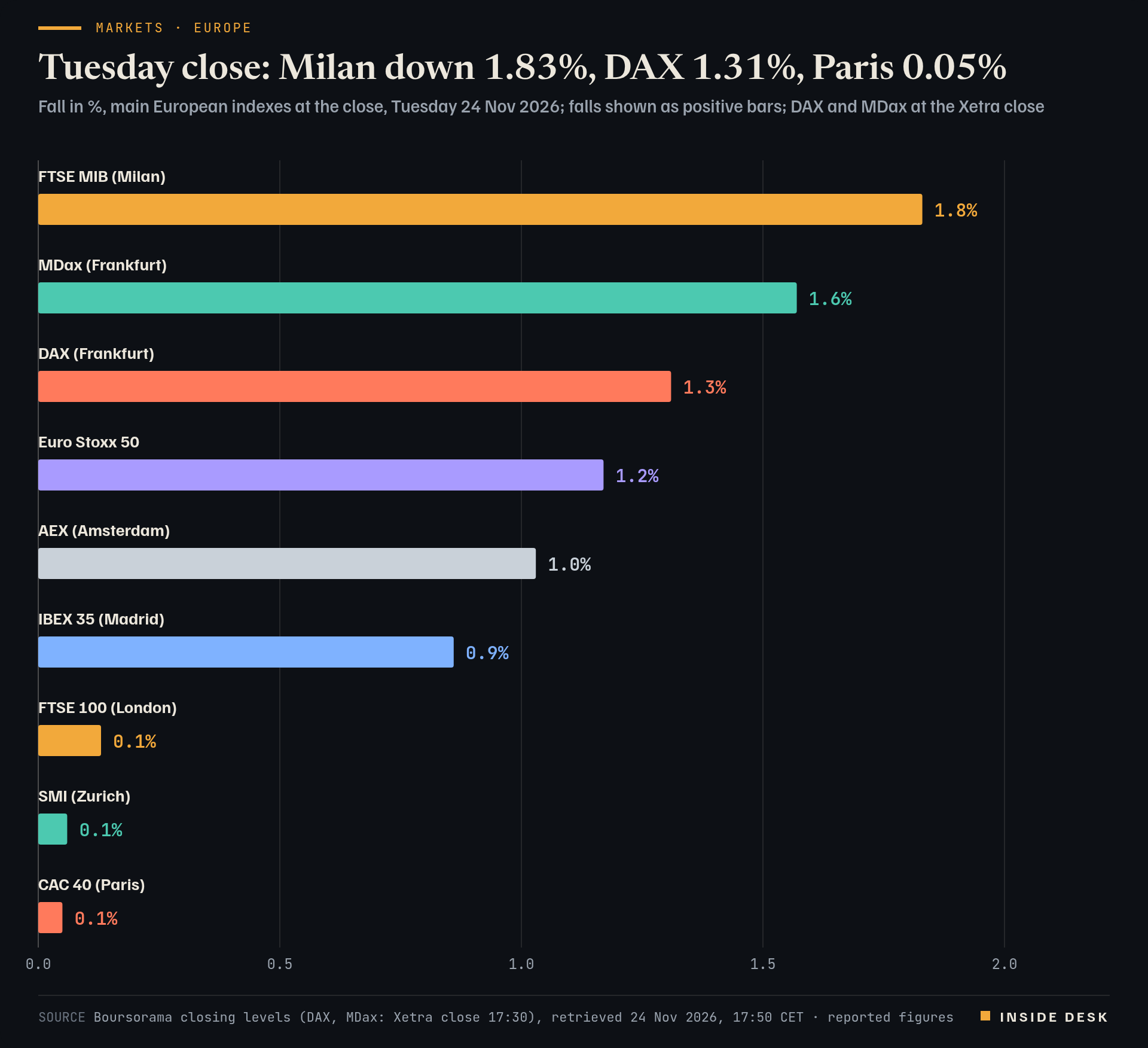
On the same day Frankfurt’s shares went the other way. The DAX closed the Xetra session at 25,005.51, down 1.31%, after Monday’s gain to 25,337.274. The MDax of mid-sized companies lost 1.57%, the Euro Stoxx 50 1.17% and Milan’s FTSE MIB 1.83%, while Paris’s CAC 40 ended 0.05% lower and London’s FTSE 100 slipped 0.13%4.
Bar chart of the size of the falls on the main European stock indexes at the close on Tuesday 24 November 2026, drawn as positive bars: FTSE MIB (Milan) down 1.83 percent to 48,126.17, MDax (Frankfurt) down 1.57 percent to 28,837.00, DAX (Frankfurt) down 1.31 percent to 25,005.51, Euro Stoxx 50 down 1.17 percent to 6,003.19, AEX (Amsterdam) down 1.03 percent to 1,077.91, IBEX 35 (Madrid) down 0.86 percent to 19,015.80, FTSE 100 (London) down 0.13 percent to 10,467.51, SMI (Zurich) down 0.06 percent to 14,727.33, CAC 40 (Paris) down 0.05 percent to 8,040.49. These are closing levels as shown by Boursorama.
Source Boursorama closing levels (DAX, MDax: Xetra close 17:30), retrieved 24 Nov 2026, 17:50 CET · reported figures. Figures as reported by the named organisations; facts cited with attribution.
Data (CSV) · SVG · PNG

Latest values as a table
| Value | |
|---|---|
| FTSE MIB (Milan) | 1.83% |
| MDax (Frankfurt) | 1.57% |
| DAX (Frankfurt) | 1.31% |
| Euro Stoxx 50 | 1.17% |
| AEX (Amsterdam) | 1.03% |
| IBEX 35 (Madrid) | 0.86% |
| FTSE 100 (London) | 0.13% |
| SMI (Zurich) | 0.06% |
| CAC 40 (Paris) | 0.05% |
The reasons for the fall had little to do with Germany. Jensen Huang’s return to Nvidia was a “Befreiungsschlag” for markets, wrote Andreas Lipkow of CMC Markets, but no solution to their underlying problems: inflation and rate worries had not gone away, nor had doubts about whether the vast AI investments will pay5. The ifo came in roughly as expected and gave buyers no new reason; investors favoured defensive sectors5. In New York the Nasdaq was 2.5% lower by midday, with Nvidia down more than 7% a day after its 31% jump6.
The ifo itself is more careful than its headline. “Die Erholung der deutschen Wirtschaft kommt voran, es fehlt jedoch an Breite,” said its president Clemens Fuest: the recovery is advancing but lacks breadth1. In manufacturing the index fell back after six rises in a row and expectations turned negative again, with consumer goods makers reporting a worse mood1. Services improved on both counts and the recovery in logistics continued; retail rose, wholesale fell, and construction slipped slightly1. Klaus Wohlrabe, who runs the survey, told Reuters there was “noch ein gewisser Weg zu gehen” before the upswing sustains itself3. Thomas Gitzel of VP Bank was blunter: the lament about the supposedly poor state of the German economy, he said, “geht mittlerweile an der Realität vorbei”, now misses reality3.
So which is it, a recovering economy or a falling market? Both, because they are different instruments. The ifo asks about 9,000 managers once a month about their own business: orders, staffing, the next six months2. The DAX prices forty large companies, many of them global businesses, minute by minute, in a market that on Tuesday was taking its cue from chipmakers in California. A survey of a logistics firm in Kassel and the price of risk in New York can move in opposite directions on the same morning without either being wrong.
Desk arithmetic puts the day in proportion. The DAX’s high this year was 27,001.67 and its low 21,863.81, Boursorama shows4. At 25,005.51 it stands about 7.4% below that high and about 14.4% above that low. A fall of 1.31% is noticeable; it is not a verdict on the German economy, any more than Monday’s rise was.
The contrarian point is not that markets are foolish. It is that slow, dull numbers deserve more of your attention than fast, exciting ones. Seven monthly rises in a survey of thousands of firms is a trend. A one-day swing in forty share prices is weather. If you want to know whether the country is getting back on its feet, the ifo, the order books and, in time, the tax receipts will tell you more than any closing bell. Nothing here is investment advice.
What to watch
- Thanksgiving on Thursday: New York is closed, and European trading tends to thin out without it.
- Next month's ifo survey, which will show whether manufacturing's November dip was a pause or a turn1.
A survey is a slow vote by the people who run things. A price is a fast vote by the people who trade them.
Sources
- ifo Geschäftsklimaindex gestiegen (November 2026) — ifo Institut, 24 Nov 2026.
- Ifo-Geschäftsklima steigt im November — Dow Jones News via finanznachrichten.de (Andreas Plecko), 24 Nov 2026, 10:51 CET.
- Ifo-Index steigt: "Erholung der deutschen Wirtschaft kommt voran" — tagesschau.de, 24 Nov 2026, 11:28 CET.
- Cours DAX (Xetra) and Indices internationaux — Boursorama, 24 Nov 2026, retrieved 17:50 CET.
- Aktien Frankfurt Schluss: DAX konsolidiert über 25 000 Punkten – Huang-Zauber wieder verflogen — wallstreet:online (Andreas Lipkow, CMC Markets), 24 Nov 2026, 17:00 CET.
- Nasdaq declines as Nvidia slides, giving back part of Monday's rally: Live updates — CNBC, updated 24 Nov 2026, 11:20 EST.
Every figure in this piece traces to a source above or to the desk’s own arithmetic on those sources, marked as such. Quotations are short and attributed. Spot an error? Write to the desk; corrections are logged on the method page.
Commentary for information only. Not investment, legal, tax, medical or political advice. Not an offer or solicitation. Analysis may be incomplete or wrong. Charts show published public data, not a trading feed; binding numbers live with the institutions that publish them.