Evening edition · Tuesday, 24 November 2026
€246.29 for Wednesday, 0.4 TWh short: Germany's power account nearly balances
Germany now sells almost as much electricity abroad as it buys. In euros the account is still lopsided, because it sells cheap hours and buys dear ones.
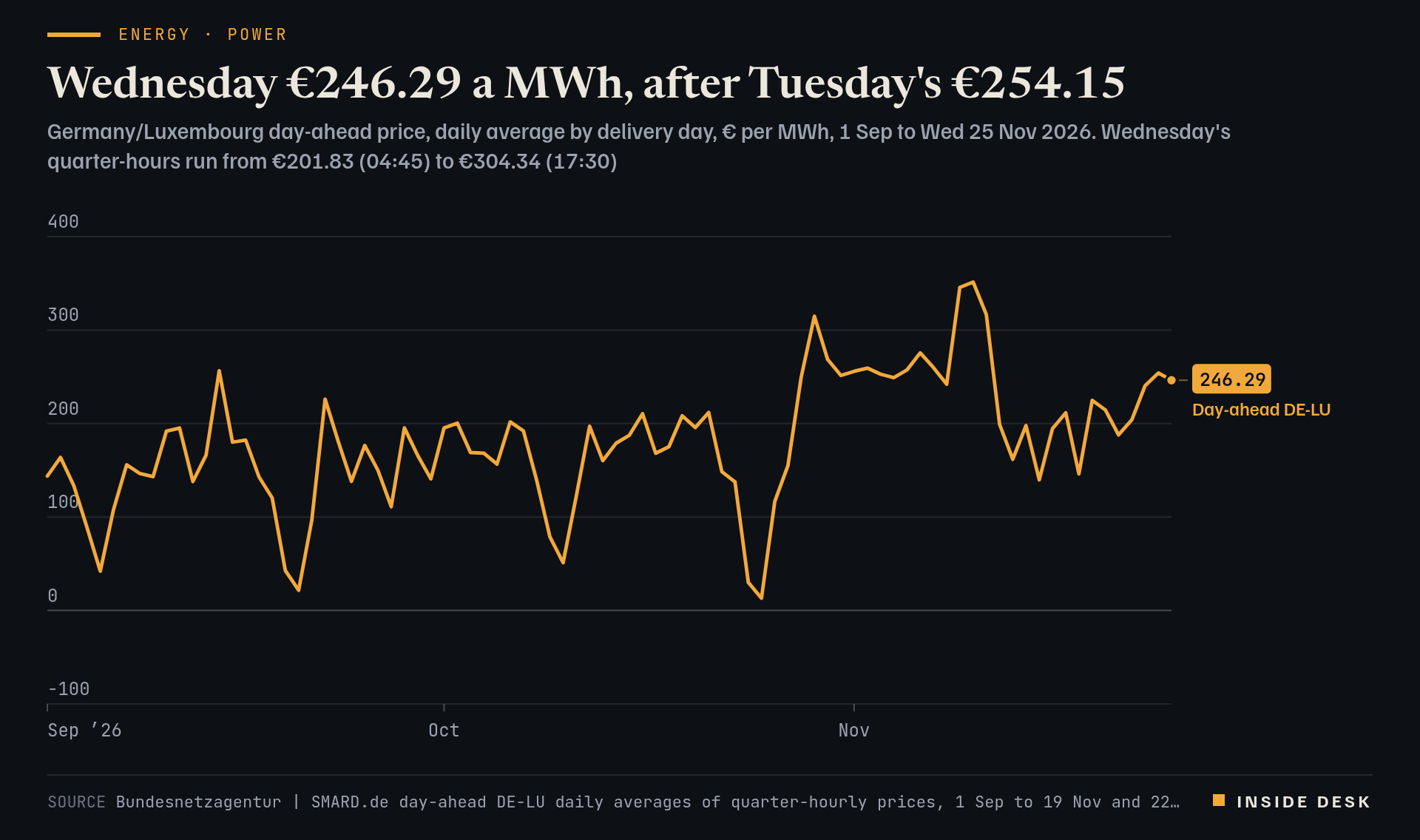
Wednesday’s electricity costs €246.29 a megawatt hour on average in the German-Luxembourg day-ahead auction, a little below Tuesday’s €254.151. The cheapest quarter-hour is €201.83 at 04:45, the dearest €304.34 at 17:30, when the lights go on and the wind does not always oblige1.
Line chart of the daily average German-Luxembourg day-ahead electricity price from 1 September to 25 November 2026, in euros per megawatt hour. Prices mostly ran between about €100 and €210 in September and October, climbed above €250 from late October, peaked at €351.48 on Tuesday 10 November, fell to €139.70 on Sunday 15 November, were €240.42 on Monday 23 and €254.15 on Tuesday 24 November, and stand at €246.29 for the latest delivery day, Wednesday 25 November.
Source Bundesnetzagentur | SMARD.de day-ahead DE-LU daily averages of quarter-hourly prices, 1 Sep to 19 Nov and 22 Nov 2026 retrieved 22 Nov 2026; 20, 21 Nov retrieved 23 Nov; 23 to 25 Nov via Fraunhofer ISE Energy-Charts (data: Bundesnetzagentur | SMARD.de), retrieved 24 Nov 2026, 17:26 CET · CC BY 4.0. Bundesnetzagentur | SMARD.de, market data. CC BY 4.0.
Data (CSV) · SVG · PNG

Latest values as a table
| Date | Day-ahead DE-LU |
|---|---|
| 2026-11-20 | 214.51 |
| 2026-11-21 | 187.88 |
| 2026-11-22 | 204.08 |
| 2026-11-23 | 240.42 |
| 2026-11-24 | 254.15 |
| 2026-11-25 | 246.29 |
Behind the daily price sits a quieter number from the statistics office. In the first nine months of 2026 Germany exported 48.8 terawatt hours of electricity worth €4.3 billion, 25.5% more by volume and 51.3% more by value than a year earlier2. Imports fell 13.3% to 49.2 terawatt hours but rose 20.4% in value to €5.7 billion2. The import surplus shrank to 0.4 terawatt hours, 97.5% less than the 17.9 terawatt hours of the same months of 2025; in euros it shrank only 24.8%, to €1.4 billion2.
The reason is in the averages. Imported power cost €116 a megawatt hour from January to September, up 38.9%; exported power fetched €87, up 20.6%2. Desk arithmetic: Germany pays about €29 more for each megawatt hour it buys than it earns for each one it sells. That is what a grid with a lot of wind and sun looks like: it has the most to sell in the hours when everyone else has plenty too.
It is neither a crisis nor a triumph. It is interconnectors doing their job: moving power to where it is short, at the price of the hour.
What to watch
- Wednesday's noon auction for Thursday, with polar air and hard night frost still over Germany.
- Whether the electricity tax cut from 1 January changes anything in the wholesale price. It should not: it is a tax line, not a market line.
A balanced account in hours is not a balanced account in euros.
Sources
- Day-ahead auction prices DE-LU, delivery days 24 and 25 Nov 2026 — Fraunhofer ISE Energy-Charts (data: Bundesnetzagentur | SMARD.de), retrieved 24 Nov 2026, 17:26 CET.
- Pressemitteilung Nr. 406: Stromexporte steigen um 25,5 % — Statistisches Bundesamt (Destatis), 20 Nov 2026.
Every figure in this piece traces to a source above or to the desk’s own arithmetic on those sources, marked as such. Quotations are short and attributed. Spot an error? Write to the desk; corrections are logged on the method page.
Commentary for information only. Not investment, legal, tax, medical or political advice. Not an offer or solicitation. Analysis may be incomplete or wrong. Charts show published public data, not a trading feed; binding numbers live with the institutions that publish them.