Morning edition · Monday, 16 November 2026
Up to 40 litres a day in the Black Forest: a week of rain and gales begins
No winter, no snow in the lowlands. Instead the weather service issues the duller warning: continuous rain on the western slopes, storm-force gusts on the ridges, and the Black Forest at the top of the list.
The weather service’s weekly hazard outlook, issued at 05:00 CET, starts with a sentence that will not trend: from Tuesday, a spell of continuous rain sets in on several west-facing upland slopes, with the southern half of the country at times stormy1. In the Black Forest the Deutscher Wetterdienst expects “unwetterartige” amounts, severe-weather levels of rain1.
The figures are specific. On Wednesday and Thursday, 25 to 35 litres per square metre in 24 hours are possible, though rated unlikely, on some western upland slopes; in the Black Forest severe weather is rated likely, with 30 to 40 litres in 24 hours possible1. On the ridges of the uplands and the Alps, gusts of force 9 to 10 are likely from the south-west, and isolated hurricane-force gusts of force 11 are not ruled out1. The rain eases only slowly from the north towards Saturday1.
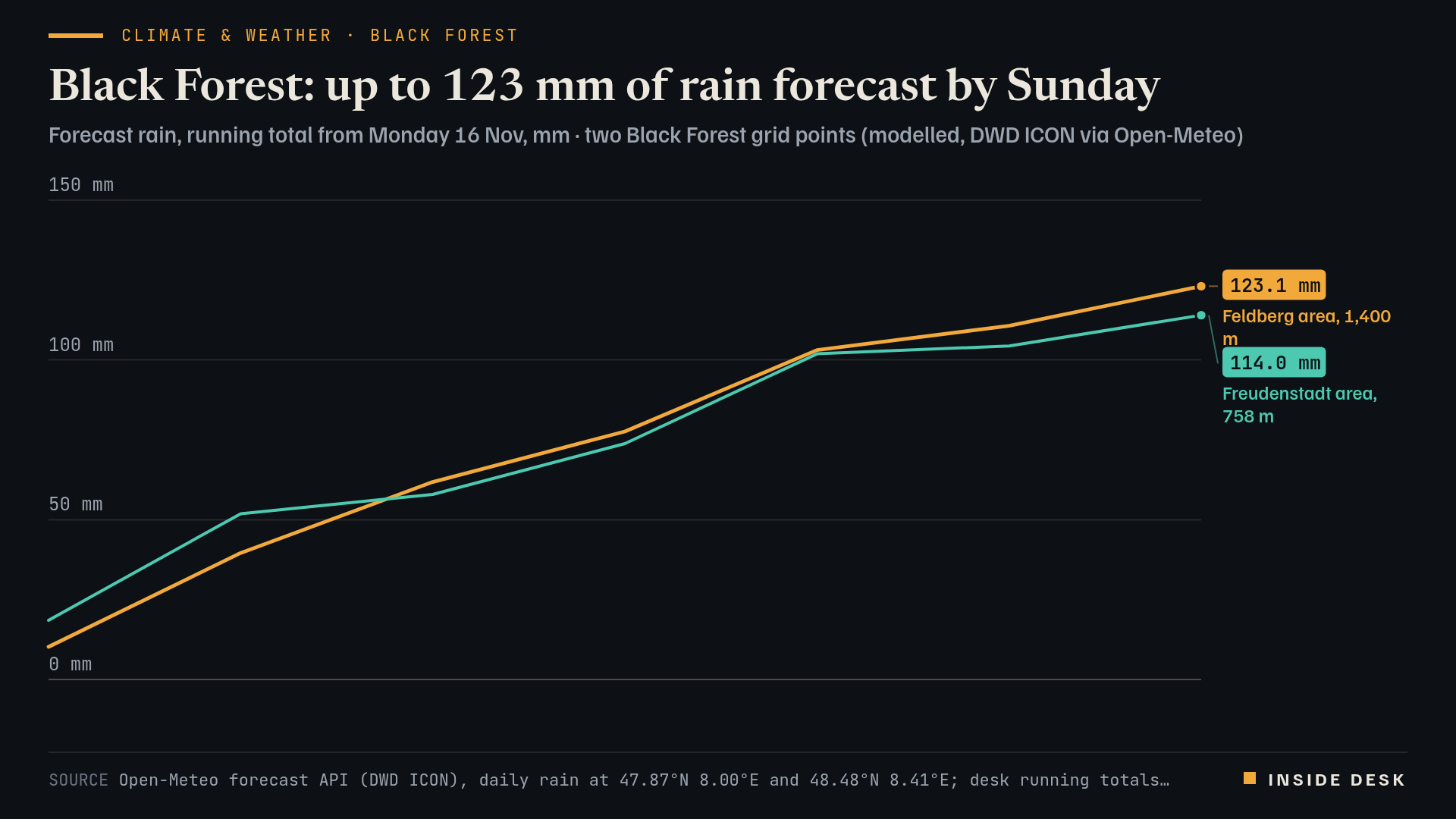
Line chart of forecast rainfall at two Black Forest grid points, running total from Monday 16 November 2026. The Feldberg-area point rises from 10.2 mm on Monday to 61.8 mm by Wednesday and 123.1 mm by Sunday 22 November, the latest value. The Freudenstadt-area point rises from 18.5 mm on Monday to 51.9 mm on Tuesday and 114.0 mm by Sunday. These are model forecasts retrieved at 05:25 CET, not measurements.
Source Open-Meteo forecast API (DWD ICON), daily rain at 47.87°N 8.00°E and 48.48°N 8.41°E; desk running totals; retrieved 16 Nov 2026, 05:25 CET · CC BY 4.0. Forecast, not observed.. Figures as reported by the named organisations; facts cited with attribution.
Data (CSV) · SVG · PNG

Latest values as a table
| Date | Feldberg area, 1,400 m | Freudenstadt area, 758 m |
|---|---|---|
| 2026-11-17 | 39.6 | 51.9 |
| 2026-11-18 | 61.8 | 57.9 |
| 2026-11-19 | 77.6 | 73.8 |
| 2026-11-20 | 103.1 | 101.9 |
| 2026-11-21 | 110.7 | 104.4 |
| 2026-11-22 | 123.1 | 114 |
The model run behind the forecast puts numbers on the week. At a grid point near the Feldberg, at 1,400 metres, the DWD’s ICON model via Open-Meteo shows 29.4 mm on Tuesday alone and 123.1 mm in total from Monday to Sunday; at a grid point near Freudenstadt, at 758 metres, 33.4 mm on Tuesday and 114.0 mm over the seven days3. Desk arithmetic: that is roughly 110 to 125 litres on every square metre of slope in a week. These are forecasts, not measurements, and grid points are not rain gauges.
Monday itself is the warm-up: mostly cloudy, showery rain from the west, highs of 8 to 14 degrees, and strong to stormy gusts, with severe gales in the uplands2. Tuesday brings a sharp divide, with only 4 to 8 degrees in the north and 15 in the south-west, locally up to 18 on the Upper Rhine2.
None of this is dramatic, which is the point. Long rain on saturated slopes is the kind of weather that fills small rivers, cellars and loss adjusters’ diaries, not front pages. The useful machinery is local: gauges, gutters, and the municipal crews who clear the drains before Wednesday rather than after it.
What to watch
A storm makes the news; three days of rain on the same slope make the claims.
Sources
- Wochenvorhersage Wettergefahren Deutschland — Deutscher Wetterdienst, 16 Nov 2026, 05:00 CET.
- Vorhersage für Deutschland — Deutscher Wetterdienst, 16 Nov 2026, 04:55 CET.
- Forecast API, daily precipitation (DWD ICON), Black Forest grid points — Open-Meteo, retrieved 16 Nov 2026, 05:25 CET.
Every figure in this piece traces to a source above or to the desk’s own arithmetic on those sources, marked as such. Quotations are short and attributed. Spot an error? Write to the desk; corrections are logged on the method page.
Commentary for information only. Not investment, legal, tax, medical or political advice. Not an offer or solicitation. Analysis may be incomplete or wrong. Charts show published public data, not a trading feed; binding numbers live with the institutions that publish them.