Morning edition · Monday, 16 November 2026
Minus 0.1% for Japan, minus 2.8% for the Kospi: Monday starts with the invoices
Japan's economy shrank for the first time in four quarters and China's October figures missed. Asia sold its chip names and kept its consumers. The week's real exam is still on Tuesday.
Two statistics offices spoke before breakfast, and neither said what the forecasters had pencilled in. Japan’s gross domestic product fell an annualised 0.1% in July to September, against a median forecast of 0.3% growth in a Reuters poll; it is the first decline in four quarters2. China’s industrial output grew 4.8% on the year in October, against an expected 5.3%, and retail sales rose just 0.4%, against 0.8% expected3.
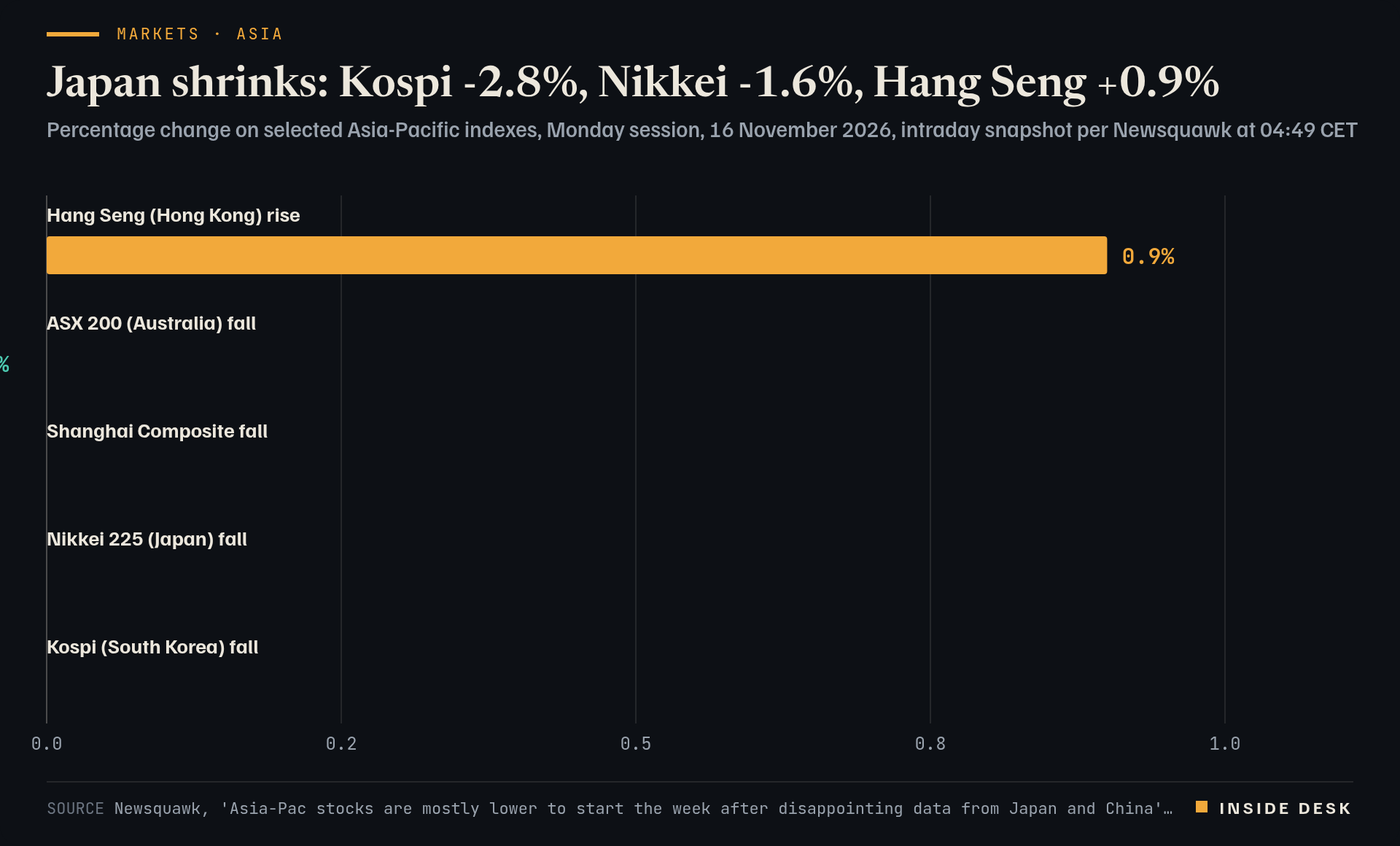
Bar chart of Monday 16 November 2026 percentage changes in Asia at about 04:49 CET, per Newsquawk: Hang Seng up 0.9 percent, ASX 200 down 0.1 percent, Shanghai Composite down 0.4 percent, Nikkei 225 down 1.6 percent and Kospi down 2.8 percent. These are intraday snapshot moves, not closes.
Source Newsquawk, 'Asia-Pac stocks are mostly lower to start the week after disappointing data from Japan and China', published 16 Nov 2026, 04:49 CET; intraday snapshot, not closing levels; retrieved 16 Nov 2026 · reported figures. Figures as reported by the named organisations; facts cited with attribution.
Data (CSV) · SVG · PNG

Latest values as a table
| Value | |
|---|---|
| Hang Seng (Hong Kong) rise | 0.9% |
| ASX 200 (Australia) fall | -0.1% |
| Shanghai Composite fall | -0.4% |
| Nikkei 225 (Japan) fall | -1.6% |
| Kospi (South Korea) fall | -2.8% |
The tape, at about 04:49 CET. The Kospi was down 2.8%, pressed by its tech heavyweights; the Nikkei 225 was down 1.6% after wiping out early gains, with tech leading the fall; the Shanghai Composite was off 0.4% and Australia’s ASX 200 0.1%1. Hong Kong went the other way: the Hang Seng was up 0.9%, led by consumer and electric-vehicle stocks1. These are intraday snapshots, not closes.
Read the split, not the headline. On a day of weak consumer data, Hong Kong’s consumer names rose and Seoul’s chip names fell1. That is not the data talking. It is the calendar: Nvidia reports on Tuesday, and Newsquawk notes reports over the weekend that co-founder Jensen Huang was considering a return as chief executive, while Treasury Secretary Bessent said the company needs a “shake-up” with an external CEO1. A market pricing a boardroom is not pricing a GDP print.
The quarter itself was less dramatic than “shrinks”. In quarterly terms the fall was 0.02%, Reuters reports; consumption fell 0.3% and capital spending rose 1.6%2. “There is no need to be overly pessimistic about the result,” Kento Minami of Daiwa Securities told Reuters2. In Europe, Euro Stoxx 50 futures were up 0.2% before dawn1.
For you. A red Monday in Asia is a price, not a verdict. The verdicts this week come on paper: an earnings report on Tuesday, US retail sales and the Fed’s minutes4. Read those, then the mood. Nothing here is investment advice.
What to watch
A market can sell a story in a morning; an economy reports once a quarter.
Sources
- Asia-Pac stocks are mostly lower to start the week after disappointing data from Japan and China — Newsquawk, 16 Nov 2026, 04:49 CET.
- Japan's economy unexpectedly shrinks as inflation squeezes households — Reuters via Investing.com, 16 Nov 2026, 01:12 CET, updated 03:36 CET.
- China's factory output, retail sales growth slow in October — Reuters via Investing.com, 16 Nov 2026, 03:05 CET.
- Nikkei, Kospi slide: Asian markets fall as Nvidia results, US inflation concerns keep investors cautious — CNBC TV18, 16 Nov 2026, 06:49 IST (02:19 CET).
Every figure in this piece traces to a source above or to the desk’s own arithmetic on those sources, marked as such. Quotations are short and attributed. Spot an error? Write to the desk; corrections are logged on the method page.
Commentary for information only. Not investment, legal, tax, medical or political advice. Not an offer or solicitation. Analysis may be incomplete or wrong. Charts show published public data, not a trading feed; binding numbers live with the institutions that publish them.