Morning edition · Friday, 13 November 2026
406 a week, rising 3.2% instead of 9.3%: England's antibiotic-resistance ledger slows but does not turn
UKHSA's annual ESPAUR count shows resistant bloodstream infections still climbing, NHS antibiotic use down by a tenth since 2019, and a gap between rich and poor areas that no prescription pad closes.
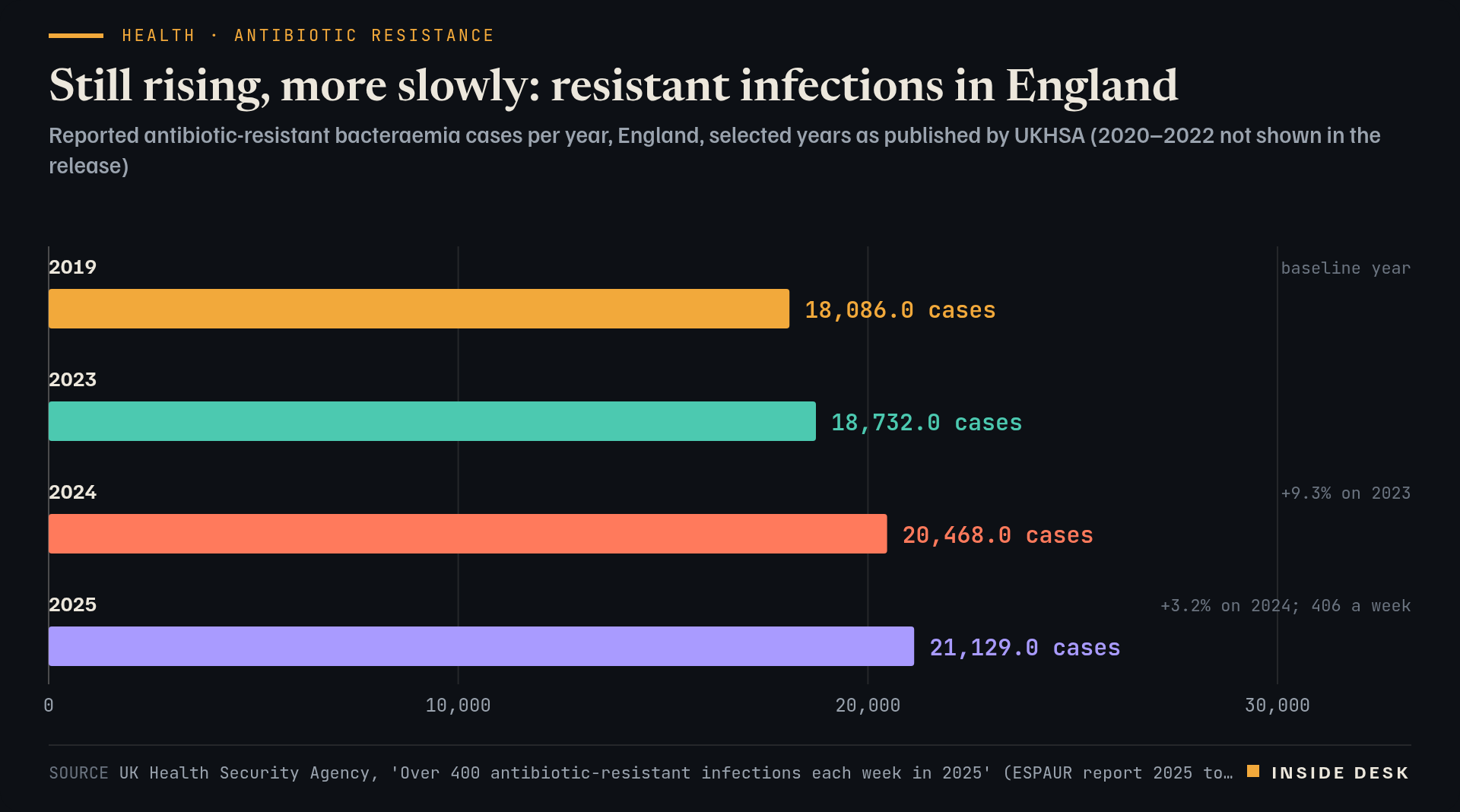
England’s UK Health Security Agency published its annual surveillance report on antibiotic use and resistance (ESPAUR) on Thursday, and the headline is a weekly number: an average of 406 antibiotic-resistant bloodstream infections reported each week in 20251. Over the year that came to 21,129 cases of resistant bacteraemia, up 16.8% from 18,086 in 20191.
Bar chart of antibiotic-resistant bacteraemia cases reported in England: 18,086 in 2019, 18,732 in 2023, 20,468 in 2024 and 21,129 in 2025, the latest value, an average of 406 a week. The rise was 9.3 percent from 2023 to 2024 and 3.2 percent from 2024 to 2025.
Source UK Health Security Agency, 'Over 400 antibiotic-resistant infections each week in 2025' (ESPAUR report 2025 to 2026), published 12 Nov 2026; retrieved 13 Nov 2026 · Contains public sector information licensed under the Open Government Licence v3.0. Figures as reported by the named organisations; facts cited with attribution.
Data (CSV) · SVG · PNG

Latest values as a table
| Value | |
|---|---|
| 2019 | 18086 cases |
| 2023 | 18732 cases |
| 2024 | 20468 cases |
| 2025 | 21129 cases |
The more interesting line is the slope. Cases rose by 3.2% between 2024 and 2025, from 20,468 to 21,129, against a 9.3% jump the year before1. Estimated deaths among people with a resistant Gram-negative bloodstream infection were broadly level, at 2,318 in 2025 against 2,399 in 20241. Slower is not the same as falling, and UKHSA does not claim it is: “We can’t rely on reducing antibiotic use alone,” said Dr Shona Arora, its interim chief medical adviser1.
The dull machinery is doing its job, though. Total NHS antibiotic use fell 10.7% between 2019 and 2025, from 17.8 to 15.9 defined daily doses per 1,000 inhabitants per day1. Private prescriptions dispensed in community pharmacies, counted separately, fell 20.8% in a year, from 0.61 to 0.481. Preliminary analysis puts about 53,400 hospital admissions linked to Gram-negative bloodstream infections at around £800 million for NHS hospitals in 2023–241.
The burden is unequal. People over 45 accounted for 89.3% of resistant cases, and almost half were in people over 741. The most deprived areas had a rate of 44.4 per 100,000, against 30.8 in the least deprived, 44.2% higher1. By care board, the range ran from 63.3 per 100,000 in North West London to 27.4 in Leicester, Leicestershire and Rutland1.
For you, the agency’s advice is the ordinary kind: take antibiotics only when a health professional has told you to, do not save or share them, return leftovers to a pharmacy, and take up the vaccines you are offered, because an infection prevented needs no antibiotic at all1.
What to watch
The cheapest antibiotic is the infection that never happens; the second cheapest is the course you did not need.
Sources
- Over 400 antibiotic-resistant infections each week in 2025 — UK Health Security Agency (GOV.UK), 12 Nov 2026.
Every figure in this piece traces to a source above or to the desk’s own arithmetic on those sources, marked as such. Quotations are short and attributed. Spot an error? Write to the desk; corrections are logged on the method page.
Commentary for information only. Not investment, legal, tax, medical or political advice. Not an offer or solicitation. Analysis may be incomplete or wrong. Charts show published public data, not a trading feed; binding numbers live with the institutions that publish them.