Morning edition · Thursday, 5 November 2026
4.90% at the first close after the vote, and 34 points since 1 October
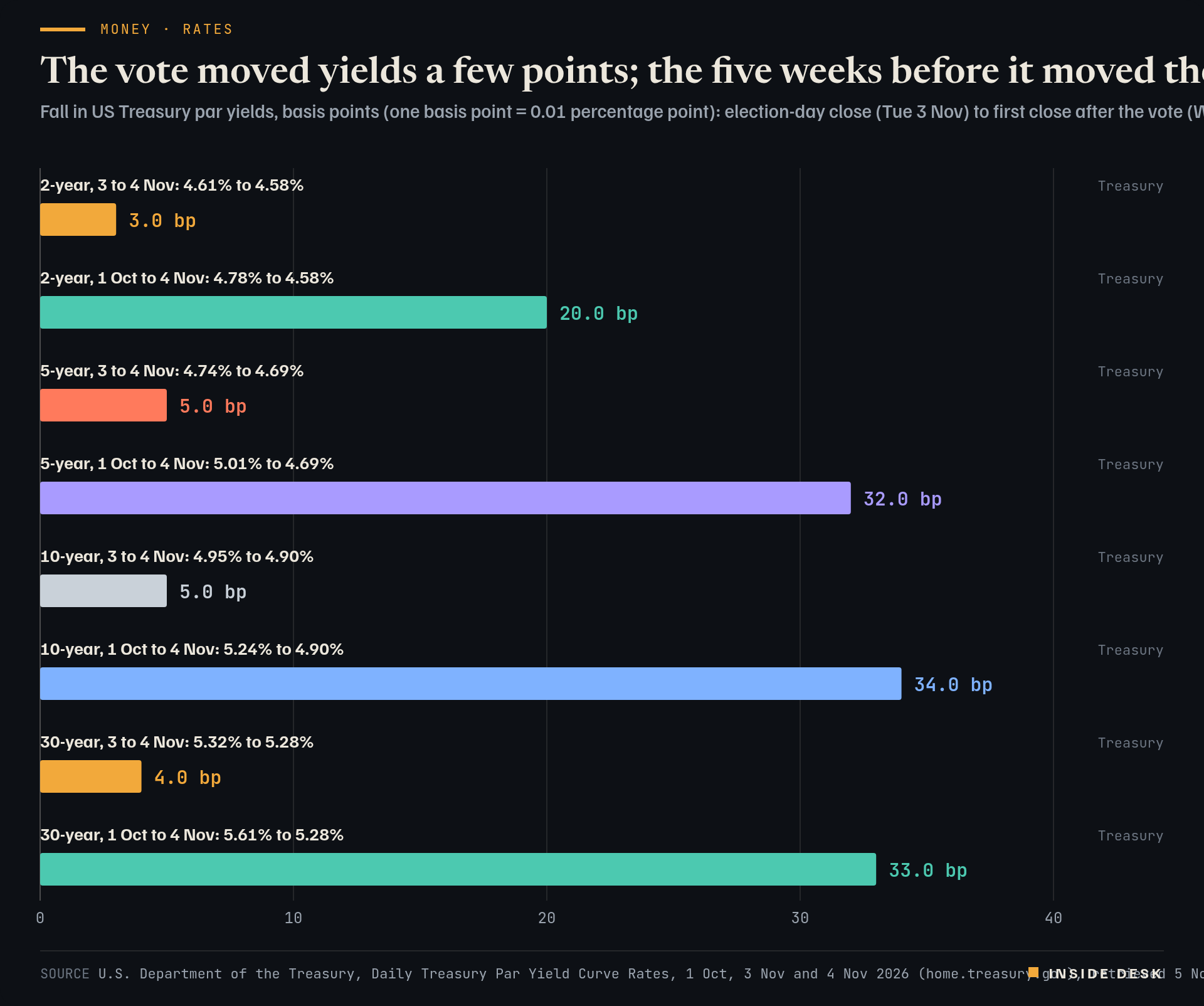
The official Treasury closes are in. The election moved the ten-year five basis points; the five weeks before it moved it nearly seven times as far.
Yesterday this desk could only quote the overnight screens. This morning there is an official number. On Wednesday, the first full trading day after the US vote, the Treasury’s closing par yield for the ten-year note was 4.90%, down from 4.95% on election day1. The two-year closed at 4.58%, from 4.61%, and the thirty-year at 5.28%, from 5.32%1.
Bar chart comparing how far US Treasury par yields fell on the first trading day after the 3 November 2026 election with how far they fell from 1 October to 4 November, in basis points. The 2-year fell 3 on the day, from 4.61% to 4.58%, and 20 since 1 October, from 4.78%. The 5-year fell 5 on the day, from 4.74% to 4.69%, and 32 since 1 October, from 5.01%. The 10-year fell 5 on the day, from 4.95% to 4.90%, and 34 since 1 October, from 5.24%. The 30-year fell 4 on the day, from 5.32% to 5.28%, and 33 since 1 October, from 5.61%. The latest values are the Wednesday 4 November closes.
Source U.S. Department of the Treasury, Daily Treasury Par Yield Curve Rates, 1 Oct, 3 Nov and 4 Nov 2026 (home.treasury.gov), retrieved 5 Nov 2026 · U.S. government data, public domain · Bars are desk arithmetic: the difference between two official closing yields.. Figures as reported by the named organisations; facts cited with attribution.
Data (CSV) · SVG · PNG

Latest values as a table
| Value | |
|---|---|
| 2-year, 3 to 4 Nov: 4.61% to 4.58% | 3 bp |
| 2-year, 1 Oct to 4 Nov: 4.78% to 4.58% | 20 bp |
| 5-year, 3 to 4 Nov: 4.74% to 4.69% | 5 bp |
| 5-year, 1 Oct to 4 Nov: 5.01% to 4.69% | 32 bp |
| 10-year, 3 to 4 Nov: 4.95% to 4.90% | 5 bp |
| 10-year, 1 Oct to 4 Nov: 5.24% to 4.90% | 34 bp |
| 30-year, 3 to 4 Nov: 5.32% to 5.28% | 4 bp |
| 30-year, 1 Oct to 4 Nov: 5.61% to 5.28% | 33 bp |
Set beside the month, those moves look small. On 1 October the ten-year closed at 5.24% and the two-year at 4.78%1. Desk arithmetic: since then the ten-year has fallen 34 basis points and the five-year 32, against 5 each on the day after the vote; the two-year has fallen 20, against 31. A basis point is a hundredth of a percentage point. In plain terms, most of the easing in American borrowing costs happened before anyone counted a ballot. Only the shortest bills went the other way: the three-month yield was 4.21%, up from 4.17% on 1 October1.
What moved it on Wednesday was less the vote than the oil. Brent crude settled 8.7% lower at $94.62 a barrel, its lowest in about two months, and Investing.com reported that lower energy prices led investors to scale back expectations of further Federal Reserve rate rises, with Treasury yields falling across the curve2. Cheaper oil today means smaller inflation prints later, which is what bond buyers are paid to anticipate.
Your own rates are set closer to home. At 13:00 CET the Bank of England announces its decision; economists polled by Reuters expect a quarter-point rise to 4.0%, its first since August 20233. Whatever London decides, the habit is the same: wait for the close, and compare it with the month, not with the night. Nothing here is investment advice.
What to watch
A night of results makes the headlines; five weeks of invoices and oil prices make the yield.
Sources
- Daily Treasury Par Yield Curve Rates, 2026 — U.S. Department of the Treasury, retrieved 5 Nov 2026, 05:16 CET.
- Asia stocks mixed as chip rout triggers KOSPI trading halt; China outperforms — Investing.com, 5 Nov 2026, 04:56 CET.
- Bank of England poised to raise rates but may push back on bets for more — Reuters (via StreetInsider), 2 Nov 2026, 01:03 CET.
Every figure in this piece traces to a source above or to the desk’s own arithmetic on those sources, marked as such. Quotations are short and attributed. Spot an error? Write to the desk; corrections are logged on the method page.
Commentary for information only. Not investment, legal, tax, medical or political advice. Not an offer or solicitation. Analysis may be incomplete or wrong. Charts show published public data, not a trading feed; binding numbers live with the institutions that publish them.