Evening edition · Tuesday, 3 November 2026
4.09% in a draft, €78.30 a month, and the number that decides it is still on next spring's payslips
The government's first estimate for next July's pension rise arrived on Tuesday. It is a good number. It is also a forecast, and the one made a year ago was half a point too low.
On Tuesday afternoon the labour ministry sent its draft pension insurance report for 2026 to the other ministries for comment, and two newspapers had read it within the hour1,2. The headline is generous: Germany’s roughly 21 million statutory pensioners could get a rise of 4.09% on 1 July 20271,2.
In money, that means the value of one pension point would go from €42.52 to €44.26 a month1. For the textbook “standard pensioner” with 45 years of average contributions, the gross pension would rise from about €1,913 to €1,992, or €78.30 a month, Reuters reported1,2. The FAZ puts it more usefully for everybody else: about €41 more for every €1,000 of monthly pension2. The government expects prices to rise by 3% in 2027, so on these figures the rise would again run ahead of inflation1.
Now the part the headline leaves out. This is an estimate, not a decision. The actual figure is normally fixed in March, once the final wage statistics for 2026 are in, by a government ordinance that the Bundesrat must approve2,3. And estimates move. A year ago the government expected 3.73% for this July; pensions actually rose by 4.24%, half a point more1. The formula does not care what anyone says in November. It reads what employers paid in wages.
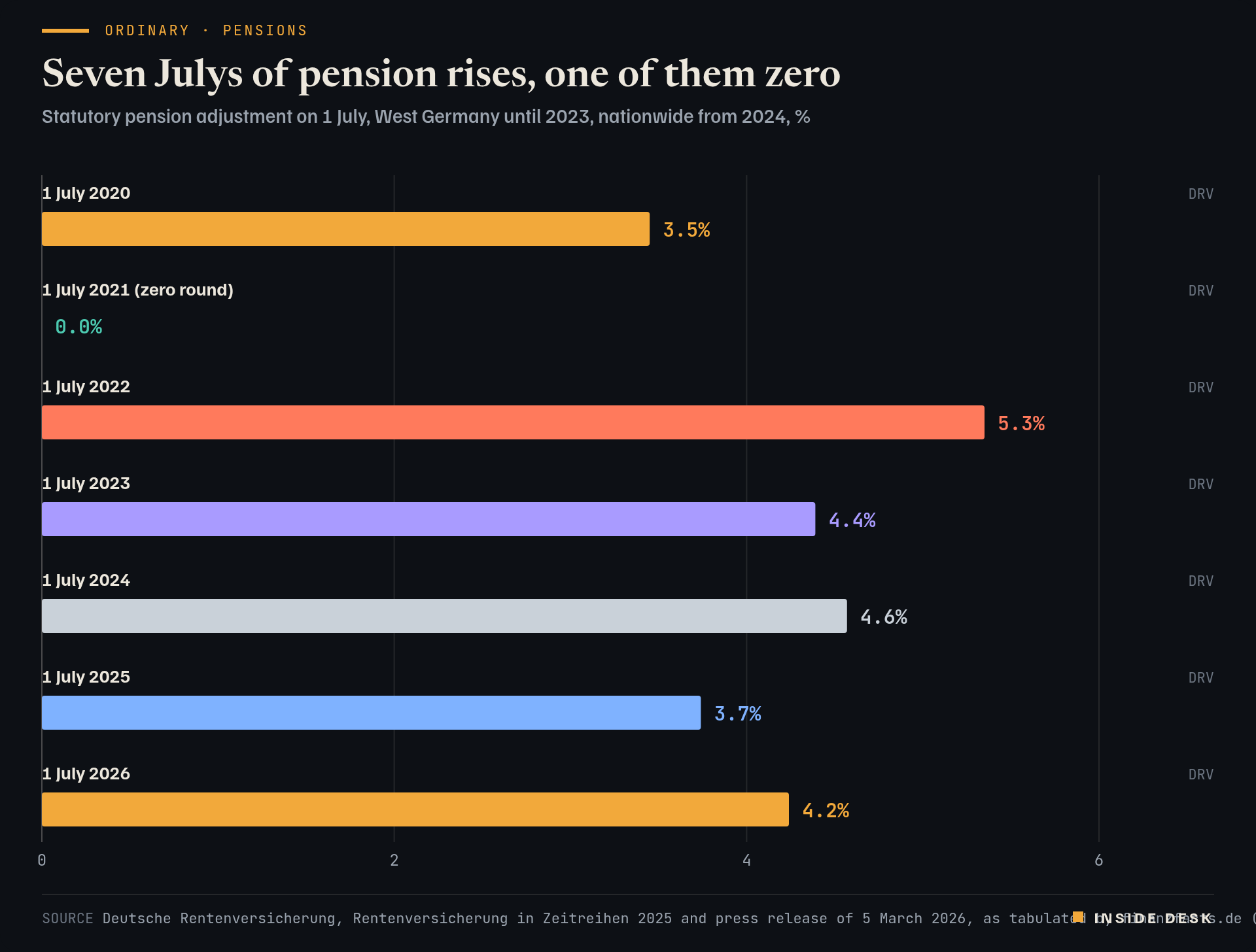
Bar chart of the German statutory pension adjustment on 1 July of each year from 2020 to 2026, for West Germany until 2023 and nationwide from 2024. 2020: 3.45%. 2021: zero, because wages had fallen in 2020. 2022: 5.35%. 2023: 4.39%. 2024: 4.57%. 2025: 3.74%. The latest value is 4.24% on 1 July 2026. The government's draft estimate of 4.09% for July 2027 is not shown, because it is not yet decided.
Source Deutsche Rentenversicherung, Rentenversicherung in Zeitreihen 2025 and press release of 5 March 2026, as tabulated by finanzfacts.de (Stand 23 Oct 2026), retrieved 3 Nov 2026 · Official adjustment rates, freely usable · Actual adjustments only; the 4.09% estimate for 2027 is not drawn.. Figures as reported by the named organisations; facts cited with attribution.
Data (CSV) · SVG · PNG

Latest values as a table
| Value | |
|---|---|
| 1 July 2020 | 3.45% |
| 1 July 2021 (zero round) | 0% |
| 1 July 2022 | 5.35% |
| 1 July 2023 | 4.39% |
| 1 July 2024 | 4.57% |
| 1 July 2025 | 3.74% |
| 1 July 2026 | 4.24% |
That is the dull machinery worth admiring. In 2026 the wage factor alone would have produced a rise of 4.25%; the sustainability factor, which weighs pensioners against contributors, would have pulled it down to 4.05%, and only the 48% “holding line” agreed in 2025 kept it at 4.24%3. Over 35 years, the pension point in the West rose by 100.7% while consumer prices rose by 101.9%3. That is not a windfall. It is a long, unglamorous promise to keep pace, mostly kept, with the bad year in plain view: in July 2021, after wages fell in 2020, the West got nothing3.
The other side of the payslip. The same draft says what it costs. The contribution rate stays at 18.6% of gross pay until the end of 2027, then rises to 19.7% in 2028 and 19.8% in 2029, slightly less than the pension insurer itself expected in spring2. The reserve does the waiting in between: €41.4 billion at the end of 2025, an expected €31.2 billion at the end of this year, which is just under one month’s spending, and about €12.1 billion at the end of 20271. Without the higher rate in 2028, Reuters reports, the reserve would then fall below its legal minimum1.
The holding line is not free either. The federal budget’s refunds for keeping the pension level at 48% are put at €1.7 billion in 2027 and €13.2 billion in 2031, after which the draft sees the level drifting down to 46.5% by 2040 under current law1. Confusingly, the draft’s own long view uses the same figure for something else: under current law, statutory pensions could rise by 46.5% in total by 2040, which the document calls an average of “around 2.8% a year”, before any effect of the coalition’s planned reform2. Read slowly, both numbers can be true at once: pensions keep rising in euros while falling a little behind wages. Add health, care and unemployment insurance and the FAZ calculates that compulsory contributions could take up to 44.6% of gross pay in 2029, against up to 43.1% today2.
None of that makes the 4.09% a trick. It makes it a sum with two columns, and both are published. You do not need to cheer the draft or fear it. If you draw a pension, you can pencil in roughly €41 per €1,000 for next July, and rub it out in March if the wage data say otherwise. If you pay into the system, the line to watch is 2028, not 2027. Nothing here is financial advice.
What to watch
A pension rise is not granted at a podium. It is worked out from last year's payroll.
Sources
- Entwurf: Renten könnten 2027 um 4,09 Prozent steigen — Reuters via onvista, 3 Nov 2026, 14:57 CET.
- Regierung erwartet 2027 Rentenerhöhung von mehr als vier Prozent — Frankfurter Allgemeine Zeitung, 3 Nov 2026, 14:18 CET.
- Rentenerhöhungen seit 1957: alle Rentenanpassungen in West und Ost — finanzfacts.de (official DRV figures, tabulated), Stand 23 Oct 2026.
Every figure in this piece traces to a source above or to the desk’s own arithmetic on those sources, marked as such. Quotations are short and attributed. Spot an error? Write to the desk; corrections are logged on the method page.
Commentary for information only. Not investment, legal, tax, medical or political advice. Not an offer or solicitation. Analysis may be incomplete or wrong. Charts show published public data, not a trading feed; binding numbers live with the institutions that publish them.