Evening edition · Monday, 2 November 2026
Podium vs Print: "resilience" in the factories and −2.0% at the tills
On the same Monday morning, Germany's factory survey was praised for its staying power and Germany's shops reported a fall nobody had forecast. Both are true; only one is spent by you.
“German industry is proving its resilience and continued its upward trend in October despite increasing cost pressure (desk translation of the German quotation)”
Phil Smith, economist at S&P Global Market Intelligence, on the final HCOB Germany manufacturing PMI, Monday 2 November 2026, with the final October reading, as reported by n-tv
−2.0%
Real, calendar and seasonally adjusted retail sales against August; nominal −1.5%. Against September 2025, real −2.3% while nominal sales rose 1.2%.
Statistisches Bundesamt (Destatis), retail turnover, press release no. 383, September 2026, provisional, published 2 November 2026
The podium. Germany’s final manufacturing purchasing managers’ index for October came in at 54.2, up from 53.9 and the same as the flash estimate, n-tv reported1. Phil Smith, the S&P Global economist who comments on the survey, said German industry was “proving its resilience” and had kept up its upward trend despite rising cost pressure (desk translation)1. He put the demand down to higher state spending on defence and infrastructure and to stronger export sales1. The PMI is a private survey; we quote it, we do not chart it.
The print. Earlier that morning, the statistics office had published the other side of the economy. Retail sales fell 2.0% in real terms in September against August, after calendar and seasonal adjustment, and 1.5% in nominal terms2. Against September 2025, real sales were down 2.3% even as nominal sales rose 1.2%2. Economists had expected growth of about 0.4%, n-tv reported1. “That is a data shock to start the week,” said Alexander Krüger, chief economist at Bank Bethmann (desk translation)1.
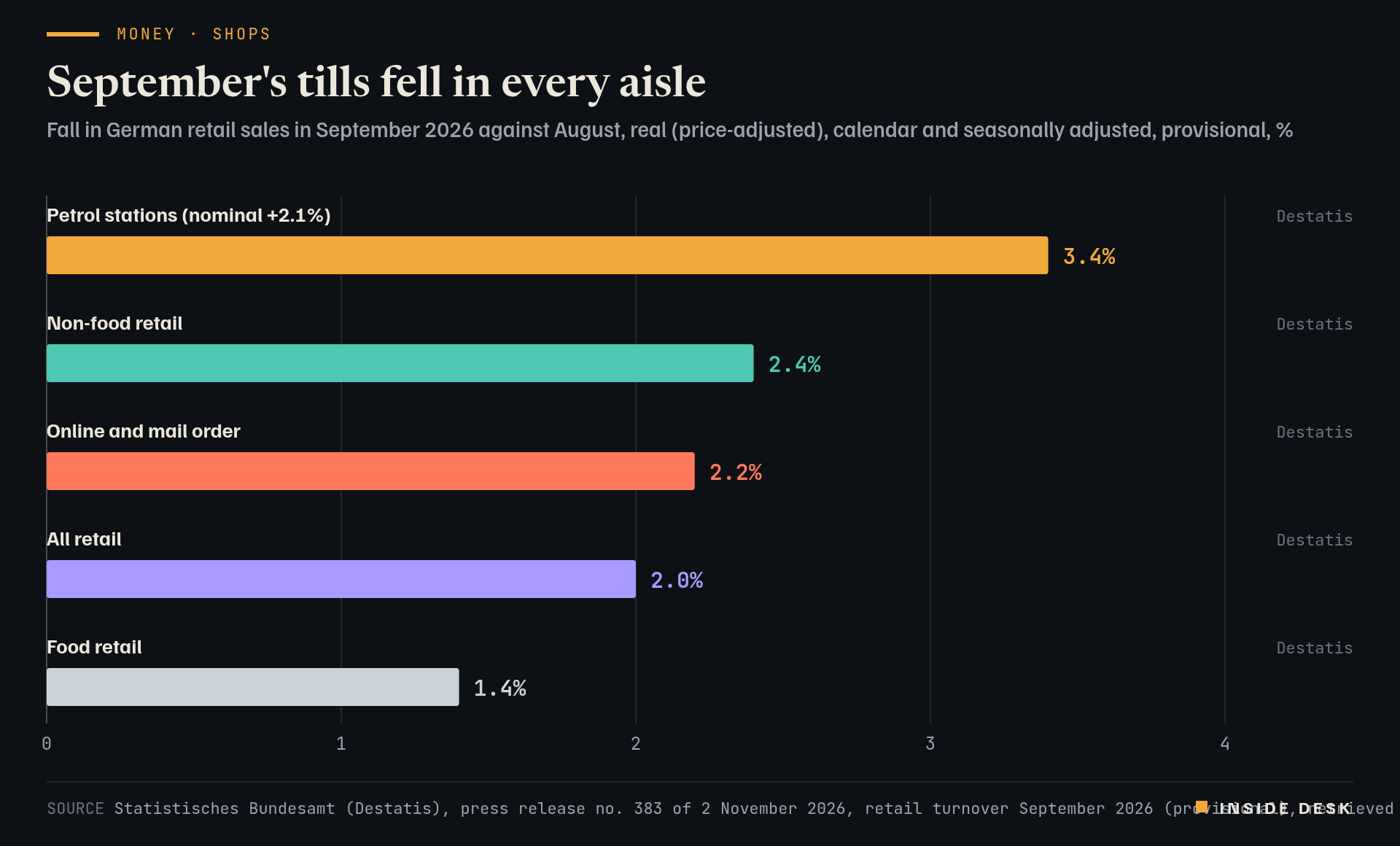
Bar chart of how far German retail sales fell in September 2026 against August, in real terms, calendar and seasonally adjusted, provisional. Petrol stations fell 3.4%, although their nominal sales rose 2.1%. Non-food retail fell 2.4%. Online and mail order fell 2.2%. All retail fell 2.0%. Food retail fell 1.4%, the smallest fall. The latest values are for September 2026, published on 2 November 2026.
Source Statistisches Bundesamt (Destatis), press release no. 383 of 2 November 2026, retail turnover September 2026 (provisional), retrieved 2 Nov 2026 · Data licence Germany – attribution – version 2.0 · Bars show the size of the fall.. Figures as reported by the named organisations; facts cited with attribution.
Data (CSV) · SVG · PNG

Latest values as a table
| Value | |
|---|---|
| Petrol stations (nominal +2.1%) | 3.4% |
| Non-food retail | 2.4% |
| Online and mail order | 2.2% |
| All retail | 2% |
| Food retail | 1.4% |
The gap. The podium and the print are not in conflict; they describe two different customers. The factories are selling to ministries and to buyers abroad. The shops sell to you. And you, in September, bought less in every aisle the office measures: food down 1.4%, non-food down 2.4%, online down 2.2%2. Petrol stations are the plainest case: their real sales fell 3.4% while their nominal sales rose 2.1%2. Desk arithmetic: forecourt customers paid more and took home less.
What the speech left out. The till. Desk arithmetic: a 1.2% nominal rise against a 2.3% real fall over the year means prices did more of the work than shoppers did. One caveat in fairness: Destatis replaced its retail sample this month, and figures since January may be revised2. A month is a month. But a recovery led by defence orders and exports will feel thin at home until the receipts come back. Nothing here is investment advice.
What to watch
- Destatis updates the retail figures in its GENESIS database 45 days after the month's end; a new sample introduced this month means revisions back to January are possible2.
A factory can be resilient on orders from the state. A shop needs the customer to come in.
Sources
- Der Börsen-Tag Montag, 2. November 2026: Deutsche Industrie wächst solide im Oktober; "Datenschock" bei Einzelhändlern — n-tv, 02 Nov 2026, 10:31 and 10:53 CET.
- Einzelhandelsumsatz im September 2026 real um 2,0 % gesunken (Pressemitteilung Nr. 383) — Statistisches Bundesamt (Destatis), 02 Nov 2026.
Every figure in this piece traces to a source above or to the desk’s own arithmetic on those sources, marked as such. Quotations are short and attributed. Spot an error? Write to the desk; corrections are logged on the method page.
Commentary for information only. Not investment, legal, tax, medical or political advice. Not an offer or solicitation. Analysis may be incomplete or wrong. Charts show published public data, not a trading feed; binding numbers live with the institutions that publish them.