Evening edition · Monday, 2 November 2026
Oil fell 6% on a sentence, gas fell 6% by teatime, and the power plants that burn it ran all weekend
Monday's relief came from a diplomat's words. Germany's electricity price is set by something slower: how many gas turbines are running when the wind stays away.
Monday was a good day for anyone who measures energy by the headline. Brent crude, the international benchmark, fell 6.4% to $106.20 a barrel by mid-afternoon in Europe, and US crude fell 6.5% to $97.351. The cause was a sentence, not a shipment. US Secretary of State Marco Rubio said President Trump “hasn’t made a decision” on attacking Iran and “would prefer to do it peacefully”1. Iran’s foreign minister said an agreement was possible if Washington “demonstrates goodwill”1.
European gas followed. The Dutch TTF price stood at €101.82 per megawatt hour at 08:45 CET, €100.10 at 11:30 and €95.20 at 15:402. Desk arithmetic: that is about 6.5% off in seven hours.
So far, the speech. Now the meter.
The plants that set the price. In Germany the price of electricity is usually set by the dearest plant needed in a given hour, and on calm days that plant tends to burn gas. Verivox puts it plainly: only about 17% of German electricity comes from gas-fired plants, but through the merit order they often set the exchange price4. That is why a cheaper gas price is good news for power only in proportion to how much gas is being burnt. And over the past five days, a great deal was.
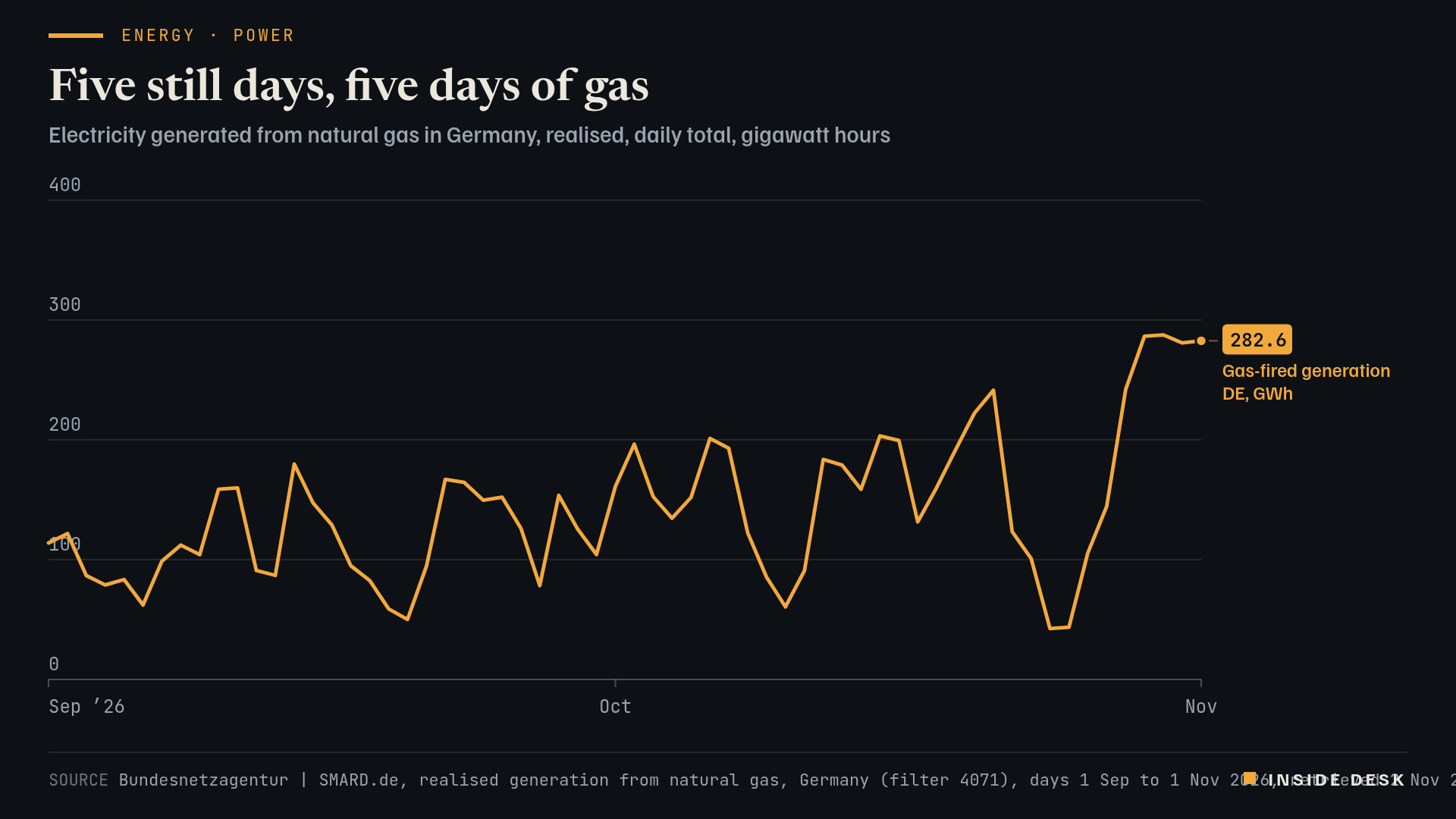
Line chart of daily electricity generation from natural gas in Germany from 1 September to 1 November 2026, in gigawatt hours. Before late October it moves mostly between about 50 and 240, falls to 42.5 on Saturday 24 October and 43.5 on Sunday 25 October during the storm, then climbs to 242.0 on 28 October and stays near 280 to 290 for four days: 286.5 on 29 October, 287.6 on 30 October, the highest of the period, 280.9 on 31 October and 282.6 on 1 November. The latest value is 282.6 gigawatt hours for Sunday 1 November.
Source Bundesnetzagentur | SMARD.de, realised generation from natural gas, Germany (filter 4071), days 1 Sep to 1 Nov 2026, retrieved 2 Nov 2026 · CC BY 4.0. Bundesnetzagentur | SMARD.de, market data. CC BY 4.0.
Data (CSV) · SVG · PNG

Latest values as a table
| Date | Gas-fired generation DE, GWh |
|---|---|
| 2026-10-27 | 144.5 |
| 2026-10-28 | 242 |
| 2026-10-29 | 286.5 |
| 2026-10-30 | 287.6 |
| 2026-10-31 | 280.9 |
| 2026-11-01 | 282.6 |
SMARD’s realised figures show German gas plants generated 105.4 gigawatt hours on Monday 26 October, then 242.0 on Wednesday, 286.5 on Thursday, 287.6 on Friday, 280.9 on Saturday and 282.6 on Sunday3. Desk arithmetic: Sunday’s gas output was about 2.7 times last Monday’s. On a Sunday when grid load was 1,113.1 gigawatt hours, gas covered roughly a quarter of it3.
Why they ran. The wind went missing. Onshore turbines generated 688.8 GWh on 26 October and 79.0 GWh on 1 November; offshore wind managed 3.5 GWh on Saturday3. The gap had to be filled by something you can switch on, and the turbines that burn gas were the ones that answered.
What it cost. The day-ahead auction priced Monday’s power at €259.31 per megawatt hour, after €251.42 on Saturday and €255.91 on Sunday3. Each was fixed in an auction held the day before delivery. The first auction run after today’s fall in gas is the one for Tuesday. When we checked at 16:30 CET, SMARD had not yet published that result3. We will not guess it.
The early sign. SMARD’s provisional hourly data for Monday show offshore wind already at 76.9 GWh in the first 15 hours of the day, against 15.1 GWh for all of Sunday, while gas-fired output was 188.1 GWh over the same 15 hours3. These figures are provisional and will be revised3. They are also the only part of today’s story that will still matter after the speeches have moved on.
What the oil traders said. Nobody in the market is calling this peace. Tamas Varga of PVM Oil Associates told CNBC that attacks on ships and refineries continue, “doing little to inspire confidence”, before adding: “Nonetheless, hope springs eternal”1. That is the right tone for a household too. A 6% fall in a futures price is a quote on a screen. It reaches you, if it does at all, through a supplier’s procurement over months and the letter that follows. Verivox’s household electricity price was 34.4 cents per kWh in October, and a new contract cost about 33 cents on 30 October4.
The calm point. The machinery deserves more credit than the speech. Every number above was published in the open: auction results before delivery, generation figures within hours, exchange quotes during the day. If you want to know whether Monday’s relief is real, watch two things this week: the next day-ahead result on SMARD, and how many gigawatt hours the gas plants are still producing. If the wind comes back, the second number will fall, and the first will follow it more reliably than any sentence from Washington or Tehran. Nothing here is investment advice.
What to watch
- Tuesday's day-ahead result for Germany and Luxembourg. It had not appeared on SMARD when we checked at 16:30 CET3.
- Whether wind returns this week. Offshore output picked up on Monday in SMARD's provisional hourly figures3.
- Whether today's fall in gas holds after the US midterms on Tuesday. The oil market had priced in escalation after the vote, CNBC reported1.
A barrel responds to a sentence. A turbine responds to the wind. Your bill follows the turbine.
Sources
- Oil prices fall as Iran-U.S pursue diplomacy — CNBC, 02 Nov 2026, updated afternoon CET.
- Natural Gas (Amsterdam) a 101,82 euro per Megawatt-Ora alle 08:45 (with 11:30 and 15:40 updates) — H2Oil, 02 Nov 2026, 08:45–15:40 CET.
- Market data: realised generation from natural gas, wind onshore and offshore; grid load; day-ahead price DE-LU, 26 October to 2 November 2026 — Bundesnetzagentur / SMARD.de, retrieved 02 Nov 2026, 16:30 CET.
- Strompreisentwicklung 2026 in Deutschland — Verivox, as of 30 Oct 2026.
Every figure in this piece traces to a source above or to the desk’s own arithmetic on those sources, marked as such. Quotations are short and attributed. Spot an error? Write to the desk; corrections are logged on the method page.
Commentary for information only. Not investment, legal, tax, medical or political advice. Not an offer or solicitation. Analysis may be incomplete or wrong. Charts show published public data, not a trading feed; binding numbers live with the institutions that publish them.