Morning edition · Friday, 30 October 2026
A tenth of a soybean crop, and a warning that arrives early
A new estimate says El Niño could cut Brazil's soybean harvest by almost 10%. The more useful lesson, from the famine early-warning people, is about timing: the worst comes after the rain, which leaves time to act.
A larger field is not a larger harvest. That is the plain point of a study by the credit bureau Serasa Experian, reported by Valor International on Thursday: unstable El Niño rainfall, especially in Brazil’s Central-West, could cut the country’s 2026/27 soybean output by 9.7%, to 163.6 million tonnes1. “A larger planted area does not necessarily mean a better crop,” said Daniel de Oliveira of Serasa, even though planting is up 1.8%, to 49.9 million hectares1.
Where it would land. Mato Grosso and Goiás would account for 80% of the potential losses, while Rio Grande do Sul in the south is the state most likely to see its harvest grow1. About 40% of the soybean area has been planted1. Serasa puts the lost gross production value at about R$33 billion, and stresses that this is an indication, not a forecast of actual losses, because prices would move too1. Valor reports that NOAA now sees a 100% chance of El Niño reaching “very strong” by the year-end1.
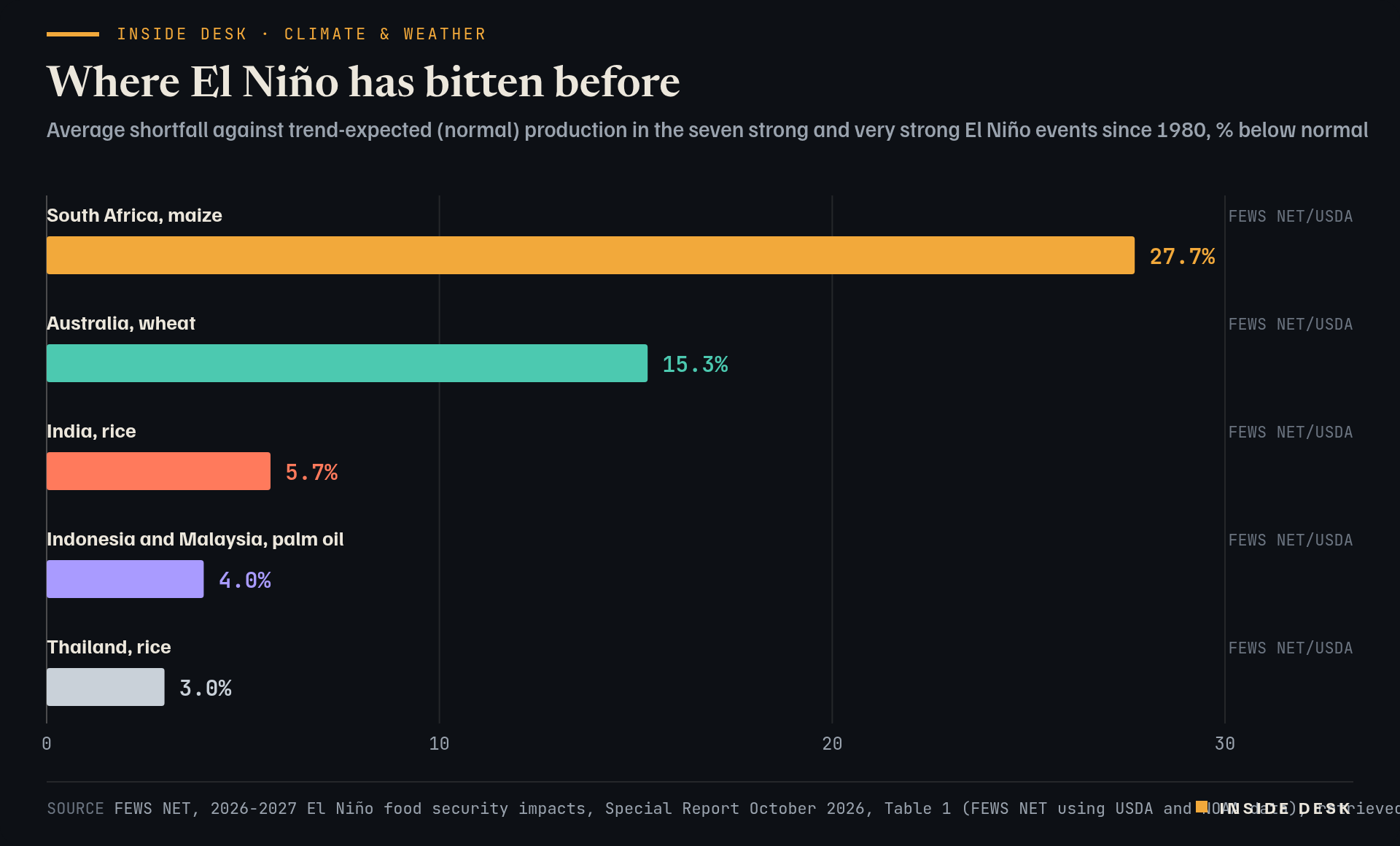
The longer view. FEWS NET, the Famine Early Warning Systems Network, has published the first of three El Niño special reports, and its tables are sobering and steadying at once2. In the seven strong and very strong El Niño events since 1980, South Africa’s maize crop averaged 27.7% below its normal trend and Australia’s wheat 15.3% below, while world output of wheat, maize and rice together came in 1.3% above normal2.
Bar chart of the average production shortfall against trend-expected normal production in the seven strong and very strong El Niño events since 1980, as reported by FEWS NET from USDA data: South Africa maize 27.7% below normal, Australia wheat 15.3%, India rice 5.7%, Indonesia and Malaysia palm oil 4.0%, and Thailand rice 3.0%. World wheat, maize and rice together averaged 1.3% above normal over the same events, which is not shown as a bar.
Source FEWS NET, 2026-2027 El Niño food security impacts, Special Report October 2026, Table 1 (FEWS NET using USDA and NOAA data), retrieved 30 Oct 2026. Figures as reported by the named organisations; facts cited with attribution.
Data (CSV) · SVG · PNG

Latest values as a table
| Value | |
|---|---|
| South Africa, maize | 27.7% |
| Australia, wheat | 15.3% |
| India, rice | 5.7% |
| Indonesia and Malaysia, palm oil | 4% |
| Thailand, rice | 3% |
The timing. The report’s most practical finding is about when. The worst hunger after an El Niño tends to arrive in the following lean season, not during the rains2. For Southern Africa, FEWS NET expects the most severe needs in November 2027 to March 2028, well after the rainfall shock, and notes that the region enters this season after a cereal harvest nearly 10% above its five-year average2. USDA projects global 2026/27 production of the three staple grains 2.7% below last year, but still the second-largest crop on record2.
The calm point. This is what early warning is for. The rain is forecast months ahead, the harvest is counted, the stocks are known, and the hardest months are marked on a calendar more than a year away. That is time for governments, aid agencies and grain traders to do dull, decisive things: buy, store, budget. The danger is not the forecast; it is reading it and waiting.
What to watch
A forecast is not a fate; it is a calendar with the hard months marked early.
Sources
- El Niño could cut Brazil's soybean crop nearly 10%, study says — Valor International / Globo Rural, 29 Oct 2026, 23:00 CET.
- 2026-2027 El Niño food security impacts (Special Report, October 2026) — FEWS NET, October 2026, retrieved 30 Oct 2026.
Every figure in this piece traces to a source above or to the desk’s own arithmetic on those sources, marked as such. Quotations are short and attributed. Spot an error? Write to the desk; corrections are logged on the method page.
Commentary for information only. Not investment, legal, tax, medical or political advice. Not an offer or solicitation. Analysis may be incomplete or wrong. Charts show published public data, not a trading feed; binding numbers live with the institutions that publish them.